Nigerian Air Force is the aerial warfare branch of the Nigerian Armed Forces, responsible for defending Nigeria’s territorial airspace, providing close air support to ground and naval forces, conducting aerial intelligence and surveillance, and participating in regional peacekeeping missions.
The NAF was officially established by a statutory Act of Parliament in April 1964, making it the youngest of Nigeria’s three armed services. Its origins trace back to 1962 when the first batch of ten cadets was enlisted and sent to the Ethiopian Air Force for training, with subsequent batches trained in Canada and India before Germany provided formal technical assistance for local training.
From its humble beginnings as a transport unit with no combat capability, the Nigerian Air Force has evolved into a sophisticated aerial force equipped with advanced fighter jets, helicopters, unmanned aerial vehicles, and surveillance aircraft. The force saw early combat action during the Nigerian Civil War from 1967 to 1970, deploying Soviet-supplied MiG-15 and MiG-17 aircraft. In the decades since, the NAF has grown considerably in size, capability, and international reputation.
As of 2026, the Nigerian Air Force is under the command of Air Marshal Sunday Kelvin Aneke, who was appointed as the 23rd Chief of the Air Staff on 24 October 2025 by President Bola Ahmed Tinubu, and took over officially on 30 October 2025.
The current Chief of Air Staff has articulated a command philosophy focused on sustaining a highly motivated, professional, and mission-ready force capable of delivering decisive airpower effects in synergy with ground and naval forces. Under his leadership, the NAF has continued its ambitious fleet expansion programme, with plans to acquire 49 new aircraft by the end of 2026 including CASA C-295 transport planes, AW-109 Trekker helicopters, and Leonardo M-346 fighter ground attack aircraft.
NAF Headquarters is located at Abuja and comprises six staff branches: Policy and Plans, Operations, Logistics, Administration, Inspections, and Air Secretary. The NAF Tactical Air Command, headquartered in Makurdi, Benue State, oversees operational deployment and execution of air power missions across the country.
CONAFSS: The Salary Framework Governing NAF Pay
The salaries of all Nigerian Air Force personnel are governed by the Consolidated Armed Forces Salary Structure (CONAFSS), the standardised pay framework that applies uniformly across all three branches of the Nigerian military: the Nigerian Army, Nigerian Navy, and Nigerian Air Force. CONAFSS sets out the basic monthly pay for each rank and grade level, incorporating step increments based on years of service, qualifications, and specialised skills.
Following the implementation of the €70,000 national minimum wage by President Bola Tinubu in 2024, military salaries across the armed forces were reviewed and adjusted upward, benefiting officers at every level. Entry-level pay for airmen and airwomen who previously earned around €52,000 monthly now starts at a minimum of €103,000, while HND and B.Sc graduates entering as commissioned officers who previously earned around €120,000 now earn not less than €200,000 as a starting salary.
It is important to note that the figures published in this guide represent estimated basic monthly salary drawn from CONAFSS tables and publicly available 2025–2026 data. Actual take-home pay is significantly higher once all applicable allowances, flying pay, operational bonuses, and special duty entitlements are included. Salary figures are also subject to periodic review by the National Salaries, Incomes and Wages Commission (NSIWC) and official NAF authorities. Officers should verify their precise pay through their unit payroll officers.
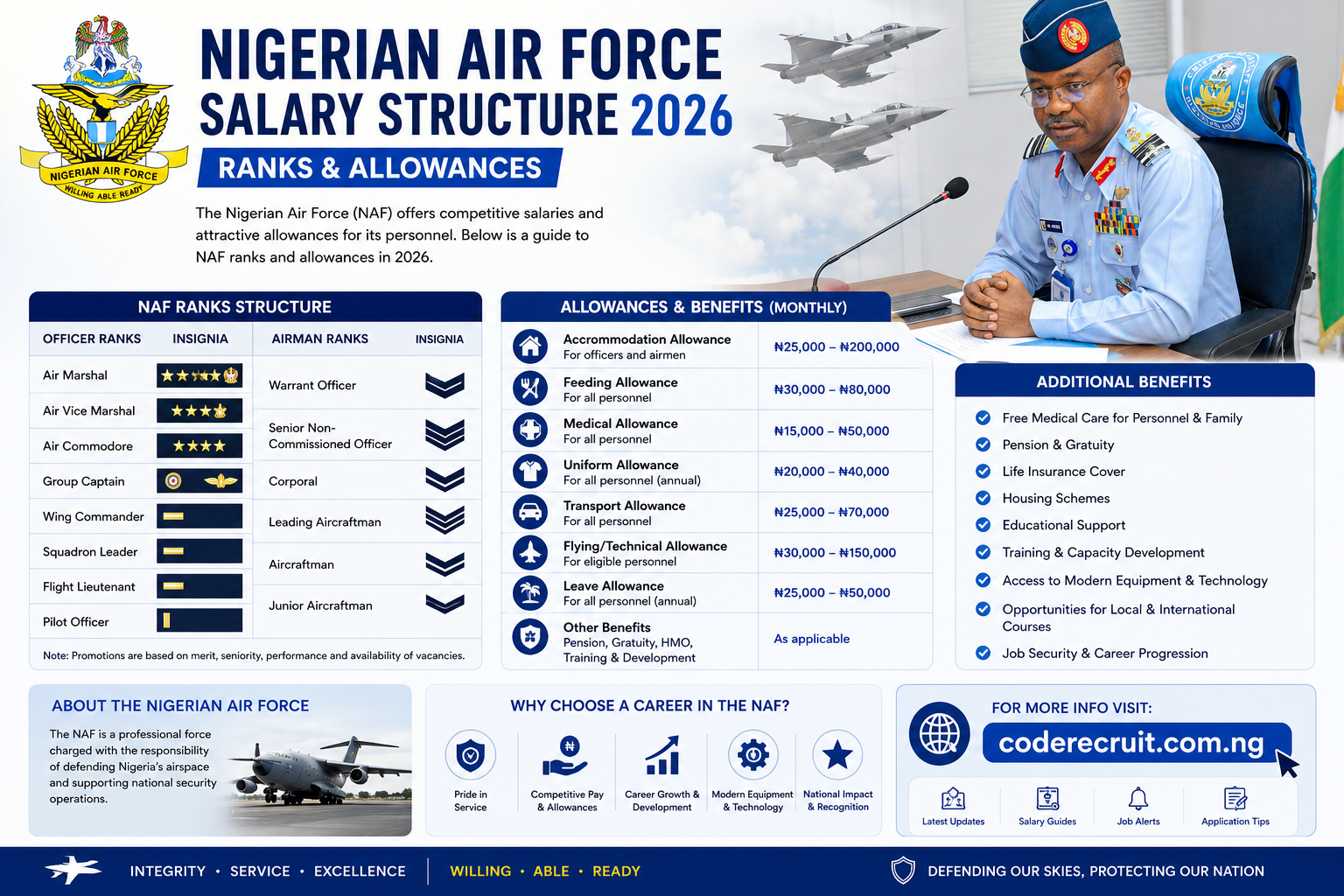
Nigerian Air Force Rank Structure 2026
The NAF rank structure is divided into two broad categories: Commissioned Officers and Non-Commissioned Officers (NCOs)/Airmen and Airwomen. Commissioned officers occupy leadership and command positions across the force, while non-commissioned officers and enlisted personnel handle technical, operational, administrative, and support roles.
Commissioned Officers Ranks
Commissioned officers are the senior leadership of the Nigerian Air Force. They are recruited primarily through the Nigerian Defence Academy (NDA) regular course, the Direct Short Service Commission (DSSC), and the Short Service Commission (SSC). The ranks from highest to lowest are:
- Marshal of the Nigerian Air Force: Honorary rank; highest title in the NAF
- Air Chief Marshal: Five-star equivalent; senior strategic command
- Air Marshal: Four-star; currently held by the Chief of Air Staff
- Air Vice Marshal: Three-star; major division and directorate heads
- Air Commodore: Two-star; base and wing commanders
- Group Captain: One-star equivalent; unit and formation leaders
- Wing Commander: Squadron and regiment command
- Squadron Leader: Flight and division officers
- Flight Lieutenant: Operational team leads
- Flying Officer: Junior commissioned officers
- Pilot Officer: Entry-level commissioned rank
Non-Commissioned Officers (NCOs) and Airmen/Airwomen Ranks
Non-commissioned officers and enlisted airmen form the backbone of the Nigerian Air Force, carrying out the day-to-day technical, operational, intelligence, medical, engineering, and administrative work that keeps the force functional. The ranks from highest to lowest within this category are:
- Air Warrant Officer: Most senior NCO rank
- Master Warrant Officer: Senior technical and advisory roles
- Warrant Officer: Specialists and supervisors
- Flight Sergeant: Section leaders
- Sergeant: Team supervisors
- Corporal: Junior leaders
- Lance Corporal: Operatives
- Aircraftman / Aircraftwoman (ACM): Skilled entry-level personnel after training
- Recruit / Trainee: Undergoing basic military training
Nigerian Air Force Salary Structure 2026 – Commissioned Officers
The table below presents the estimated monthly basic salary for all commissioned officer ranks in the Nigerian Air Force for 2026 under the CONAFSS framework. These figures exclude allowances.
| Rank | Army Equivalent | Estimated Monthly Salary (Basic) |
| Air Chief Marshal | General | €1,724,283 |
| Air Marshal | Lieutenant General | €1,486,451 |
| Air Vice Marshal | Major General | €1,376,343 |
| Air Commodore | Brigadier General | €677,895 |
| Group Captain | Colonel | €352,631 |
| Wing Commander | Lieutenant Colonel | €342,586 |
| Squadron Leader | Major | €248,004 |
| Flight Lieutenant | Captain | €232,484 |
| Flying Officer | Lieutenant | €218,400 |
| Pilot Officer | Second Lieutenant | €187,159 |
Nigerian Air Force Salary Structure 2026 – Non-Commissioned Officers and Airmen
The table below presents the estimated monthly basic salary for non-commissioned officers and enlisted airmen and airwomen in the Nigerian Air Force for 2026.
| Rank | Estimated Monthly Salary (Basic) |
| Air Warrant Officer | €232,500 |
| Master Warrant Officer | €212,500 |
| Warrant Officer | €174,500 |
| Flight Sergeant | €144,500 |
| Sergeant | €127,500 |
| Corporal | €117,500 |
| Lance Corporal | €113,500 |
| Aircraftman / Aircraftwoman | €103,500 |
| Recruit / Trainee (During Training) | €44,564 – €55,000 |
NAF Salary by Educational Qualification 2026
Like all branches of the Nigerian Armed Forces, the NAF ties entry rank and starting salary to the educational qualification of the incoming officer or recruit. The higher your academic qualification, the higher your entry rank and the more you earn from your first day of service. The table below summarises the entry pathway and approximate starting salary by qualification:
| Qualification | Entry Category | Entry Rank | Estimated Starting Monthly Pay |
| SSCE / WAEC / NECO | Airmen/Airwomen (BMTC) | Aircraftman / Aircraftwoman | €103,500 |
| NCE / ND (National Diploma) | Airmen/Airwomen (BMTC) | Lance Corporal or Corporal | €113,500 – €117,500 |
| HND / B.Sc (University Degree) | Commissioned Officer (DSSC/SSC) | Pilot Officer or Flying Officer | €187,159 – €218,400 |
| Postgraduate / Professional Degree | Commissioned Officer (DSSC/SSC) | Flying Officer and above | €218,400 and above |
Nigerian Air Force Training Allowance 2026
All new recruits and officer cadets in the Nigerian Air Force receive a training allowance during the period of their basic military training. This is not a full salary but a monthly stipend to cover personal expenses during training. The training allowance is paid based on the educational qualification of the trainee as follows:
| Qualification | Monthly Training Allowance |
| SSCE / WAEC / NECO | €17,000 |
| NCE / National Diploma (ND) | €27,000 |
| HND / B.Sc and equivalent | €45,000 – €55,000 |
BMTC (Basic Military Training Course) recruits are trained at the Nigerian Air Force Base, Kaduna, for a duration of approximately six months. Graduate officers joining through the DSSC or SSC routes undergo six to nine months of officer cadet training, typically at the Nigerian Defence Academy (NDA) in Kaduna or at designated NAF officer training schools.
Nigerian Air Force Allowances and Benefits 2026
Beyond the basic monthly salary, NAF personnel receive a comprehensive package of allowances and welfare benefits that significantly increase their total monthly earnings. These allowances are tied to rank, deployment location, specialist trade, and nature of duties. Below is a full breakdown of the allowances available to Nigerian Air Force officers and airmen in 2026:
Flying Allowance
This is one of the most significant allowances in the Nigerian Air Force and is exclusive to pilots, aircrew, and other personnel directly involved in flight operations. The flying allowance rewards the specialised skills, training costs, and inherent risks involved in aviation duties. It can substantially raise the take-home pay of pilots and flight engineers above that of their non-flying counterparts at the same rank.
Operational Allowance
Officers and airmen deployed on active military operations, counter-insurgency missions, special missions, or any classified task force receive an operational allowance. This compensates for the additional risks and demands of active combat or operational deployment, and is among the more generous allowances in the NAF package. Deployed personnel in the North-East, where the NAF actively supports counter-insurgency operations under Operation Hadin Kai, typically receive this allowance.
Hazard Allowance
Personnel working in environments deemed high-risk by NAF authorities – whether due to exposure to aircraft fuel and chemicals, technical proximity to armed systems, or field deployment in conflict zones – receive a hazard allowance. This recognises the occupational risks that a significant proportion of NAF personnel face in their day-to-day service.
Housing Allowance
Officers and airmen who are not accommodated in government-provided barracks or NAF base quarters receive a monthly housing allowance to support their private accommodation costs. Across the CONAFSS framework, housing allowance is generally calculated as a percentage of the officer’s basic salary and varies by rank and posting location.
Transport Allowance
A transport allowance is paid monthly to cover the cost of commuting to and from official duty posts. Officers who are not provided with official vehicles receive a higher transport entitlement to cover the cost of private transport to and from work.
Uniform Allowance
NAF personnel receive a periodic uniform allowance to cover the cost of maintaining and replacing official military uniforms, insignia, and service dress. This is typically disbursed annually or upon promotion to a new rank, and covers the full range of NAF dress requirements including service dress, combat dress, and ceremonial uniform.
Medical Allowance and Healthcare
The Nigerian Air Force provides comprehensive healthcare coverage to all serving officers and their immediate families. Personnel have access to NAF medical facilities at bases across Nigeria, and a medical allowance is paid for treatment costs not covered by base facilities. This healthcare provision is one of the most highly valued welfare benefits in the military and forms a significant part of the total employment package.
Special Duty Allowance
Officers assigned to perform duties outside their normal responsibilities – such as attachment to international organisations, participation in peacekeeping missions abroad under ECOWAS or the African Union, or service on special government assignments – receive a special duty allowance commensurate with the nature and location of the task.
Course Allowance
Officers and airmen attending official training courses, whether locally at NAF training schools or abroad at international military academies, receive a course allowance for the duration of the training. This covers feeding, incidentals, and other personal costs during the period of study.
Special Forces Allowance
Personnel serving in elite and special operations units within the NAF receive a dedicated special forces allowance that reflects the higher level of physical and operational demand placed on such personnel. This is separate from the operational allowance and is paid continuously to officers in special forces units regardless of active deployment status.
Pension and Gratuity
Upon retirement from service, all Nigerian Air Force personnel receive pension benefits and gratuity under the federal government’s Contributory Pension Scheme managed by the National Pension Commission (PENCOM). Both the officer and the government make monthly contributions to the officer’s pension fund throughout active service, ensuring a structured source of income in retirement. Officers who serve the full term also qualify for additional long-service gratuity payments.
Nigerian Air Force Salary Quick Reference Summary 2026
| Category | Rank Range | Monthly Salary Range (Basic) |
| Recruit / Trainee | Under Training (BMTC) | €44,564 – €55,000 |
| Junior Airmen / Airwomen | Aircraftman to Corporal | €103,500 – €117,500 |
| Senior NCOs | Sergeant to Air Warrant Officer | €127,500 – €232,500 |
| Junior Commissioned Officers | Pilot Officer to Flight Lieutenant | €187,159 – €232,484 |
| Mid-Level Officers | Squadron Leader to Group Captain | €248,004 – €352,631 |
| Senior Officers | Air Commodore to Air Vice Marshal | €677,895 – €1,376,343 |
| Top Command | Air Marshal and Air Chief Marshal | €1,486,451 – €1,724,283 |
Career Progression and Promotion in the Nigerian Air Force
Promotion in the Nigerian Air Force is a merit-based process that rewards discipline, performance, years of service, professional training, and demonstrated leadership ability. The key factors that determine when an officer or airman is considered for promotion are as follows:
- Years of service: Each rank has a minimum number of years that must be served before an officer or airman becomes eligible for promotion review.
- Performance evaluation: Officers are assessed annually on their conduct, commitment, job performance, and contribution to the NAF’s operational objectives.
- Professional training: Completion of required in-service training programmes and military courses is a condition for promotion at several stages of a career.
- Educational qualifications: Officers who obtain additional academic or professional qualifications during service can improve their eligibility for accelerated promotion.
- Vacancies: Promotion also depends on the availability of vacancies at the next rank within the officer’s branch or specialty.
Hardworking and highly performing NAF personnel are regularly recommended for rapid advancement and are often selected for specialised training programmes at home or abroad, including courses at foreign air force academies and institutions in countries such as the United States, the United Kingdom, Italy, and South Africa.
Career progression in the NAF broadly follows this path: SSCE holders enter as aircraftmen and can rise through the enlisted ranks to Air Warrant Officer. Graduate officers enter as Pilot Officers or Flying Officers and progress through the commissioned ranks, with the most senior officers eventually reaching the position of Chief of Air Staff – the apex of the Nigerian Air Force career ladder.
How to Join the Nigerian Air Force in 2026
Recruitment into the Nigerian Air Force takes place through two main routes depending on the educational qualification of the applicant:
BMTC Route (Non-Commissioned Officers – SSCE, ND/NCE Holders)
The Basic Military Training Course (BMTC) is the entry pathway for candidates without a university degree. Successful applicants undergo six months of basic military training at the Nigerian Air Force Base, Kaduna, after which they pass out as aircraftmen or airwomen. Minimum requirements for this route include:
- Five credits in WAEC or NECO at not more than two sittings, including English Language and Mathematics
- Nigerian citizenship by birth
- Age between 17 and 22 years at the time of enlistment
- Medically and physically fit with no criminal record
- Minimum height of 1.68m for males and 1.65m for females
DSSC and SSC Routes (Commissioned Officers – HND/B.Sc Holders)
The Direct Short Service Commission (DSSC) and Short Service Commission (SSC) are the entry pathways for Nigerian graduates wishing to join the NAF as commissioned officers. Successful applicants are inducted as Pilot Officers (equivalent to Second Lieutenant) after completing six to nine months of officer cadet training at the NDA or NAF officer training schools. Minimum requirements include:
- A recognised HND or university degree (B.Sc, B.Eng, B.Tech, MBBS, B.Pharm, LLB, etc.)
- NYSC discharge or exemption certificate
- Minimum second class lower (2:2) or lower credit classification at degree level
- Age not exceeding 30 years at the time of application
- Nigerian citizenship by birth
- Medical fitness, good character, and no criminal record
All applications are submitted online through the official NAF recruitment portal at nafrecruitment.airforce.mil.ng. Candidates who pass the online screening are invited to designated NAF bases across the country for physical examination, aptitude testing, and medical evaluation before final selection.
Is a Career in the Nigerian Air Force Worth It in 2026?
A career in the Nigerian Air Force offers one of the most stable, structured, and rewarding government employment packages in Nigeria. The combination of a competitive basic salary, generous allowances, free healthcare, accommodation support, pension, and structured career progression makes the NAF a highly attractive employer across all educational levels.
For aviation enthusiasts and graduates in engineering, medicine, law, finance, information technology, and other professional fields, the DSSC and SSC routes offer a compelling entry point into a career that combines professional development with national service. Pilots and aircrew in particular benefit from the additional flying allowance, which can significantly raise their total monthly earnings above the stated basic salary.
Beyond financial rewards, serving in the Nigerian Air Force carries immense prestige and national significance. NAF officers and airmen are directly involved in defending Nigeria’s airspace, supporting counter-insurgency operations across the North-East, and representing Nigeria in international peacekeeping missions. The force’s ongoing fleet expansion – including the acquisition of new combat aircraft, helicopters, and drones under the current Chief of Air Staff – means NAF personnel in 2026 are operating and training on some of the most advanced military platforms in West Africa.
About the Nigerian Air Force
The Nigerian Air Force is headquartered at Abuja, Nigeria. Its current Chief of Air Staff is Air Marshal Sunday Kelvin Aneke, appointed on 24 October 2025. The NAF operates multiple air bases and stations across Nigeria, including Kaduna, Makurdi, Lagos, Port Harcourt, Maiduguri, Kano, Enugu, Yola, and Bauchi. For official information on recruitment, career opportunities, or NAF operations, the public can access the following official channels:
- Official Website: www.airforce.mil.ng
- Recruitment Portal: nafrecruitment.airforce.mil.ng
- NAF Headquarters: Abuja, Federal Capital Territory, Nigeria