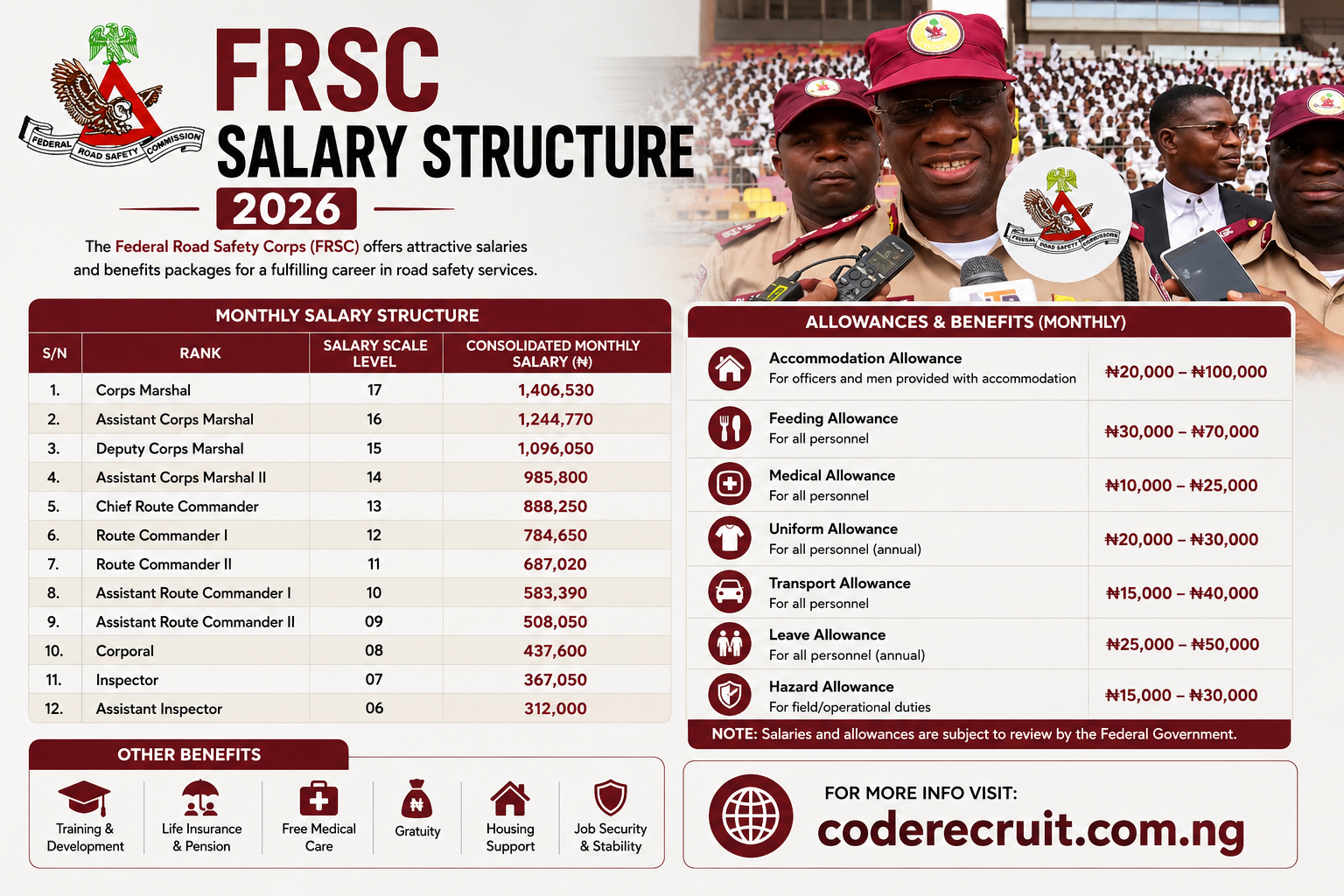
FRSC salary structure for 2026 is one of the most searched topics among applicants considering a career in Nigeria’s road safety agency, serving officers seeking clarity on pay, and citizens interested in how the Federal Road Safety Corps compensates its workforce. This comprehensive guide provides everything you need, the CONPASS pay framework, salary figures for every rank across all three cadres, all allowances and benefits, qualification-based entry salaries, rank insignia, the full recruitment process, and tips for prospective applicants.
The Federal Road Safety Corps (FRSC) remains one of Nigeria’s most attractive paramilitary career destinations, offering stable government employment, a transparent rank-and-pay structure, genuine career advancement, and the daily satisfaction of contributing to public safety on Nigeria’s roads. Whether you are entering with SSCE, NCE/ND, HND, or a university degree, there is a defined entry point, salary band, and progression pathway designed for your qualification level.
Quick Summary
| Detail | Information |
|---|---|
| Organisation | Federal Road Safety Corps (FRSC) |
| Supervising Ministry | Federal Ministry of Transport |
| Establishment Year | 1988 (FRSC Act Cap F19 LFN 2004) |
| Salary Structure | CONPASS (Consolidated Paramilitary Salary Structure) |
| Number of Cadres | 3 (Assistant, Inspectorate, Superintendent) |
| Lowest Rank | Road Safety Assistant III (RSA III) |
| Highest Rank | Corps Marshal (CM) |
| Minimum Monthly Basic Salary | ₦40,000 – ₦45,000 (RSA III / SSCE entry) |
| Maximum Monthly Salary | ₦900,000 – ₦1,100,000+ (Corps Marshal) |
| SSCE Entry Starting Salary | ₦40,000 – ₦87,000/month |
| NCE/ND Entry Starting Salary | ₦95,000 – ₦121,000/month |
| HND/B.Sc. Entry Starting Salary | ₦170,000 – ₦221,000/month |
| Official Recruitment Portal | recruitment.frsc.gov.ng |
| Official Website | www.frsc.gov.ng |
| Current Corps Marshal | Corps Marshal Shehu Mohammed (2024 –) |
About the Federal Road Safety Corps (FRSC)
The Federal Road Safety Corps (FRSC) is Nigeria’s lead federal paramilitary agency for road safety management and traffic regulation. Established in 1988 under the FRSC Act (Cap F19 LFN 2004), the Corps was created in direct response to Nigeria’s rising road accident fatalities and the urgent need for a dedicated, nationally coordinated road safety institution.
The FRSC operates under the Federal Ministry of Transport and is present in all 36 states and the Federal Capital Territory through a national network of 37 Sector Commands, unit commands, and patrol posts. The Corps works in close collaboration with the Nigerian Police Force (NPF), the Vehicle Inspection Officers (VIO), and state traffic management agencies.
The statutory functions of the FRSC, as defined by the FRSC (Establishment) Act, include:
- Prevention and minimisation of road accidents on all federal highways
- Rescue operations — first response and evacuation of crash victims from accident scenes
- Driver licensing — administration of the National Driver’s Licence (NDL) and the National Vehicle Identification Number (NVIS) system
- Road safety education — public awareness campaigns, school road safety clubs, and community outreach
- Traffic enforcement — patrol, speed monitoring, sobriety checkpoints, and prosecution of traffic offenders
- Vehicle roadworthiness — inspection and certification of commercial and private vehicles
- Highway research and data — crash reporting, road safety statistics, and policy advocacy
The FRSC has a workforce of over 40,000 personnel nationwide, making it one of the largest paramilitary institutions in Nigeria. Its headquarters is located at FRSC National Headquarters, 4 Maputo Street, Wuse Zone 3, Abuja.
What Is CONPASS? The Paramilitary Salary Framework
FRSC salaries are determined under the Consolidated Paramilitary Salary Structure (CONPASS) — the uniform Federal Government pay framework that governs all paramilitary agencies in Nigeria. CONPASS applies to the:
- Federal Road Safety Corps (FRSC)
- Nigeria Customs Service (NCS)
- Nigeria Immigration Service (NIS)
- Nigeria Security and Civil Defence Corps (NSCDC)
- Nigeria Correctional Service (NCoS)
- Federal Fire Service (FFS)
Under CONPASS, salary is primarily determined by rank and grade level, with incremental step increases accruing annually based on years of service. Educational qualification at entry determines the starting cadre and rank, which directly sets the initial salary band. Promotions to higher ranks trigger corresponding CONPASS pay increases.
The CONPASS framework is administered by the National Salaries, Income and Wages Commission (NSIWC) and is subject to periodic Federal Government review. Salary adjustments, including the recent influence of Nigeria’s new national minimum wage of ₦70,000 — have impacted CONPASS rates across the lower cadres.
FRSC Rank Structure: Three Cadres Explained
The Federal Road Safety Corps organises its workforce into three main cadres based on educational qualification and functional responsibility. Understanding these cadres is essential to knowing where you would enter the Corps and what your starting salary would be.
Cadre 1: Assistant Cadre (SSCE / O’Level Holders)
The Assistant Cadre is the entry level for applicants who hold SSCE (WAEC, NECO, NABTEB) certificates. Personnel in this cadre are primarily responsible for direct traffic assistance, patrol duties, crowd management at accident scenes, public education support, and other field-level functions. Ranks in this cadre (from lowest to highest) are:
- Road Safety Assistant III (RSA III) — Entry-level; basic field duties
- Road Safety Assistant II (RSA II) — After initial service and training
- Road Safety Assistant I (RSA I) — Supervisory role over junior assistants
- Senior Road Safety Assistant II (SRA II) — Senior field operations role
- Senior Road Safety Assistant I (SRA I) — Highest rank within the Assistant Cadre
In some FRSC rank nomenclature systems, particularly those referencing the older rank structure, these positions are also referred to as Road Marshal Assistant (RMA) III, II, I, Senior Road Marshal Assistant (SRMA), and Chief Road Marshal Assistant (CRMA). Both naming conventions are used across official and unofficial FRSC communications.
Cadre 2: Inspectorate Cadre (NCE / ND / OND Holders)
The Inspectorate Cadre is designed for mid-level officers holding NCE, National Diploma (ND), or Ordinary National Diploma (OND) qualifications. Officers in this cadre carry supervisory and coordination responsibilities, managing junior assistants, coordinating traffic operations, enforcing regulations, and leading community road safety campaigns. Ranks include:
- Assistant Road Safety Officer (ARSO) — Entry level for NCE/ND holders
- Road Safety Officer II (RSO II)
- Road Safety Officer I (RSO I)
- Senior Road Safety Officer (SRSO) — Highest Inspectorate rank
In the older FRSC nomenclature, these ranks correspond to the Marshal Inspector cadre, Marshal Inspector III, II, I, Senior Marshal Inspector (SMI), and Principal Marshal Inspector (PMI).
Cadre 3: Superintendent Cadre (HND / B.Sc. Graduates)
The Superintendent Cadre is the senior officer category, open to holders of HND or first degrees (B.Sc., B.Eng., B.A., B.Tech.) from accredited institutions. Superintendent Cadre officers lead route commands, sector commands, and strategic operations. This cadre contains the highest-paid positions in the FRSC. Ranks progress as follows:
- Assistant Superintendent of Road Safety II (ASRS II) — Graduate entry level
- Assistant Superintendent of Road Safety I (ASRS I)
- Deputy Superintendent of Road Safety (DSRS)
- Superintendent of Road Safety (SRS)
- Chief Superintendent of Road Safety (CSRS)
- Assistant Controller of Road Safety (ACRS)
- Deputy Controller of Road Safety (DCRS)
- Controller of Road Safety (CRS)
- Assistant Controller-General of Road Safety (ACGRS)
- Deputy Controller-General of Road Safety (DCGRS)
- Controller-General of Road Safety / Corps Marshal (CM) — The apex rank in the FRSC
In the older FRSC officer rank nomenclature, these positions correspond to: Assistant Route Commander (ARC), Route Commander (RC), Superintendent Route Commander (SRC), Chief Route Commander (CRC), Assistant Corps Commander (ACC), Deputy Corps Commander (DCC), Corps Commander (CC), Assistant Corps Marshal (ACM), Deputy Corps Marshal (DCM), and Corps Marshal (CM).
FRSC Rank Insignia and Symbols
FRSC officers display their rank through distinctive insignia worn on shoulder epaulettes. The insignia system follows a logical progression:
| Cadre / Level | Insignia Description |
|---|---|
| Assistant Cadre (RSA III to SRA I) | Chevrons on sleeve, number of chevrons increases with rank |
| Inspectorate Cadre (ARSO to SRSO) | Bars/Stars on shoulder, increasing with rank progression |
| Superintendent Cadre, Junior (ASRS to CSRS) | Stars and Laurel Wreaths on epaulettes |
| Superintendent Cadre, Senior (ACRS to DCGRS) | Multiple Stars with Laurel and Crown symbols |
| Corps Marshal (Apex Rank) | National Coat of Arms / Eagle, highest insignia |
These insignia are displayed prominently on the shoulder epaulettes of the FRSC’s distinctive orange and white uniform and are used to establish authority, hierarchy, and command protocol across all field and office deployments.
FRSC Salary Structure 2026: Assistant Cadre (SSCE Holders)
The following table presents the estimated monthly basic salary for all ranks in the FRSC Assistant Cadre in 2026, based on the CONPASS pay scale:
| Rank | Abbreviation | Monthly Basic Salary (₦) | Entry Qualification |
|---|---|---|---|
| Road Safety Assistant III | RSA III | ₦40,000 – ₦45,000 | SSCE (Entry Level) |
| Road Safety Assistant II | RSA II | ₦46,000 – ₦50,000 | Promotion from RSA III |
| Road Safety Assistant I | RSA I | ₦52,000 – ₦60,000 | Promotion from RSA II |
| Senior Road Safety Assistant II | SRA II | ₦65,000 – ₦70,000 | Promotion from RSA I |
| Senior Road Safety Assistant I | SRA I | ₦75,000 – ₦85,000 | Promotion from SRA II |
Note: Some sources report the starting salary for SSCE-entry officers at approximately ₦87,000 per month when the full CONPASS grade scale and recent welfare adjustments are applied. The range above reflects the base salary band; actual monthly take-home (including allowances) is higher.
FRSC Salary Structure 2026: Inspectorate Cadre (NCE / ND Holders)
| Rank | Abbreviation | Monthly Basic Salary (₦) | Entry Qualification |
|---|---|---|---|
| Assistant Road Safety Officer | ARSO | ₦95,000 – ₦110,000 | NCE / ND (Entry Level) |
| Road Safety Officer II | RSO II | ₦115,000 – ₦130,000 | Promotion from ARSO |
| Road Safety Officer I | RSO I | ₦135,000 – ₦150,000 | Promotion from RSO II |
| Senior Road Safety Officer | SRSO | ₦160,000 – ₦180,000 | Promotion from RSO I |
FRSC Salary Structure 2026: Superintendent Cadre (HND / B.Sc. Graduates)
| Rank | Abbreviation | Monthly Basic Salary (₦) |
|---|---|---|
| Assistant Superintendent of Road Safety II | ASRS II | ₦170,000 – ₦190,000 |
| Assistant Superintendent of Road Safety I | ASRS I | ₦200,000 – ₦220,000 |
| Deputy Superintendent of Road Safety | DSRS | ₦230,000 – ₦250,000 |
| Superintendent of Road Safety | SRS | ₦260,000 – ₦300,000 |
| Chief Superintendent of Road Safety | CSRS | ₦310,000 – ₦350,000 |
| Assistant Controller of Road Safety | ACRS | ₦360,000 – ₦400,000 |
| Deputy Controller of Road Safety | DCRS | ₦410,000 – ₦450,000 |
| Controller of Road Safety | CRS | ₦460,000 – ₦500,000 |
| Assistant Controller-General of Road Safety | ACGRS | ₦550,000 – ₦650,000 |
| Deputy Controller-General of Road Safety | DCGRS | ₦700,000 – ₦800,000 |
| Corps Marshal (Controller-General) | CM | ₦900,000 – ₦1,100,000+ |
Important Note: All figures above represent basic monthly salary only, based on the CONPASS pay scale as applied to FRSC in 2026. Actual take-home pay for all ranks is higher once allowances, transport, housing, hazard, uniform, and others, are added. Salaries may also vary slightly based on posting location, step increments within grade, and the timing of Federal Government salary circulars.
FRSC Entry-Level Salary by Educational Qualification
One of the most practical questions for any prospective FRSC applicant is: how much will I earn when I first join, based on my certificate? The answer is directly tied to your educational qualification at the point of entry:
| Qualification | Entry Cadre | Entry Rank | Estimated Starting Monthly Salary (₦) |
|---|---|---|---|
| SSCE / WAEC / NECO / NABTEB | Assistant Cadre | Road Safety Assistant III (RSA III) | ₦40,000 – ₦87,000 |
| NCE / National Diploma (ND) / OND | Inspectorate Cadre | Assistant Road Safety Officer (ARSO) | ₦95,000 – ₦121,000 |
| HND / B.Sc. / B.Eng. / B.Tech. / B.A. | Superintendent Cadre | Asst. Superintendent of Road Safety II (ASRS II) | ₦170,000 – ₦221,000 |
| Postgraduate / Master’s Degree | Superintendent Cadre | Higher Superintendent Level | ₦221,000 – ₦300,000+ |
The salary gap between an SSCE-entry Road Safety Assistant and an HND/B.Sc.-entry Superintendent officer is significant, reinforcing the financial incentive for applicants to invest in higher education before applying to the FRSC.
FRSC Allowances and Benefits 2026
In addition to basic monthly salary, FRSC officers receive a range of allowances and welfare benefits that can meaningfully increase total monthly compensation. Below is a comprehensive breakdown of all confirmed FRSC entitlements:
1. Transport Allowance
All FRSC personnel receive a monthly transport allowance to cover commuting and official movement costs. This is particularly relevant given the nature of FRSC work, which involves regular field deployment, patrols, and sector-to-sector movements. The allowance scales with rank.
2. Housing / Rent Allowance
Officers who do not reside in government-provided accommodation are entitled to a monthly housing or rent allowance. This allowance reflects the cost of renting in the officer’s posting location and increases with seniority. It represents a significant supplement to base pay, especially for junior officers posted to urban areas with high rental costs.
3. Hazard / Operational Allowance
Given the inherently dangerous nature of FRSC fieldwork, including first-response rescue operations at accident scenes, enforcement operations on high-speed expressways, and patrol duties in high-traffic, high-risk environments, officers receive a hazard allowance. This is higher for personnel deployed to particularly dangerous road corridors or accident black spots.
4. Uniform / Clothing Allowance
An annual uniform allowance is provided to all officers for the purchase and maintenance of the FRSC’s distinctive orange and white uniform, boots, reflective gear, and other official kit. This typically ranges from a few thousand naira to higher amounts for senior ranks.
5. Medical / Health Allowance
FRSC personnel and their immediate dependants are entitled to healthcare support through the National Health Insurance Scheme (NHIS) and Federal Government medical facilities. This healthcare cover is a meaningful non-monetary benefit given Nigeria’s high cost of private medical care.
6. Meal Subsidy
Officers on extended patrol duties, special operations, or training exercises receive a meal subsidy to cover feeding costs during their assignments. This is particularly applicable to officers on 24-hour shifts, interstate escort duties, and emergency deployment operations.
7. Leave Allowance
All FRSC staff are entitled to paid annual leave in accordance with the Federal Government’s leave schedule. A leave allowance — typically equivalent to one month’s basic salary, is paid to officers proceeding on annual leave to support personal and family expenditures during the leave period.
8. Furniture Allowance
A one-off or periodic furniture allowance is provided to officers, particularly on first posting to a new station or upon promotion to certain senior grades. This allowance helps officers set up their official or personal accommodation.
9. Duty Tour / Overtime Allowance
Officers deployed on special duty assignments, including election security duties, long-distance escort operations, highway safety campaigns, and interstate patrols, receive duty tour allowances. Officers who work beyond regular hours during emergency operations may also qualify for overtime compensation.
10. Training Allowance
Officers undergoing sponsored training, at the FRSC National Training College in Udi, Enugu State, or at external institutions, receive a training allowance that covers accommodation, feeding, and other costs associated with the training period.
11. Pension and Gratuity
All FRSC officers participate in the Contributory Pension Scheme (CPS) under the Pension Reform Act 2014. The Federal Government contributes 10% of the officer’s consolidated salary, while the officer contributes 8%. On retirement or after qualifying years of service, officers receive both a pension (monthly retirement income) and a gratuity (lump sum payment). Officers who die in service have their pension benefits extended to designated beneficiaries.
The Full FRSC Recruitment Process 2026
Understanding how the FRSC recruits helps applicants prepare thoroughly and avoid common errors that lead to disqualification. The process runs entirely online and follows these stages:
Stage 1: Online Application
Interested candidates visit the official FRSC recruitment portal at https://recruitment.frsc.gov.ng when the portal is open and complete the online application form. Applicants must provide accurate personal information, upload scanned copies of all required documents, and select their preferred cadre based on their educational qualification. The process is completely free — no payment is required at any stage.
Stage 2: Shortlisting
After the application portal closes, the FRSC recruitment secretariat reviews all submitted applications and shortlists candidates based on eligibility criteria, educational qualification, age, physical requirements, and completeness of submitted documents. Shortlisted candidates are notified via email, SMS, and announcements on the official FRSC website.
Stage 3: Computer-Based Aptitude Test (CBT)
Shortlisted candidates are invited to sit a Computer-Based Test (CBT). The aptitude test covers:
- English Language — comprehension, grammar, vocabulary
- General Mathematics / Quantitative Reasoning — arithmetic, problem-solving, data interpretation
- General Knowledge and Current Affairs — Nigerian history, current events, road safety laws
- Road Safety Knowledge — basic highway code, traffic regulations, FRSC Act provisions
- Logical and Abstract Reasoning — analytical thinking, pattern recognition
Stage 4: Physical Fitness Screening
Candidates who pass the CBT undergo a physical fitness screening that tests endurance, agility, strength, and general physical capability. FRSC officers are required to perform rescue operations, manage traffic in challenging conditions, and participate in emergency response activities, making physical fitness a non-negotiable standard.
Stage 5: Document Verification
All original and certified copies of academic certificates, identification documents, and other supporting materials are verified at designated FRSC screening centres. Candidates who submit falsified, forged, or inconsistent documents are immediately disqualified and may face prosecution.
Stage 6: Medical Examination
A comprehensive medical examination confirms each candidate’s health status and physical fitness for the demands of FRSC field operations. Officers are expected to maintain physical and medical fitness throughout their careers.
Stage 7: Training at FRSC National Training College
Successful candidates proceed to the FRSC National Training College, Udi, Enugu State for basic training. The training period typically spans two to five months depending on the cadre and intake category. Training covers road safety law and enforcement, defensive driving, accident rescue techniques, traffic management, first aid and emergency response, and physical conditioning.
General Requirements to Join the FRSC in 2026
All applicants, regardless of cadre, must meet the following baseline eligibility requirements:
- Must be a Nigerian citizen by birth
- Must possess a valid National Identification Number (NIN)
- Must be between 18 and 30 years old at the time of application (upper age limits may vary by cadre)
- Must hold the minimum educational qualification for the cadre applied for (SSCE, ND/NCE, HND/B.Sc.)
- Minimum of five O’Level credits in not more than two sittings, including English Language and Mathematics (for SSCE entry and above)
- Must be physically and medically fit — confirmed through medical examination during screening
- Must have no criminal record and must not have been previously dismissed from any government service
- Must not be a member of any cult, secret society, or unlawful organisation
- Must meet minimum height requirements — generally at least 1.65m (5 ft 5 in) for male applicants; specific requirements are published per recruitment cycle
- Must be willing to serve in any state or sector to which posted
- For graduate cadre: must possess a valid NYSC Discharge or Exemption Certificate
Career Progression and Promotion in the FRSC
One of the most attractive aspects of an FRSC career is its clearly defined promotion pathway that allows diligent officers to advance from entry level all the way to the apex Corps Marshal position over a career spanning decades. Promotion is based on:
- Years of service at current rank, minimum time-in-rank requirements must be met
- Annual Performance Evaluation — consistent satisfactory or outstanding performance assessments
- Completion of mandatory training courses — professional development at the FRSC National Training College and other approved institutions
- Promotion examinations — written assessments for certain rank transitions, particularly within the Marshal and Inspectorate cadres
- Vacancy availability — promotion is also subject to established vacancies at the next grade
- Disciplinary record — a clean record free of serious infractions is a prerequisite
A typical career trajectory: an RSA III with an SSCE qualification who joins at ₦40,000–₦45,000 per month can expect to reach Senior Road Safety Assistant (SRA I) within 10–15 years of dedicated service. A graduate who joins as ASRS II at ₦170,000–₦190,000 can realistically reach Controller of Road Safety (CRS) level within 15–20 years, potentially earning over ₦460,000 in basic salary per month. The most senior positions, ACGRS, DCGRS, and Corps Marshal, require decades of distinguished service and competitive selection processes.
FRSC Salary Compared to Other Paramilitary Agencies
Understanding how FRSC salaries compare to peer paramilitary agencies helps applicants make an informed career choice:
| Agency | SSCE Entry Monthly Salary (₦) | Graduate Entry Monthly Salary (₦) | Apex Rank Salary (₦) |
|---|---|---|---|
| Federal Road Safety Corps (FRSC) | ₦40,000 – ₦87,000 | ₦170,000 – ₦221,000 | ₦900,000 – ₦1,100,000+ |
| Nigeria Immigration Service (NIS) | ₦50,000 – ₦90,000 | ₦180,000 – ₦250,000 | ₦1,000,000+ |
| Nigeria Customs Service (NCS) | ₦60,000 – ₦100,000 | ₦200,000 – ₦300,000 | ₦1,200,000+ |
| Nigeria Security & Civil Defence Corps (NSCDC) | ₦40,000 – ₦70,000 | ₦150,000 – ₦200,000 | ₦800,000 – ₦900,000 |
| Nigeria Correctional Service (NCoS) | ₦40,000 – ₦70,000 | ₦140,000 – ₦190,000 | ₦800,000 – ₦900,000 |
| Federal Fire Service (FFS) | ₦55,000 – ₦80,000 | ₦160,000 – ₦220,000 | ₦800,000 – ₦950,000 |
The FRSC sits in the mid-tier of paramilitary compensation in Nigeria. While the Customs Service and Immigration Service generally offer higher pay, particularly at entry levels, driven by IGR-related supplements in Customs, the FRSC offers competitive compensation, excellent job stability, and the additional benefit of a highly visible, impactful public safety mandate.
Tips for Prospective FRSC Applicants
- Apply only through the official portal at recruitment.frsc.gov.ng, never pay agents, and never submit applications through unofficial websites or social media vendors
- Know the FRSC Act — familiarise yourself with the FRSC (Establishment) Act and the Nigerian Highway Code before sitting the aptitude test; road safety knowledge questions are standard
- Begin physical training early — the FRSC physical screening is rigorous; begin cardiovascular training, press-ups, and endurance exercises well in advance
- Gather and certify all documents — SSCE result, birth certificate, LGA certificate of origin, NIN slip, and NYSC certificate (if applicable) should be ready and certified by the time the portal opens
- Apply for the correct cadre — select the cadre that matches your highest academic qualification; applying below your qualification level wastes earning potential
- Do not make multiple applications — submitting more than one application in the same recruitment cycle leads to automatic disqualification
- Stay updated through official channels — follow FRSC’s official social media handles and website; do not rely on unofficial blogs for recruitment dates and requirements
- Never pay for a slot — the FRSC recruitment is entirely free; anyone demanding money for placement, shortlisting, or training admission is a fraudster
Lastly
The FRSC salary structure in 2026 spans from approximately ₦40,000 per month for a new Road Safety Assistant III (SSCE entry) to over ₦1,100,000 per month for the Corps Marshal. With three clearly defined cadres based on educational qualification, a comprehensive allowances package, structured career progression, pension benefits, and the profoundly meaningful work of reducing road deaths and protecting lives on Nigeria’s highways, the FRSC offers one of the most complete and socially purposeful paramilitary careers available to Nigerians today.
Whether you are an SSCE graduate ready to begin your career in road safety, an ND holder looking to join the Inspectorate Cadre, or a university graduate targeting the Superintendent route, the Federal Road Safety Corps has a defined place for your qualification, your ambition, and your commitment to national service.
For the latest recruitment announcements, shortlist releases, and official salary circulars, always refer to:
- FRSC Official Website: https://www.frsc.gov.ng
- FRSC Recruitment Portal: https://recruitment.frsc.gov.ng