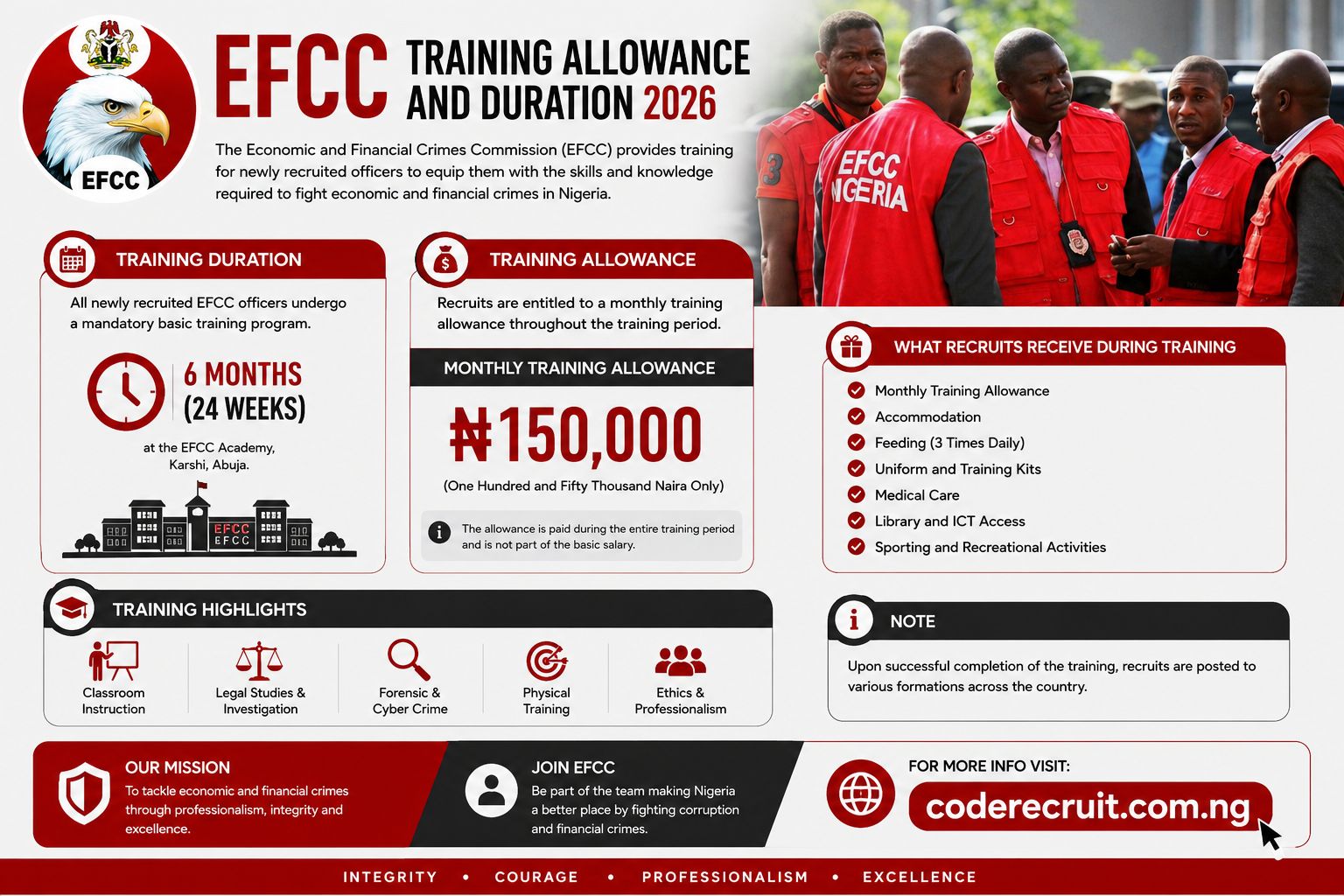
The amount of allowance a trainee receives is determined by their educational qualification at the point of entry into the commission. The higher the qualification, the higher the training allowance.
EFCC Training Allowance by Qualification (2026)
| Trainee Qualification | Monthly Training Allowance (₦) |
|---|---|
| SSCE / WAEC / NECO Holders | ₦15,000 – ₦25,000 |
| OND / NCE Holders | ₦15,000 – ₦25,000 |
| HND / B.Sc. (Graduate) Holders | ₦20,000 – ₦35,000 |
| Master’s Degree / Professional Certification Holders | ₦20,000 – ₦35,000 |
In summary:
- Trainees who joined the EFCC with an SSCE, OND, or NCE qualification earn between ₦15,000 and ₦25,000 per month during the training period.
- Trainees who joined with an HND, B.Sc., or higher academic degree earn between ₦20,000 and ₦35,000 per month during the training period.
Important Note: The EFCC training allowance is a temporary payment. It is applicable only during the training period and is terminated immediately upon successful completion of the training programme. Once training is complete, officers begin earning their full monthly salary under the EFCC’s Consolidated Paramilitary Salary Structure (CONPASS).
What Does the Training Allowance Cover?
While the training allowance may appear modest compared to the full EFCC salary, it is designed to cover trainees’ basic living expenses during the residential training period, including:
- Personal toiletries and grooming items
- Transportation during weekend or personal-time movements
- Phone top-up and communication costs
- Supplementary meals and snacks beyond what the academy provides
- Personal clothing and miscellaneous personal expenses
Trainees are generally housed, fed, and kitted within the academy’s residential facilities at no personal cost, so the allowance serves as spending money for personal needs rather than a living wage.
EFCC Training Duration 2026
The EFCC training duration is divided into two distinct categories, based on the educational qualification of the recruit. This is a critical detail every prospective EFCC officer must understand before applying or planning for the training period.
Category 1: SSCE, OND, and NCE Holders
Recruits who joined the EFCC using their West African Senior School Certificate (WAEC/NECO), Ordinary National Diploma (OND), or National Certificate of Education (NCE) are required to undergo a training period of approximately six (6) months.
This six-month programme is designed to equip these officers with the foundational knowledge, skills, and physical readiness required to function in supporting roles within the commission. It includes physical drills, classroom instruction, fieldwork introductions, and general law enforcement orientation.
Category 2: HND, B.Sc., and Master’s Degree Holders
Recruits who joined the EFCC with a Higher National Diploma (HND), Bachelor of Science (B.Sc.), or a postgraduate Master’s degree are required to undergo a more extensive training period of approximately one year (12 months).
The extended training duration for graduates reflects the broader scope of responsibilities they will take on as officers. Their training covers not only the physical and procedural aspects of law enforcement but also advanced investigative techniques, legal frameworks, forensic accounting, digital crime investigation, intelligence gathering, and prosecution procedures.
EFCC Training Duration Summary Table
| Entry Qualification | Training Duration | Nature of Training |
|---|---|---|
| SSCE / OND / NCE | 6 Months (approximately) | Physical training, law enforcement basics, fieldwork orientation, classroom instruction |
| HND / B.Sc. / Master’s | 12 Months (approximately) | Advanced investigations, forensic accounting, digital forensics, legal procedures, intelligence, physical drills |
The training is described as rigorous, combining intense physical exercises, academic coursework, and mental conditioning. It takes place both within and outside the EFCC Academy premises, with field exercises conducted at designated training grounds.
About the EFCC Academy
The EFCC Academy is the official training and research institution of the Economic and Financial Crimes Commission. It is the institution responsible for producing professionally trained, intellectually equipped, and physically conditioned anti-financial-crime officers for the commission and for supporting other law enforcement agencies both within Nigeria and across Africa.
History of the EFCC Academy
The academy was first established in 2005 under the name Training and Research Institute (TRI). Following years of expansion and institutional development, it was officially re-designated and rebranded as the EFCC Academy in 2012. Since then, it has grown into one of Nigeria’s most respected law enforcement training institutions, known not only for training EFCC officers but also for hosting training programmes for officers from other Nigerian agencies and international anti-corruption bodies.
Mandate of the EFCC Academy
The mandate of the EFCC Academy, as defined in consonance with Sections 6 and 11 of the EFCC Establishment Act (2004), is:
- To develop and deliver high-quality, cutting-edge training for all staff of the EFCC
- To provide capacity building support to other Nigerian law enforcement and security agencies
- To train stakeholders in Ministries, Departments, and Agencies (MDAs) on financial crime prevention
- To support other Anti-Corruption Agencies (ACAs) within and outside Nigeria by sharing expertise and best practices
- To conduct research into evolving financial crime trends and develop updated training modules accordingly
The academy’s official vision is: “To provide cutting-edge training necessary for the effective discharge of the Commission’s mandate.”
In recent years, the EFCC Academy has also been designated as the official training institution for the Network of National Anti-Corruption Institutions of West Africa (NACIWA), making it a regional hub for anti-corruption capacity building across West Africa.
In 2024, the academy launched an Electronic Learning Management Studio — a digital e-learning platform that extends the academy’s training reach beyond physical attendance, enabling distance learning for officers and partner agencies.
EFCC Academy Location and Facilities
The EFCC Academy is located at:
No. 1, Idoma Way, Federal Housing, Phase 1, Karu, Abuja, Nigeria.Karu is a suburb of Abuja, the Federal Capital Territory, and the academy’s location provides easy access to the commission’s corporate headquarters at Jabi, Abuja, as well as to courts and law enforcement partner institutions in the FCT.
The academy operates as a residential facility. Trainees are housed within the academy compound during their training period, meaning they do not need to commute to training daily. Accommodation, meals, training kits, and course materials are provided for trainees at no personal cost, which is why the training allowance serves primarily as personal spending money.
Key facilities at the EFCC Academy include:
- Lecture halls and classroom blocks for academic instruction
- A library and research centre for coursework and independent study
- Physical training grounds and drill fields for paramilitary conditioning
- An indoor gymnasium and fitness facility
- Residential dormitories for trainees
- A dining hall providing regular meals for trainees
- An Electronic Learning Management Studio for digital and e-learning programmes
- Conference rooms for workshops and seminars
Courses and Subjects Studied During EFCC Training
The EFCC Academy offers a comprehensive curriculum that combines paramilitary physical training with academic and professional instruction. The courses studied during EFCC training reflect the commission’s broad mandate to investigate and prosecute financial crimes. Key subjects and training modules include:
Law Enforcement and Criminal Justice
- Introduction to Nigerian criminal law and criminal procedure
- Law enforcement ethics and professional conduct
- Rules of evidence and admissibility in financial crime prosecutions
- Human rights in law enforcement
- Report writing and investigative documentation
Financial Crime Investigation
- Financial crimes and investigative methodology
- Money laundering: detection, tracing, and prosecution
- Public sector fraud prevention, detection, and investigation
- Foreign exchange investigation and banking regulations
- Tracing and tracking of suspicious financial transactions
- Asset tracing, seizure, and forfeiture procedures
- Asset management in cross-border crime
Forensic and Digital Investigations
- Digital forensics and cyber crime investigation
- Forensic accounting and auditing
- Financial analysis and interpretation of financial records
- Auditing and investigation fundamentals
- Use of investigative technology and digital tools
Anti-Corruption and Compliance
- Anti-corruption frameworks in Nigeria and internationally
- Compliance and regulatory standards for financial institutions
- Fraud risk assessment and internal control
- Integrity management and public accountability
Physical and Paramilitary Training
- Physical fitness drills and endurance exercises
- Close-quarter drills and formation marching
- Field operations simulation
- Self-defence and personal protection techniques
- Arrest and detention procedures
Many of the academic courses are offered in affiliation with reputable tertiary institutions both within Nigeria and internationally, giving EFCC Academy training a recognized academic standing in addition to its operational value.
Notably, tuition at the EFCC Academy is completely free. The Federal Government bears all costs associated with running the academy, and trainees are not required to pay any fees, for courses, accommodation, meals, or materials.
What EFCC Training Involves: Daily Activities and Expectations
EFCC training is widely regarded as one of the most demanding in Nigeria’s paramilitary landscape. New recruits should go in fully prepared for a structured, disciplined, and physically and mentally intensive programme. Here is what a typical training period at the EFCC Academy involves:
Physical Conditioning
Every training day begins with early morning physical training. This includes long-distance runs, group fitness drills, obstacle course navigation, press-ups, sit-ups, and squad formation exercises. Physical fitness is taken very seriously, and trainees who do not meet fitness benchmarks may face extended physical training periods or potential disqualification.
Classroom Instruction
Afternoons are typically dedicated to classroom lectures on law enforcement, financial crime investigation, legal procedures, accounting, digital forensics, and related subjects. These sessions are delivered by experienced EFCC officers, legal experts, forensic accountants, and invited resource persons from partner institutions.
Fieldwork and Simulations
Trainees participate in field exercises and simulation drills that mirror real-world EFCC operations. These include mock investigations, evidence gathering scenarios, surveillance exercises, and mock prosecutions. Field exercises are conducted both within the academy grounds and at designated external sites.
Discipline and Regimentation
Like all paramilitary training programmes, EFCC training is strictly regimented. Trainees are expected to adhere to a strict schedule of wake-up, physical training, breakfast, lectures, lunch, afternoon drills, dinner, and lights-out. Punctuality, discipline, team cohesion, and respect for authority are emphasized throughout the training period.
Examinations and Assessments
Trainees sit formal examinations and undergo continuous assessments on the academic and professional modules. A trainee must attain satisfactory scores across all assessments to be certified as having completed the training programme successfully.
Graduation Ceremony
Upon successful completion of the training, recruits are formally graduated at a passing-out parade ceremony held at the EFCC Academy. This ceremony marks their official transition from trainee status to full EFCC officer status, and they subsequently proceed to their posting stations across Nigeria.
What Happens After EFCC Training?
After successfully completing the mandatory training programme and being graduated at the passing-out parade, the following happens:
- Training Allowance Stops Immediately: The monthly training allowance ceases on the day the training programme ends. It is not paid beyond the training period under any circumstances.
- Transition to Full EFCC Salary: Officers begin earning their full monthly salary under the EFCC’s Consolidated Paramilitary Salary Structure (CONPASS), based on their grade level and qualifications.
- Posting to Commands: Newly graduated officers are posted to EFCC commands, zonal offices, and operational units across Nigeria. Postings are determined by the commission based on operational needs and the officer’s area of specialization.
- Issuance of Official Identity: Officers are issued their official EFCC identity cards, operational badges, and official uniforms.
- Enrollment in IPPIS and Pension Scheme: Officers are enrolled in the Integrated Personnel and Payroll Information System (IPPIS) for salary payment and registered with the Pension Commission (PENCOM) contributory pension scheme.
- Commencement of Duties: Officers begin their official duties, investigations, intelligence gathering, prosecution support, surveillance, forensic accounting, or administrative functions, depending on their designated unit and specialization.
EFCC Full Salary After Training in 2026
Once training is completed, officers earn the full EFCC monthly salary. Below is a summary of estimated post-training monthly earnings based on entry qualification and grade level:
| Entry Qualification / Grade Level | Entry Rank | Estimated Monthly Basic Salary (₦) |
|---|---|---|
| SSCE (GL 03–05) | Detective Assistant III | ₦40,000 – ₦60,000 |
| OND / NCE (GL 06–07) | Assistant Detective Inspector | ₦74,000 – ₦95,000 |
| HND / B.Sc. (GL 08) | Detective Superintendent | ₦105,000 – ₦120,000 |
| Master’s / Law Degree (GL 09) | Senior Detective Superintendent | ₦120,000 – ₦150,000 |
| Senior Officer (GL 10–12) | Principal Detective Superintendent | ₦150,000 – ₦180,000 |
| Management (GL 13–17) | Assistant Director to Director | ₦210,000 – ₦700,000+ |
In addition to the basic salary, full EFCC officers receive various allowances including hazard allowance, transport allowance, housing allowance, intelligence allowance, and medical allowance, which substantially increase their total monthly take-home pay.
Requirements to Join the EFCC in 2026
Before you can be shortlisted for training at the EFCC Academy, you must meet the following entry requirements:
Educational Requirements
- Minimum of five (5) credit passes in WASSCE, NECO, or GCE, obtained in not more than two sittings. A credit pass in English Language is compulsory.
- Relevant OND, NCE, HND, or B.Sc. degree from a recognized Nigerian or foreign institution (for higher cadre entry)
- NYSC Discharge Certificate or Exemption Letter for degree holders
Personal Requirements
- Must be a Nigerian citizen by birth
- Age: typically 18 to 35 years at the time of application
- Must have no criminal record (minor road traffic offences may be waived)
- Must be physically and medically fit, with no serious health conditions that would impair law enforcement duties
- Must possess good communication skills — both written and oral
- Must be of good character, verifiable through a background check, references, and guarantors
Application Requirements
- Valid National Identification Number (NIN)
- Birth certificate or statutory declaration of age
- SSCE / WASC / NECO result(s)
- First school leaving certificate
- Local Government Area (LGA) identification letter
- Two completed guarantors’ forms (from responsible citizens)
- Passport photographs
Preferred Disciplines for Graduate Entry
Graduates with qualifications in the following fields are most sought-after by the EFCC:
- Law (LL.B)
- Accounting and Finance
- Computer Science and Cybersecurity
- Economics
- Criminology and Security Studies
- Banking and Finance
- Statistics and Mathematics
- Public Administration
How to Apply for EFCC Recruitment and EFCC Academy in 2026
Applications for EFCC recruitment and the EFCC Academy are submitted online through the official EFCC portal. Follow the steps below:
- Visit the EFCC Official Website: Open your browser and go to the official EFCC website at efcc.gov.ng.
- Navigate to the Careers Section: From the main menu or homepage, click on the “Careers” page at efcc.gov.ng/efcc/careers. This page lists all available positions and current recruitment exercises.
- Register an Account: Create a new account on the recruitment portal by providing your full name, a valid email address, phone number, and a secure password.
- Fill Out the Application Form: Log in to your account and carefully complete the online application form. Provide accurate and up-to-date personal information, academic qualifications, work experience (if applicable), and contact details.
- Upload Required Documents: Scan and upload all required documents including your SSCE result, birth certificate, LGA identification, guarantors’ forms, and passport photograph in the required format.
- Submit Your Application: Review all entries for accuracy before submitting. An incorrect entry could result in disqualification.
- Await the Shortlist Announcement: After submission, check the EFCC website and your registered email address regularly for updates on the shortlisting of candidates for screening, aptitude tests, and physical assessments.
For EFCC Academy Direct Admission (Cadets)
Candidates who wish to apply directly to the EFCC Academy as cadets (rather than as general recruits) must:
- Meet all the general educational and personal requirements above
- Have a valid JAMB (UTME) score that meets the EFCC Academy’s specified cut-off mark
- Apply through the EFCC Academy portal available on the official EFCC website
As noted earlier, EFCC Academy is entirely tuition-free. No school fees, accommodation fees, or material fees are charged. All costs are borne by the Federal Government.
EFCC Training Allowance vs Other Paramilitary Agencies in Nigeria (2026)
To help you understand how the EFCC training allowance compares with what other Nigerian paramilitary agencies pay their trainees, here is a side-by-side comparison:
| Agency | SSCE Trainee Allowance | Graduate Trainee Allowance | Training Duration (SSCE) | Training Duration (Graduate) |
|---|---|---|---|---|
| EFCC | ₦15,000 – ₦25,000/month | ₦20,000 – ₦35,000/month | 6 months | 12 months |
| ICPC | ₦15,000 – ₦20,000/month | ₦20,000 – ₦30,000/month | 6 months | 12 months |
| NSCDC | ₦10,000 – ₦15,000/month | ₦15,000 – ₦25,000/month | 3 – 6 months | 6 – 9 months |
| Nigeria Customs Service | ₦15,000 – ₦20,000/month | ₦20,000 – ₦30,000/month | 6 months | 6 – 9 months |
| Nigeria Immigration Service | ₦10,000 – ₦20,000/month | ₦15,000 – ₦25,000/month | 3 – 6 months | 6 months |
The EFCC’s training allowance is generally competitive and among the higher-paying across Nigerian paramilitary agencies, reflecting the commission’s status as one of the best-compensated federal agencies in Nigeria.
Conclusion
The EFCC training allowance and duration in 2026 are well-defined and straightforward: SSCE holders receive between ₦15,000 and ₦25,000 per month during their six-month training, while graduate officers receive between ₦20,000 and ₦35,000 per month during their twelve-month training at the EFCC Academy in Karu, Abuja.
While the training allowance is modest compared to the full EFCC salary, it is important to keep perspective: during training, all basic needs, accommodation, feeding, kitting, and instruction, are fully provided by the Federal Government. The allowance is essentially pocket money. Upon graduation, officers immediately transition to competitive full salaries under the CONPASS framework, with additional allowances for hazard, housing, transport, and intelligence duties.
A career at the EFCC is more than just a pay cheque. It is a career of national significance, standing on the front lines of Nigeria’s battle against financial crimes, money laundering, corruption, and economic sabotage. If you have the discipline, the academic background, and the commitment to serve with integrity, the EFCC represents one of the most rewarding and prestigious careers in the Nigerian federal service.
Keep an eye on the official EFCC website for updates on recruitment exercises, academy admissions, and shortlisted candidates. Best of luck in your application.
Found this post helpful? Please share it with friends and family preparing for the EFCC recruitment exercise. If you have any questions, drop them in the comments section below.