If you are considering joining the Nigeria Police Force (NPF), or you are simply curious about how much police officers earn, this is the most comprehensive and up-to-date guide on the Nigeria Police salary structure for 2026.
This guide covers every rank from Constable to Inspector General of Police, the CONPASS grading system, all allowances and benefits, rank symbols and insignia, promotion criteria, entry requirements, and a comparison of police pay with other Nigerian security agencies.
The Nigeria Police Force is the principal law enforcement agency in Nigeria, established under Section 214 of the 1999 Constitution.
With over 370,000 officers and men deployed across 36 states and the Federal Capital Territory, the NPF is one of the largest police forces in Africa. Understanding its salary and rank structure is essential whether you are an applicant, a serving officer seeking clarity, or a Nigerian citizen interested in public sector transparency.
Quick Summary: Nigeria Police Salary Structure 2026
| Detail | Information |
|---|---|
| Organisation | Nigeria Police Force (NPF) |
| Governing Law | Section 214–216, 1999 Constitution of Nigeria; Police Act |
| Salary System | CONPASS (Consolidated Police Salary Structure) |
| Total Number of Ranks | 15 Ranks (from Constable to Inspector General) |
| Lowest Rank | Police Constable |
| Highest Rank | Inspector General of Police (IGP) |
| Minimum Monthly Basic Salary | ₦43,293 (Constable) |
| Maximum Monthly Basic Salary | ₦938,578 (Inspector General of Police) |
| DPO Monthly Salary | ₦172,089 – ₦199,723 (SP/CSP range) |
| Force Headquarters | Louis Edet House, Shehu Shagari Way, Abuja |
| Current IGP | IGP Kayode Egbetokun |
| Official Website | www.npf.gov.ng |
About the Nigeria Police Force (NPF)
The Nigeria Police Force (NPF) traces its origins to the 30-man Consular Guard established in Lagos in 1861 during the British colonial era. This guard was expanded to 600 men in 1891 and renamed the “Hausa Police”, before being further enlarged and renamed the Hausa Constabulary with 1,200 officers and men. Subsequent colonial forces , the Lagos Police Force (1896), the Niger Coast Constabulary (1894), and the Northern and Southern Nigeria Police Forces , were eventually unified in 1930 to form Nigeria’s first National Police.
Today, the Nigeria Police Force operates under Section 4 of the Police Act, which mandates it to:
- Prevent and detect crime across the Federation
- Apprehend offenders and bring them to justice
- Preserve law and order in communities
- Protect lives and property of all persons in Nigeria
- Enforce all laws and regulations it is directly charged with
- Perform military duties within and outside Nigeria as required by law
For administrative purposes, the NPF is divided into seven departments, each headed by a Deputy Inspector General of Police (DIG):
- Department of Finance and Administration
- Department of Operations
- Department of Logistics and Supply
- Force Criminal Investigation Department (FCID)
- Department of Training and Development
- Department of Research and Planning
- Department of Information and Communication Technology (ICT)
The Force is further divided into 17 Zonal Commands, each headed by an Assistant Inspector General (AIG), with State Commands (headed by Commissioners of Police), Area Commands (headed by Assistant Commissioners of Police), Police Divisions (headed by DPOs), and Police Outposts (headed by ASPs and Inspectors).
What Is the CONPASS Salary System?
Police salaries in Nigeria are paid under the CONPASS , Consolidated Police Salary Structure. This is a federal government-approved pay scale specifically designed for the Nigeria Police Force, distinct from the CONPSS (civil service salary structure) used for regular public servants. CONPASS was introduced to provide a rank-specific, transparent compensation framework for all NPF personnel.
Under CONPASS, salary is primarily determined by:
- Rank and grade level, higher ranks attract significantly higher pay
- Years of service, within-grade increments accrue over time
- Posting and deployment, officers posted to high-risk or specialist units may earn additional allowances
- Educational qualification, the entry level and initial grade placement can be influenced by academic credentials (OND, HND, or B.Sc.)
Two broad officer categories exist within the CONPASS framework: Commissioned Officers (ACP and above) who earn significantly more, and Non-Commissioned Officers (Constable through Inspector) who form the operational backbone of the Force.
Complete Nigeria Police Rank Structure 2026
The NPF has 15 official ranks arranged from highest to lowest. Below is the complete hierarchy with rank insignia descriptions:
Senior/Commissioned Officer Ranks
| Rank | Abbreviation | Insignia / Symbol | Role |
|---|---|---|---|
| Inspector General of Police | IGP | Four Silver Stars | Overall commander of the entire Nigeria Police Force |
| Deputy Inspector General of Police | DIG | Three Silver Stars | Heads one of seven NPF departments; reports directly to IGP |
| Assistant Inspector General of Police | AIG | Two Silver Stars | Heads a Zonal Command; supports DIGs across departments |
| Commissioner of Police | CP | One Silver Star | Commands a State Police Command |
| Deputy Commissioner of Police | DCP | Crown and One Star | Deputy at State Command level; specialist command positions |
| Assistant Commissioner of Police | ACP | Crown With Ribbon | Heads Area Commands; supports CPs at state level |
| Chief Superintendent of Police | CSP | Three Silver Pips (Stars) | Divisional command; senior investigative roles |
| Superintendent of Police | SP | Two Silver Pips | Divisional Police Officer (DPO); commands police divisions |
| Deputy Superintendent of Police | DSP | One Silver Pip | Supports SP; investigative and operational duties |
| Assistant Superintendent of Police | ASP | One Silver Bar | Commands Police Outposts; operational field duties |
Non-Commissioned Officer (NCO) Ranks
| Rank | Abbreviation | Insignia / Symbol | Role |
|---|---|---|---|
| Inspector of Police | Insp | Two Silver Chevrons with a Star | Supervisory field officer; commands small patrol units |
| Sergeant Major | S/Maj | Crown above Three Chevrons | Senior NCO; station administration and coordination |
| Sergeant | Sgt | Three Chevrons | Leads patrol teams; station-level duties |
| Corporal | Cpl | Two Chevrons | Leads small patrol groups; supports Sergeants |
| Constable | PC | No Insignia (Plain Uniform) | Entry-level officer; frontline policing, patrols, duties |
Nigeria Police Salary Structure 2026: Full Breakdown by Rank
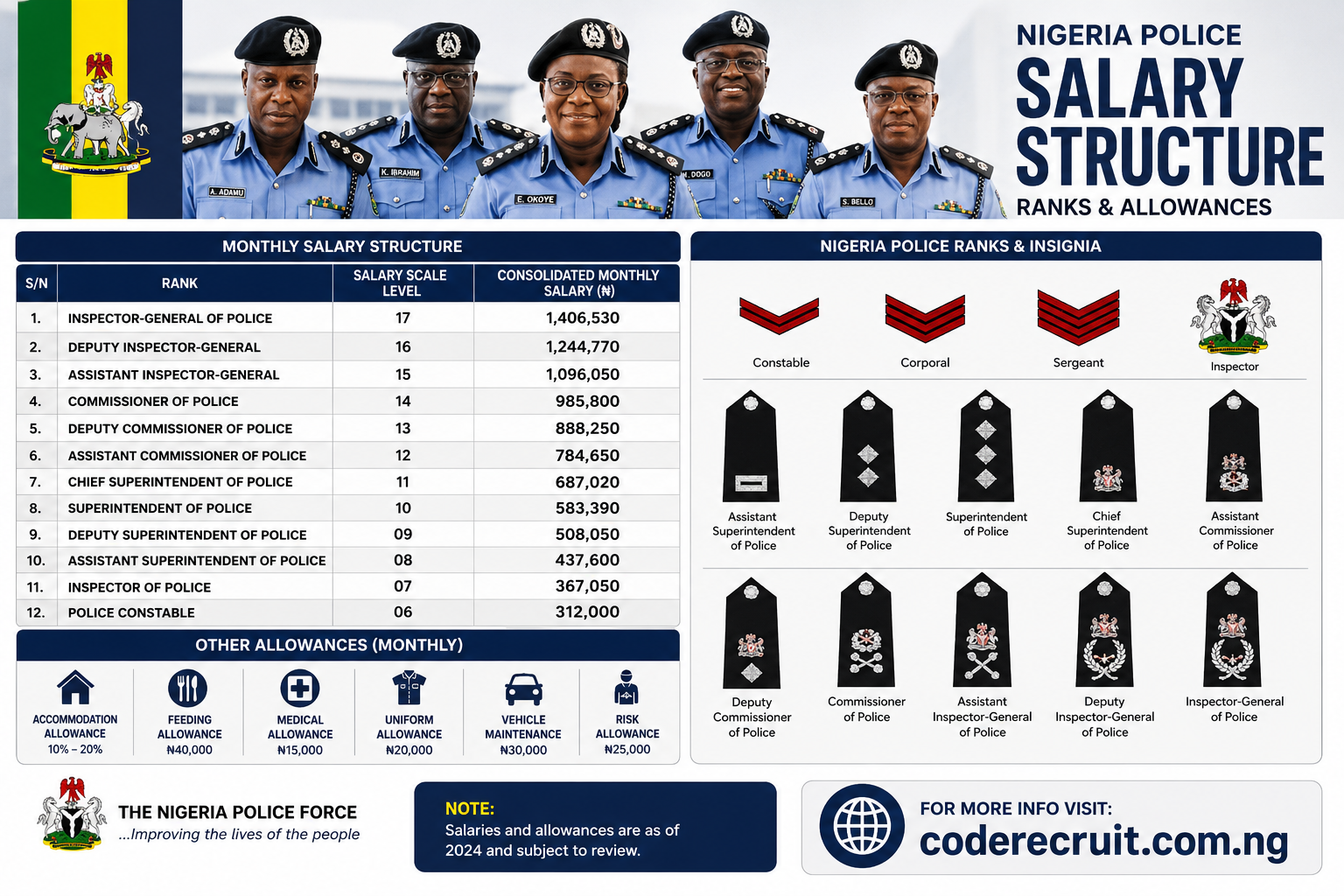
The table below provides the complete monthly basic salary for every rank in the Nigeria Police Force in 2026. These figures are based on the current CONPASS pay scale as implemented under the Federal Government’s salary structure. Note that actual take-home pay is higher when allowances are factored in.
Top Command Salaries
| Rank | Monthly Basic Salary (₦) | Annual Basic Salary (₦) |
|---|---|---|
| Inspector General of Police (IGP) | ₦938,578 | ₦11,262,936 |
| Deputy Inspector General of Police (DIG) | ₦854,272 | ₦10,251,264 |
| Assistant Inspector General of Police (AIG) | ₦527,387 | ₦6,328,644 |
Senior Management Officer Salaries
| Rank | Monthly Basic Salary (₦) | Annual Basic Salary (₦) |
|---|---|---|
| Commissioner of Police (CP) | ₦302,970 | ₦3,635,640 |
| Deputy Commissioner of Police (DCP) | ₦278,852 | ₦3,346,224 |
| Assistant Commissioner of Police (ACP) | ₦212,938 | ₦2,555,256 |
Middle-Level Officer Salaries
| Rank | Monthly Basic Salary (₦) | Annual Basic Salary (₦) |
|---|---|---|
| Chief Superintendent of Police (CSP) | ₦199,723 | ₦2,396,676 |
| Superintendent of Police (SP) | ₦187,616 | ₦2,251,392 |
| Deputy Superintendent of Police (DSP) | ₦170,399 | ₦2,044,788 |
| Assistant Superintendent of Police (ASP) | ₦156,318 | ₦1,875,816 |
Junior Officer and Non-Commissioned Officer Salaries
| Rank | Monthly Basic Salary (₦) | Annual Basic Salary (₦) |
|---|---|---|
| Inspector of Police | ₦100,000+ | ₦1,200,000+ |
| Sergeant Major | ₦100,000+ | ₦1,200,000+ |
| Sergeant | ₦55,973 – ₦100,000 | ₦671,676+ |
| Corporal | ₦51,113 – ₦95,000 | ₦613,356+ |
| Police Constable | ₦43,293 – ₦80,000 | ₦519,516+ |
Important Note: The figures above represent basic salary only. Actual take-home pay for every rank is higher due to housing allowances, transport allowances, hazard/risk allowances, uniform allowances, and other entitlements. Salaries may also vary slightly based on state of posting, years of service within grade, and promotion timing.
What Does Each Rank Earn? Detailed Pay Insights
Inspector General of Police Salary
The IGP is the apex of the Nigeria Police Force hierarchy. The IGP earns a monthly basic salary of approximately ₦938,578, the highest in the Force. In addition to base pay, the IGP receives official accommodation in Abuja, a government-provided vehicle fleet, security and protocol details, and substantial operational allowances that significantly raise total annual compensation. The IGP is appointed by the President of Nigeria on the advice of the Nigeria Police Council, as stipulated under Section 215(1)(a) of the 1999 Constitution.
Deputy Inspector General Salary
The DIG earns approximately ₦854,272 per month. There are seven DIGs in the Force, each heading one of the seven NPF departments. DIGs are among the most senior officers in the country’s law enforcement system and receive generous official entitlements alongside their base pay.
Commissioner of Police Salary
The Commissioner of Police commands an entire state police command and earns approximately ₦302,970 per month in basic salary. As a state-level commander, the CP also benefits from official accommodation, a government vehicle, and operational allowances. The CP rank is the entry point into what is considered the “top echelon” of police management in Nigeria.
Superintendent of Police / DPO Salary
The Divisional Police Officer (DPO) is typically a Superintendent of Police (SP) or, in busier divisions, a Chief Superintendent of Police (CSP). A DPO running a police division , the most visible police management level in Nigeria , earns between ₦172,089 and ₦199,723 per month in basic pay. When operational and other allowances are added, the DPO’s total monthly earnings are considerably higher.
Inspector of Police Salary
The Inspector of Police is the highest non-commissioned officer rank and earns approximately ₦87,135 to ₦100,000 per month in basic salary. Inspectors command patrol units, supervise lower-ranked officers, and manage station-level activities. They represent the senior supervisory layer between constables and commissioned officers.
Police Constable Salary (Entry Level)
A freshly recruited Police Constable, the entry-level rank , earns approximately ₦43,293 to ₦60,000 per month depending on posting and applicable allowances. While this is the lowest basic pay in the Force, constables also receive housing and transport support that partially offsets the base figure. The Constable is the most numerous rank in the NPF and forms the operational foundation of day-to-day policing across Nigeria.
Nigeria Police Allowances and Benefits 2026
Beyond basic salary, every Nigeria Police Force officer is entitled to a range of allowances and welfare benefits. These entitlements vary by rank, posting, and operational role. Below is a full breakdown:
Housing / Rent Allowance
Officers who do not reside in police barracks receive a monthly housing or rent allowance. This ranges from approximately ₦30,000 to ₦50,000 per month for junior to mid-level officers, and significantly more for senior ranks. Officers housed in official police barracks accommodation have their rent deducted at a heavily subsidised rate.
Transport Allowance
All officers receive a monthly transport allowance to cover commuting expenses. The amount scales with rank, reflecting the expectation that senior officers carry out wider operational duties requiring greater mobility. Senior officers are additionally entitled to official government vehicles.
Risk / Hazard Allowance
Given the inherently dangerous nature of police work, all NPF officers receive a risk or hazard allowance. This is significantly higher for officers deployed to frontline combat operations, anti-terrorism units, mobile police (MOPOL) formations, and high-risk postings in conflict-prone areas or volatile states.
Uniform Allowance
Officers receive an annual uniform allowance to cover the cost of purchasing and maintaining official police uniforms, boots, and gear. This ranges from approximately ₦4,000 to ₦30,000 annually, depending on rank and specialisation.
Medical and Health Benefits
Police officers and their immediate dependants are entitled to access medical services through the Nigeria Police Medical Services. Officers may also access the National Health Insurance Scheme (NHIS) and, at senior levels, specialist referral services. This represents a meaningful non-monetary benefit, particularly given Nigeria’s high cost of private healthcare.
Leave and Annual Allowance
Officers are entitled to paid annual leave in accordance with the Police Service Commission regulations. A leave allowance is also paid, typically as a lump sum to support travel and personal costs during the leave period.
Pension and Gratuity
Nigeria Police officers contribute to the Contributory Pension Scheme under the Pension Reform Act 2014. The federal government contributes 10% of consolidated salary while the officer contributes 8%. On retirement, officers receive a pension and, depending on years of service, a gratuity payment. Officers who die in active service have their benefits extended to next-of-kin.
Special Duty and Overtime Allowances
Officers deployed on special assignments , such as election security duties, VIP protection, MOPOL operations, peacekeeping missions with the African Union or United Nations, and counter-terrorism operations , receive additional special duty allowances and, where applicable, international per diem rates.
Death-in-Service Benefits
The family of an officer who dies in the line of duty is entitled to a death benefit payment, outstanding salary arrears, and pension continuation for dependants, subject to administrative processing through the Police Service Commission and the Pension Commission.
Four Entry Routes into the Nigeria Police Force
There are four official pathways into the NPF, each with different entry ranks, requirements, and salary starting points:
1. Police Constable (Rank-and-File Recruitment)
This is the standard entry route for the majority of recruits. Successful applicants join as Constables and rise through the non-commissioned officer ranks. Minimum requirement is an SSCE (WAEC or NECO) with at least five credits including English Language. Applicants must be between 18 and 25 years old, physically fit, and must not have a criminal record.
2. Cadet Inspector
This route is for applicants with an Ordinary National Diploma (OND) or equivalent qualification. Successful candidates are commissioned as Cadet Inspectors, undergo the standard training programme, and are deployed as Inspectors upon graduation. This entry point offers faster career progression than the Constable route.
3. Cadet Assistant Superintendent of Police (ASP)
Applicants holding a Bachelor’s Degree (B.Sc., B.A., B.Tech.) or Higher National Diploma (HND) from accredited institutions enter as Cadet ASPs. This is a direct commissioned officer entry and the most prestigious non-Academy route into the Force. Cadet ASPs undergo a shorter training period than Constables and are commissioned into the officer corps upon graduation.
4. Nigeria Police Academy (POLAC) Degree Programme
The Nigeria Police Academy (POLAC), located in Wudil, Kano State, offers a full-time four-year degree programme that trains candidates as police officers. Graduates of POLAC are commissioned directly as Assistant Superintendents of Police (ASP) upon graduation, making this the most structured and prestigious entry pathway. POLAC cadets are trained simultaneously in academic disciplines and military/police sciences.
General Requirements to Join the Nigeria Police Force
Police Service Commission Recruitment 2026 – Portal, Requirements, How to Apply
Regardless of entry route, all applicants must meet the following baseline requirements:
- Must be a Nigerian citizen by birth
- Must possess a valid National Identification Number (NIN)
- Must be between 18 and 25 years old (Constable route); upper limits vary for other entry categories
- Minimum of five O’Level credits in WAEC or NECO, including English Language and Mathematics
- Must be physically and mentally fit, a medical examination is conducted during screening
- Must have no criminal conviction by any court of competent jurisdiction
- Must not belong to any cult, secret society, or unlawful association
- Must meet minimum height requirements (generally 5 ft 7 inches for males; 5 ft 4 inches for females)
- Must be willing to serve in any state in Nigeria as posted by the Force
Career Progression and Promotion in the Nigeria Police Force
Career advancement in the NPF is governed by the Police Service Commission (PSC), which is the constitutional body responsible for police appointments, promotions, and dismissals. Promotion in the Force depends on a combination of factors:
- Years of service at current rank , minimum time-in-rank requirements must be met before eligibility for promotion
- Annual Performance Evaluation Report (APER), consistent positive performance ratings are required
- Professional examination results, promotion examinations are conducted by the PSC for certain rank transitions
- Completion of required training courses, officers must complete prescribed training at NPF institutions before advancing to the next grade
- Vacancy availability, promotion is also subject to available vacancies at the next rank level in the Force
A Constable with a good service record can realistically expect to reach the rank of Inspector within 10–15 years. University graduates entering as Cadet ASPs can reach the rank of Deputy Superintendent within 5–10 years of active service. Senior positions , Commissioner of Police and above , typically require decades of dedicated service, strong performance records, and passage through competitive selection boards.
How Nigeria Police Salary Compares to Other Security Agencies
A frequently asked question concerns how NPF salaries compare to those of other Nigerian security and law enforcement agencies. The table below provides a comparative overview at the entry and mid levels:
| Agency | Entry Level Monthly Salary (Approx.) | Mid-Level Monthly Salary (Approx.) |
|---|---|---|
| Nigeria Police Force (NPF) | ₦43,293 – ₦60,000 | ₦150,000 – ₦212,938 |
| Nigeria Immigration Service (NIS) | ₦50,000 – ₦70,000 | ₦180,000 – ₦250,000 |
| Nigeria Customs Service (NCS) | ₦60,000 – ₦90,000 | ₦200,000 – ₦350,000 |
| Nigeria Security and Civil Defence Corps (NSCDC) | ₦40,000 – ₦55,000 | ₦120,000 – ₦200,000 |
| National Drug Law Enforcement Agency (NDLEA) | ₦50,000 – ₦75,000 | ₦170,000 – ₦250,000 |
| Federal Road Safety Corps (FRSC) | ₦40,000 – ₦60,000 | ₦130,000 – ₦200,000 |
Nigeria Police salaries are generally considered lower than the Customs Service and Immigration Service at the entry level, largely due to the Customs Service’s significant internally generated revenue (IGR) through import duties and levies. Many officers rely on special duty allowances, posting-based incentives, and promotion increments to meaningfully increase their earnings over a career.
Welfare Concerns and Calls for Reform
The issue of police welfare and remuneration has been a long-standing public and institutional debate in Nigeria. Advocates for police reform have consistently argued that low basic salaries , particularly at the constable and corporal levels , contribute to poor morale, understaffing, and systemic challenges within the Force. Various panels and commissions have recommended salary upward adjustments aligned with the National Minimum Wage, better housing conditions, enhanced health insurance, and improved equipment provision.
The Federal Government has periodically reviewed CONPASS rates, and the recent national minimum wage adjustment to ₦70,000 has accelerated conversations about bringing constable-level pay into alignment with the new baseline. Officers and civil society organisations continue to advocate for comprehensive welfare reform as a cornerstone of any meaningful police restructuring programme in Nigeria.
Tips for Aspiring Nigeria Police Officers
- Apply only through the official NPF portal at www.npf.gov.ng or the recruitment portal announced by the Police Service Commission (PSC) , never through agents or third-party websites
- Improve your physical fitness now, the police recruitment screening involves rigorous physical assessment; begin a disciplined fitness routine well before the exercise
- Organise your documents early, SSCE certificate, birth certificate, NIN, and LGA certificate of origin are core requirements
- Consider your entry route carefully, if you hold a B.Sc. or HND, the Cadet ASP route provides a significantly higher starting rank and faster progression compared to the Constable pathway
- Study for the aptitude test, the NPF recruitment aptitude test covers English, Mathematics, current affairs, and general knowledge
- Do not pay anyone for a police recruitment slot , the entire process is free; anyone demanding payment is committing fraud
- Plan your career realistically, entry-level salaries are modest, but with promotions, allowances, and career development, total earnings improve significantly over 10–20 years of service
Conclusion
The Nigeria Police Force salary structure in 2026 runs from a minimum of approximately ₦43,293 per month for a Police Constable to a maximum of approximately ₦938,578 per month for the Inspector General of Police. While basic salaries , especially at the entry level , remain below what many consider adequate, the complete compensation package including housing allowances, transport support, risk allowances, health benefits, pension contributions, and career progression opportunities provides a broader picture of what a police career in Nigeria offers.
Whether you are deciding whether to join the NPF, planning your promotion strategy as a serving officer, or simply seeking transparency on how your tax money funds Nigeria’s law enforcement, this guide has provided the most comprehensive and current salary breakdown available. For official recruitment notices and policy updates, always refer to the Nigeria Police Force official website at www.npf.gov.ng and the Police Service Commission at www.psc.gov.ng.
- NPF Official Website: www.npf.gov.ng
- Police Service Commission: www.psc.gov.ng