Nigerian Navy salary structure for 2026 is one of the most searched topics by applicants, current personnel, and Nigerians curious about military compensation. Whether you are considering joining the Nigerian Navy, preparing for the ongoing 39AK Recruitment, or simply want to understand how much naval officers are paid at every rank , this is the most comprehensive and up-to-date guide available.
The Nigerian Navy operates under the Consolidated Armed Forces Salary Structure (CONAFSS) , the unified pay system administered by the National Salaries, Income and Wages Commission (NSIWC) , which applies across all three branches of Nigeria’s armed forces: the Army, Navy, and Air Force. Salaries are determined by rank, grade level, years of service, step increments, and educational qualification at entry.
Beyond basic salary, the Navy provides a broad package of allowances, benefits, and career development opportunities that make it one of Nigeria’s most attractive uniformed service careers.
Quick Summary
| Detail | Information |
|---|---|
| Organisation | Nigerian Navy (NN) |
| Parent Body | Nigerian Armed Forces / Ministry of Defence |
| Salary System | CONAFSS (Consolidated Armed Forces Salary Structure) |
| Administered By | National Salaries, Income and Wages Commission (NSIWC) |
| Commissioned Officer Ranks | 11 ranks (Midshipman to Admiral) |
| Non-Commissioned Officer Ranks | 8 ranks (Trainee/Ordinary Seaman to Master Warrant Officer) |
| Lowest Entry Rank | Ordinary Seaman (SSCE holders) |
| Highest Rank | Admiral (Chief of Naval Staff) |
| Minimum Monthly Basic Salary | ₦103,851 – ₦104,851 (Ordinary Seaman) |
| Maximum Monthly Salary (incl. allowances) | ₦2,500,000 – ₦2,900,290+ (Admiral) |
| SSCE Entry Starting Salary | ₦103,000 – ₦105,000/month (Ordinary Seaman) |
| NCE/ND Entry Starting Salary | ₦110,000 – ₦117,000/month (Seaman) |
| HND/B.Sc. Entry Starting Salary | ₦217,459 – ₦240,199/month (Sub-Lieutenant) |
| Official Recruitment Portal | joinnigeriannavy.com / navy.mil.ng |
About the Nigerian Navy
The Nigerian Navy (NN) is the naval branch of the Nigerian Armed Forces, responsible for defending Nigeria’s territorial waters, protecting maritime economic interests, combating sea piracy and maritime crime, enforcing maritime laws, and supporting joint military operations with the Army and Air Force. The Nigerian Navy is one of the largest and most capable navies in Africa, with over 25,000 active personnel operating from bases across Nigeria’s 853-kilometre Atlantic coastline, major inland waterways, and the Gulf of Guinea.
The Nigerian Navy was formally established on February 26, 1964, with its operational headquarters at Naval Headquarters, Ship House, Ship House Road, Maitama, Abuja. The service is headed by the Chief of Naval Staff (CNS), who holds the rank of Admiral and is appointed by the President of Nigeria as Commander-in-Chief of the Armed Forces.
Key Nigerian Navy commands and establishments include:
- Naval Training Command (NAVTRAC) , oversees all training institutions
- Nigerian Naval College (NAVCOLLEG), Expo, Apapa , officer training
- Nigerian Navy Basic Training School (NNBTS), Onne, Rivers State , ratings/recruits training
- Nigerian Naval Engineering College (NNEC), Sapele , technical specialisation
- Nigerian Defence Academy (NDA), Kaduna , degree programme for commissioned officers
- Naval bases in Lagos, Port Harcourt, Calabar, Warri, Apapa, and Bayelsa
What Is CONAFSS? The Nigerian Military Salary Framework
The Consolidated Armed Forces Salary Structure (CONAFSS) is the approved pay framework governing the remuneration of all personnel in the Nigerian Army, Navy, and Air Force. Introduced and periodically reviewed by the National Salaries, Income and Wages Commission (NSIWC), CONAFSS ensures a standardised, transparent, and rank-based compensation structure across all three services.
Under CONAFSS, five key factors determine a service member’s pay:
- Rank , the primary determinant; each rank has a defined salary band
- Grade level within rank , step increments within the same rank accrue annually
- Years of service , continuous service increases within-grade pay
- Educational qualification at entry , SSCE, NCE/ND, HND, and B.Sc. holders enter at different ranks with different starting salaries
- Special duties and deployment , sea duty, operational deployment, peacekeeping missions, and hazard postings attract additional allowances beyond basic CONAFSS pay
The Nigerian Navy is widely regarded as the highest-paid branch among Nigeria’s three armed services at comparable ranks, largely due to sea duty allowances, maritime hazard bonuses, and operational allowances that are unique to naval service.
Nigerian Navy Rank Structure: Commissioned and Non-Commissioned Officers
The Nigerian Navy has two broad officer categories with distinct rank hierarchies and entry pathways:
Commissioned Officer Ranks (Highest to Lowest)
Commissioned officers are those who join through the Nigerian Defence Academy (NDA), the Direct Short Service Commission (DSSC), or the Short Service Commission (SSC). They hold formal commissions signed by the President and lead operational, strategic, and administrative functions.
- Admiral (Chief of Naval Staff)
- Vice Admiral
- Rear Admiral
- Commodore
- Captain
- Commander
- Lieutenant Commander
- Lieutenant
- Sub-Lieutenant
- Acting Sub-Lieutenant
- Midshipman
Non-Commissioned Officer Ranks / Ratings (Highest to Lowest)
Non-commissioned officers (NCOs), also called Ratings, are those who enter through the standard annual recruitment exercise (e.g., the 39AK Intake) using SSCE, NCE, or National Diploma qualifications. They undergo training at the Nigerian Navy Basic Training School (NNBTS) in Onne, Rivers State.
- Master Warrant Officer
- Warrant Officer
- Chief Petty Officer
- Petty Officer
- Leading Seaman (Leading Rating)
- Able Seaman (Able Rating)
- Seaman (Ordinary Rating)
- Ordinary Seaman
Nigerian Navy Salary Structure 2026: Commissioned Officers (Full Table)
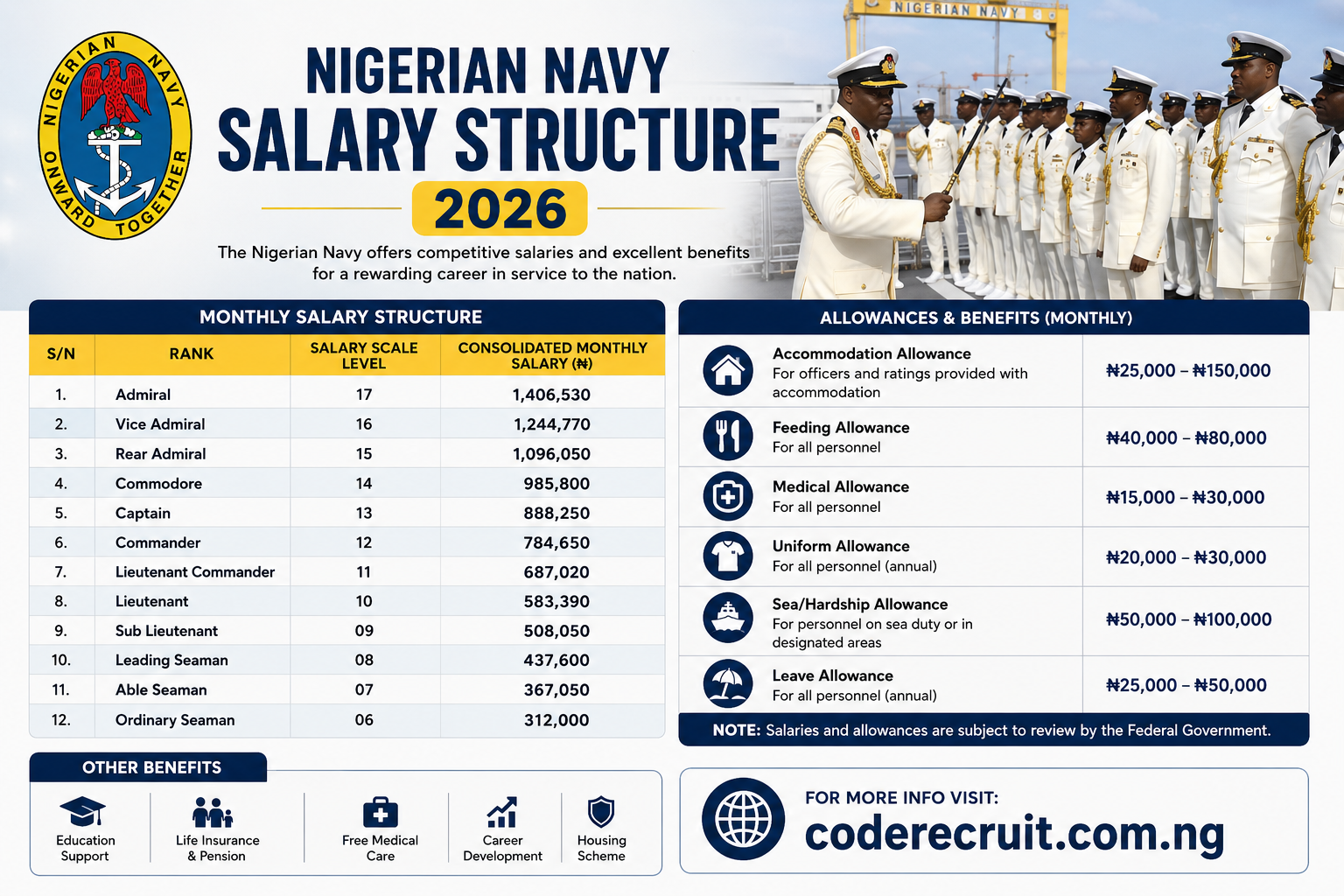
The table below presents the current estimated monthly basic salary for all commissioned officer ranks in the Nigerian Navy under the CONAFSS framework for 2026. Actual take-home pay is higher when operational and other allowances are included.
| Rank | Army Equivalent | Monthly Basic Salary (₦) | Estimated Annual (₦) |
|---|---|---|---|
| Admiral | General | ₦2,524,299 – ₦2,900,290 | ₦30,291,588 – ₦34,803,480 |
| Vice Admiral | Lieutenant General | ₦1,876,091 – ₦2,876,091 | ₦22,513,092 – ₦34,513,092 |
| Rear Admiral | Major General | ₦1,366,393 – ₦1,966,393 | ₦16,396,716 – ₦23,596,716 |
| Commodore | Brigadier General | ₦744,570 – ₦844,578 | ₦8,934,840 – ₦10,134,936 |
| Captain | Colonel | ₦458,074 – ₦558,074 | ₦5,496,888 – ₦6,696,888 |
| Commander | Lieutenant Colonel | ₦281,673 – ₦381,673 | ₦3,380,076 – ₦4,580,076 |
| Lieutenant Commander | Major | ₦230,652 – ₦330,652 | ₦2,767,824 – ₦3,967,824 |
| Lieutenant | Captain | ₦195,685 – ₦492,494 | ₦2,348,220 – ₦5,909,928 |
| Sub-Lieutenant | Lieutenant | ₦217,459 – ₦317,459 | ₦2,609,508 – ₦3,809,508 |
| Acting Sub-Lieutenant | , | ₦130,852 – ₦250,000 | ₦1,570,224 – ₦3,000,000 |
| Midshipman | Second Lieutenant | ₦200,199 – ₦240,199 | ₦2,402,388 – ₦2,882,388 |
Note: Salary ranges reflect variations across sources, step increments within grade, and the impact of recent government welfare adjustments. Figures represent basic pay; total compensation with allowances can be substantially higher , up to double the basic figure for officers on operational or sea deployments.
Nigerian Navy Salary Structure 2026: Non-Commissioned Officers / Ratings (Full Table)
Ratings form the operational backbone of the Nigerian Navy. Their salaries have seen notable upward movement following recent government minimum wage reviews and welfare enhancement circulars for the armed forces.
| Rank | Monthly Basic Salary (₦) | Notes |
|---|---|---|
| Master Warrant Officer | ₦155,655 – ₦185,605 | Senior NCO advisory roles; highest-paid rating |
| Warrant Officer | ₦170,502 – ₦170,572 | Technical specialist and supervisory roles |
| Chief Petty Officer | ₦120,572 – ₦150,204 | Senior section leaders; experienced operators |
| Petty Officer | ₦90,254 – ₦140,254 | Supervisory field duties |
| Leading Seaman (Leading Rating) | ₦72,659 – ₦128,659 | Junior leader positions |
| Able Seaman (Able Rating) | ₦68,850 – ₦117,850 | Skilled operational seamen |
| Seaman (Ordinary Rating) | ₦58,005 – ₦112,005 | Entry level for NCE/ND holders |
| Ordinary Seaman | ₦50,000 – ₦104,851 | Entry level for SSCE holders after basic training |
| Trainee (Under Training) | ₦15,000 – ₦15,220 | Training stipend only; not full salary |
Important: The lower figures in the Trainee row represent the training stipend paid during the approximately six-month basic training period at NNBTS, Onne. Once training is completed and a recruit is confirmed as an Ordinary Seaman, their full salary begins.
Entry-Level Salaries by Educational Qualification
One of the most frequently asked questions about the Nigerian Navy is: “How much will I earn when I first join, based on my certificate?” The answer depends directly on the qualification presented at the time of enlistment or commission:
| Entry Qualification | Starting Rank | Estimated Starting Monthly Salary (₦) |
|---|---|---|
| SSCE / WAEC / NECO (5 credits) | Ordinary Seaman | ₦103,000 – ₦105,000 |
| NCE / OND / National Diploma | Seaman | ₦110,000 – ₦117,000 |
| HND / B.Sc. (DSSC/SSC route) | Sub-Lieutenant | ₦217,459 – ₦240,199 |
| NDA Graduate (Commissioned) | Sub-Lieutenant / Lieutenant | ₦217,459 – ₦292,494 |
This qualification-based entry structure is a defining feature of the Nigerian Navy , and a powerful incentive for applicants to pursue higher education before enlisting, given the significant salary gap between an SSCE-entry Ordinary Seaman and an HND/B.Sc.-entry Sub-Lieutenant.
Nigerian Navy Training Allowance 2026
During the basic training period , which lasts between six and nine months depending on the intake category , recruits and cadets receive a training stipend rather than a full salary. These figures are separate from the main salary structure and apply only during the training phase:
| Trainee Category | Monthly Training Stipend (₦) |
|---|---|
| SSCE Certificate Holders | ₦10,000 – ₦15,000 |
| NCE / National Diploma (ND) Holders | ₦25,000 |
| HND / B.Sc. Holders (DSSC/SSC Cadets) | ₦35,000 |
| Regular Cadets at the Nigerian Defence Academy (NDA) | ₦25,000 – ₦30,000 |
| Short Service Cadets | ₦15,000 – ₦20,000 |
Once training is completed and personnel are confirmed as serving officers or ratings, their standard monthly salary under CONAFSS begins immediately.
Nigerian Navy Allowances and Benefits 2026
In addition to basic monthly salary, all Nigerian Navy personnel are entitled to a range of allowances and welfare benefits. These entitlements can significantly , sometimes dramatically , increase total monthly take-home pay, particularly for personnel deployed at sea or on operational assignments.
Sea Duty Allowance
The sea duty allowance is arguably the most significant allowance unique to naval service and unavailable to Army or Air Force personnel in the same form. Officers and ratings deployed aboard naval vessels , including frigates, patrol boats, survey vessels, and submarines , receive a sea duty allowance that compensates for the additional physical and psychological demands of long-duration seagoing service. This allowance substantially boosts monthly earnings for personnel regularly deployed at sea.
Operational / Hazard Allowance
Personnel deployed on active operations , including anti-piracy patrols in the Gulf of Guinea, counter-insurgency support in the Lake Chad Basin, maritime law enforcement, and joint security operations , receive an operational/hazard allowance of up to ₦75,000 per month in addition to basic salary.
Transport Allowance
All Navy personnel receive a monthly transport allowance of up to ₦45,000 to ₦50,000 to cover commuting and mobility costs. Senior officers additionally benefit from official government vehicles where assigned.
Housing / Rent Allowance
Personnel not occupying official naval barracks accommodation receive a monthly housing/rent allowance of up to ₦50,000, depending on their rank and the location of their posting. Officers at senior ranks may be assigned official quarters within naval bases.
Clothing / Uniform Allowance
An annual clothing/uniform allowance of approximately ₦40,000 is provided to cover the cost of purchasing and maintaining official naval uniforms, white service dress, and rank insignia.
Special Forces Allowance
Personnel serving in the Nigerian Navy’s elite Special Boat Service (SBS) and other specialist units receive a special forces allowance of up to ₦70,000 per month, reflecting the advanced training and heightened operational risk associated with these roles.
Medical and Healthcare Benefits
All naval personnel and their immediate dependants are entitled to free medical care through the Nigerian Armed Forces Medical Services and Nigerian Navy hospitals and sick bays. This is a significant non-monetary benefit , particularly given the high cost of private healthcare in Nigeria , and extends through retirement in respect of service-related conditions.
Free Accommodation (Barracks)
Officers and ratings are housed in official naval barracks and quarters at reduced or nil rent, depending on rank and base availability. Naval residential accommodation is typically of a higher standard than equivalent civilian rental housing in the same locations.
Pension and Gratuity
Nigerian Navy personnel contribute to the Contributory Pension Scheme (CPS) under the Pension Reform Act 2014. The Federal Government contributes 10% of consolidated salary, while the officer or rating contributes 8%. On reaching retirement age or completing the minimum qualifying service period, personnel receive both a pension and a gratuity lump sum. Officers who die in active service have their benefits , including outstanding salaries, gratuity, and pension continuation , extended to their next-of-kin.
Educational Sponsorship
The Nigerian Navy sponsors both local and international professional development courses for career advancement. Officers may be sponsored to attend the Nigerian Naval War College, the Nigerian Army Command and Staff College, the Nigerian Defence College, and international military schools, particularly in the United Kingdom, United States, France, and Germany.
International Peacekeeping Allowances
Nigerian Navy personnel deployed on international peacekeeping missions , under the African Union (AU), the Economic Community of West African States (ECOWAS), or the United Nations (UN) , receive substantial international per diem allowances paid in foreign currency (typically US dollars), which represent a major financial benefit for those selected for such deployments.
Entry Routes into the Nigerian Navy
There are four official pathways to a career in the Nigerian Navy:
1. Nigerian Navy Ratings (Annual General Recruitment)
This is the standard entry route for the majority of enlisted personnel. Recruitment intakes are designated by batch numbers , the most recent being Batch 39AK (2026). Candidates with SSCE, NCE, or ND qualifications apply through the official portal at joinnigeriannavy.com, sit aptitude tests and physical assessments, and , if successful , undergo basic training at the Nigerian Navy Basic Training School (NNBTS) in Onne, Rivers State, before being confirmed as ratings. SSCE holders start as Ordinary Seamen; NCE/ND holders start as Seamen.
2. Nigerian Defence Academy (NDA)
The Nigerian Defence Academy (NDA), located in Kaduna, is the premier military university that trains officers for all three branches of Nigeria’s armed forces. NDA admits candidates after SSCE with strong grades and subjects them to five years of combined military and academic training. NDA graduates are commissioned as Sub-Lieutenants or Lieutenants and represent the most prestigious officer entry pathway in the Navy.
3. Direct Short Service Commission (DSSC)
The DSSC is designed for Nigerian graduates and professionals who wish to join the Navy as commissioned officers in specific specialised fields , including medicine, engineering, law, nursing, pharmacy, information technology, chaplaincy, and accounting. DSSC officers are commissioned directly as Sub-Lieutenants after a short basic military training course. A valid NYSC Discharge or Exemption Certificate is mandatory.
4. Short Service Commission (SSC)
The SSC offers a service period of typically five to eight years for graduates who wish to serve in the Navy for a defined period rather than as a full career. SSC is an excellent option for professionals who want to contribute to national security while maintaining the option of a subsequent civilian career. SSC officers are also commissioned as Sub-Lieutenants after basic training.
General Requirements to Join the Nigerian Navy
Regardless of entry route, all applicants must meet the following baseline requirements:
- Must be a Nigerian citizen by birth
- Must possess a valid National Identification Number (NIN)
- Must be 18 to 26 years old for ratings entry (SSCE/ND/NCE); specific age bands apply for DSSC and SSC
- Minimum of five O’Level credits in WAEC or NECO in not more than two sittings, including English Language and Mathematics
- Must be physically and medically fit; a full medical examination is conducted during screening
- Must have no criminal conviction by any court
- Must not belong to any cult, secret society, or unlawful association
- Must meet minimum height requirements (generally 1.68m/5 ft 6 in for males; 1.65m/5 ft 5 in for females)
- Must be willing to serve in any location to which posted, including at sea
- Must be single (for entry-level ratings recruitment , marital status requirements vary for DSSC)
Career Progression and Promotion in the Nigerian Navy
Career advancement in the Nigerian Navy is governed by the Armed Forces Council and the Naval Appointments and Promotions Board. Promotion is competitive and depends on a combination of:
- Time-in-rank , minimum years at current rank must be served before promotion eligibility
- Annual Confidential Report (ACR) , consistent outstanding performance evaluations are required
- Promotion examination results , written promotion exams are a feature of ratings advancement in particular
- Professional courses completed , mandatory courses must be attended at approved naval training institutions
- Operational record and conduct , commendations and operational achievements strengthen candidacy
- Vacancy availability , promotions are also subject to establishment vacancies at the next rank
A typical career trajectory: an Ordinary Seaman can reasonably expect to reach Petty Officer within 10–12 years of exemplary service. An NDA-commissioned Sub-Lieutenant can reach Captain within 15–20 years. The most senior ranks , Rear Admiral and above , require 25 or more years of active, distinguished service and are attained by only a small percentage of commissioned officers.
How Nigerian Navy Salary Compares to Other Armed Forces Branches
The Nigerian Navy is widely acknowledged as the highest-paid branch of Nigeria’s armed forces at comparable ranks, largely due to sea duty allowances, maritime hazard bonuses, and specialist operational entitlements. Below is an approximate comparison at selected ranks:
| Rank Level | Nigerian Navy (₦/month) | Nigerian Army (₦/month) | Nigerian Air Force (₦/month) |
|---|---|---|---|
| Highest Rank (Admiral / General) | ₦2,500,000 – ₦2,900,290+ | ₦2,400,000 – ₦2,800,000+ | ₦2,400,000 – ₦2,800,000+ |
| Mid Senior (Commodore / Brig. General) | ₦744,570 – ₦844,578 | ₦700,000 – ₦820,000 | ₦700,000 – ₦820,000 |
| Junior Officer (Sub-Lieutenant / Lieutenant) | ₦217,459 – ₦317,459 | ₦180,000 – ₦270,000 | ₦190,000 – ₦280,000 |
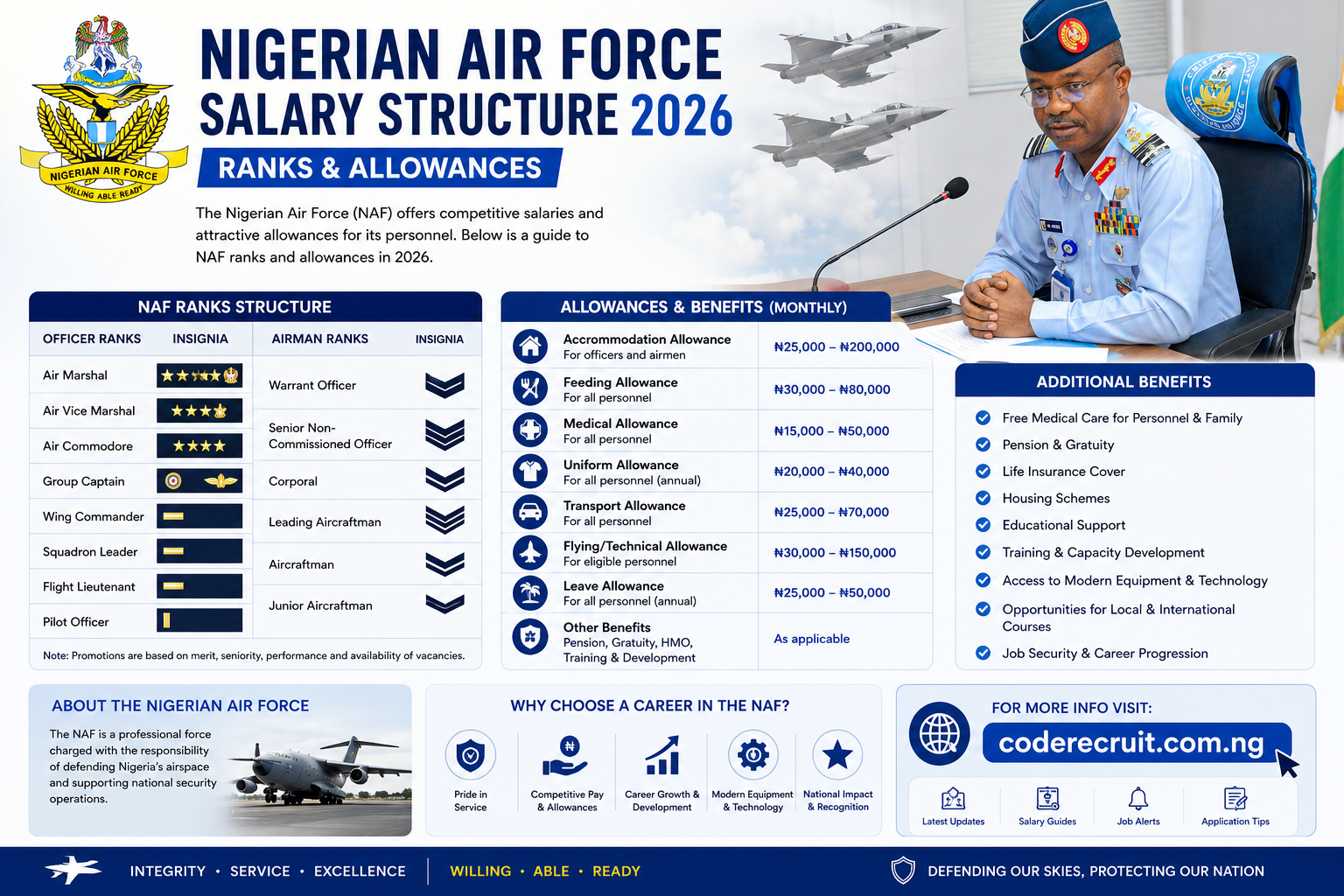
| Entry NCO (Ordinary Seaman / Private) | ₦103,000 – ₦105,000 | ₦65,000 – ₦90,000 | ₦70,000 – ₦95,000 |
The salary advantage of the Nigerian Navy is most pronounced at the entry (rating) level, where naval recruits earn significantly more than Army and Air Force recruits at equivalent entry stages, driven by sea duty supplement pay and the higher operational risk of maritime service.
Tips for Prospective Nigerian Navy Recruits
- Apply only through the official portal at joinnigeriannavy.com , never through agents, social media vendors, or unofficial websites
- Start physical conditioning early , the Navy physical screening is rigorous and includes swimming tests, endurance runs, push-ups, and sit-ups; begin a structured fitness programme months before the exercise
- Organise your documents in advance , SSCE certificate, birth certificate, NIN, LGA certificate of origin, and NYSC certificate (for DSSC/SSC) should be certified and ready
- Consider the DSSC/SSC route if you hold a degree , commissioning as a Sub-Lieutenant with a starting salary over ₦217,000 per month is far more advantageous than enlisting as an Ordinary Seaman at ₦104,000
- Learn to swim , naval recruits are expected to demonstrate basic swimming ability during screening; inability to swim may disqualify candidates
- Study for the aptitude test , the Navy entrance aptitude test covers Mathematics, English Language, current affairs, general knowledge, and basic sciences
- Never pay for a recruitment slot , the process is entirely free; anyone demanding money for an application, shortlisting, or training placement is committing fraud and should be reported
- Be ready to relocate , naval service postings are national and include seagoing assignments; flexibility and willingness to serve anywhere in Nigeria (or at sea) are essential
Lastly
The Nigerian Navy salary structure in 2026 ranges from a training stipend of approximately ₦10,000 to ₦15,000 per month for new recruits during their training period, to a confirmed entry salary of ₦103,851 per month for Ordinary Seamen, up to over ₦2,900,290 per month for the Admiral (Chief of Naval Staff). When the full package of allowances , sea duty, hazard, transport, housing, clothing, special forces, and medical benefits , is factored in, the Nigerian Navy offers one of the most comprehensive compensation packages in Nigerian public service.
Whether you are targeting the Ordinary Seaman rank through the 39AK General Recruitment, seeking a commission through the DSSC as a graduate professional, or aspiring to the NDA officer path, a career in the Nigerian Navy offers competitive pay, exceptional career development, international exposure, and the privilege of serving Nigeria’s maritime interests with honour and distinction.
For official recruitment announcements, shortlist releases, and the latest salary circulars, always refer to the official channels:
- Official Recruitment Portal: https://www.joinnigeriannavy.com
- Nigerian Navy Official Website: https://www.navy.mil.ng