The Department of State Services (DSS) is Nigeria’s domestic intelligence and internal security agency. It operates under the Office of the National Security Adviser and reports directly to the President of Nigeria.
The agency is responsible for counter-intelligence, counter-terrorism, intelligence gathering, VIP protection, and the safeguarding of government assets and institutions.
The DSS is a civilian security agency and is technically distinct from Nigeria’s military and paramilitary forces, although it follows a paramilitary-style rank structure similar to the police, army, and other uniformed services.
Because the agency operates with a significant degree of secrecy, much of the publicly available information on its salary structure is drawn from a combination of leaked data, official pay structure frameworks (such as CONPASS), and information shared by current and former personnel.
DSS vs SSS: Are They the Same?
One of the most common questions asked is whether DSS and SSS are the same agency. The answer is yes, there is no difference between DSS and SSS.
- DSS stands for Department of State Services
- SSS stands for State Security Service
SSS is simply the former name of the organization. The agency rebranded to DSS, but many Nigerians — particularly older generations — still refer to it by its former name, SSS. Whether you see “DSS salary” or “SSS salary” referenced online, both terms refer to the exact same agency and pay structure.
Core Functions & Responsibilities of DSS Officers
DSS officers are deployed across a wide range of duties depending on their rank, training, and area of specialization. Key responsibilities include:
- VIP Protection: One of the primary duties of DSS officers is the protection of high-ranking government officials, including the President, Vice President, Governors, Ministers, and other key political figures.
- Counter-Terrorism: Identifying, monitoring, and neutralizing terrorist threats within Nigeria’s borders.
- Counter-Intelligence: Detecting and countering espionage activities by foreign or hostile entities.
- Intelligence Gathering: Collecting and analyzing information relevant to national security.
- Internal Security Operations: Investigating threats to internal stability, including subversive activities and organized crime with national security implications.
- Protection of Government Assets and Institutions: Securing critical government buildings, infrastructure, and installations.
DSS Rank Structure & Hierarchy in Nigeria 2026
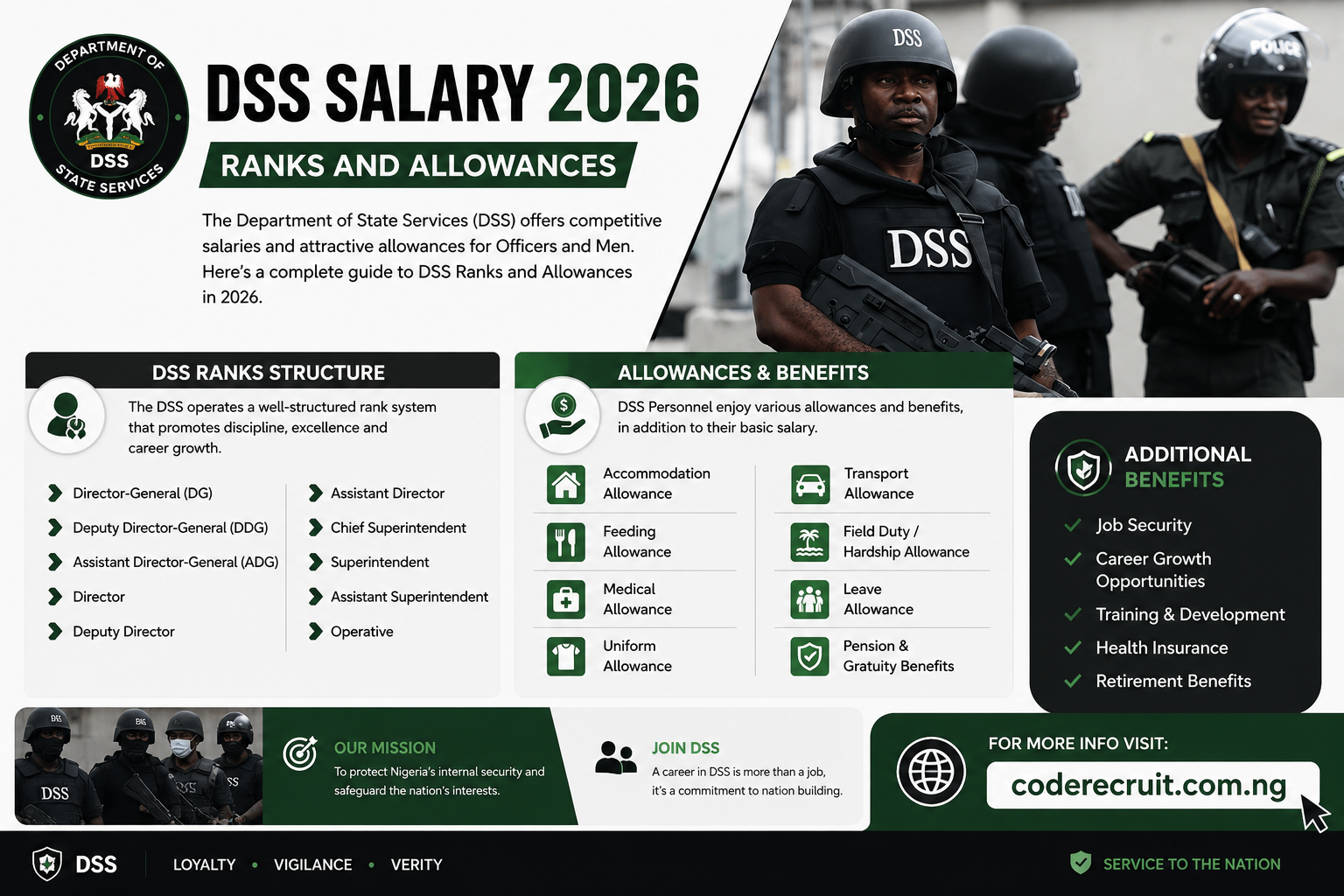
The DSS follows a paramilitary rank structure similar to the military, with a clear progression path from entry-level recruits to the Director-General. The hierarchy can be broken down into three broad categories:
Non-Commissioned Officers (NCOs)
This set of officers usually includes those who joined the DSS with SSCE qualifications. Their work focuses on fieldwork and tactical duties under supervision. Promotions within these ranks depend on performance, discipline, and years of service.
- Recruit / Training Cadet
- Private Officer
- Lance Corporal
- Corporal
- Sergeant
- Staff Sergeant
Commissioned Officers (Junior to Mid-Level)
This category includes those who join the DSS with either a B.Sc./HND or who have been commissioned after academy training.
- Second Lieutenant
- Lieutenant
- Captain
- Major
- Lieutenant Colonel
- Colonel
Senior / Top Officers
- Brigadier General
- Major General
- Director
- Director-General (DG of DSS)
Note: Promotions at every level depend on years of service, internal examinations, and performance reviews.
DSS Salary Structure 2026: Full Breakdown by Rank
Below is the estimated monthly salary for each DSS rank, based on the Consolidated Paramilitary Salary Structure (CONPASS) and internal security funding models. These figures represent estimated base salaries — actual take-home pay is often higher once allowances are included.
| DSS Rank | Estimated Monthly Salary (₦) |
|---|---|
| Recruit / Cadet | ₦70,000 – ₦90,000 |
| Private Officer | ₦90,000 – ₦110,000 |
| Lance Corporal | ₦110,000 – ₦130,000 |
| Corporal | ₦130,000 – ₦150,000 |
| Sergeant | ₦150,000 – ₦170,000 |
| Staff Sergeant | ₦170,000 – ₦200,000 |
| Second Lieutenant | ₦180,000 – ₦200,000 |
| Lieutenant | ₦200,000 – ₦220,000 |
| Captain | ₦220,000 – ₦250,000 |
| Major | ₦270,000 – ₦300,000 |
| Lieutenant Colonel | ₦300,000 – ₦350,000 |
| Colonel | ₦350,000 – ₦400,000 |
| Brigadier General | ₦400,000 – ₦450,000 |
| Major General | ₦450,000 and above |
| Director | ₦500,000 – ₦600,000 |
| Director-General (DG) | ₦1,500,000 – ₦2,000,000+ |
Note: Salaries may vary slightly depending on posting location, years of service, and internal reviews. These figures are estimates and not officially published by the DSS due to the agency’s classified nature.
Alternative Entry-Level Estimates by Qualification
Some sources also break down salary expectations based on the qualification level at the point of entry:
- Entry-Level (SSCE/OND holders): Junior officer salaries typically range from ₦120,000 to ₦350,000 monthly.
- Mid-Level (Degree holders): Senior officer roles for degree holders typically earn between ₦300,000 and ₦550,000 monthly.
- Higher-Level (Master’s degree/extensive experience): Officers may advance to high-ranking roles with significantly higher pay, in line with the Director-level figures above.
Some commonly referenced figures for specific cadres also include:
- Inspector: ₦180,000 – ₦200,000 monthly
- Senior/Chief Inspector: ₦190,000 – ₦240,000 monthly
- Assistant Superintendent: ₦250,000 – ₦280,000 monthly
Important: Because the DSS is a secret service agency, official salary figures are not publicly disclosed. The figures presented in this article are estimates compiled from multiple sources and may not represent the exact, current official pay scale. They should be treated as a general guide rather than an authoritative reference.
Understanding CONPASS: How DSS Salaries Are Determined
The DSS salary system follows the Consolidated Paramilitary Salary Structure (CONPASS), the standard salary framework applied across Nigeria’s paramilitary and security agencies, including the Nigeria Police Force, Nigeria Security and Civil Defence Corps (NSCDC), Nigeria Immigration Service (NIS), Nigerian Correctional Service (NCoS), and the Federal Fire Service (FFS).
Under CONPASS, salaries increase based on the following factors:
- Rank: Each rank corresponds to a specific salary grade level and step within CONPASS.
- Years of Service: Officers move up through salary steps within their grade level as they accumulate years of service.
- Qualifications: Higher academic and professional qualifications can place officers on higher entry steps or qualify them for faster promotion.
- Posting Location: Officers posted to certain locations — particularly high-risk or remote areas — may receive additional location-based allowances that affect total take-home pay.
- Internal Reviews: Periodic reviews by the National Salaries, Incomes and Wages Commission can adjust CONPASS rates across all paramilitary agencies, including the DSS.
DSS Allowances & Benefits 2026
In addition to base salaries, DSS officers enjoy a wide range of allowances and benefits that significantly enhance their total earnings and quality of life. These benefits vary depending on rank, posting, and the nature of assigned duties.
Risk Allowance
This allowance is assigned specifically to officers who operate in very high-risk zones, such as conflict-prone areas or regions with active security threats — to compensate for the elevated danger associated with their duties.
Transport Allowance
Helps cover commuting expenses related to an officer’s job. The amount varies based on duty location and the officer’s rank.
Housing Allowance
Provided to help officers with accommodation costs, making it easier to find suitable living arrangements. The amount typically varies based on rank and the city of posting.
Medical / Health Insurance Benefits
DSS officers receive health insurance that covers medical expenses for themselves and, in many cases, their families — ensuring access to necessary healthcare services.
Duty Tour Allowance (DTA)
Paid to officers for official travel and investigations carried out away from their normal duty post.
Special Duty Allowance
Officers may receive a special duty allowance if they work in challenging areas or during specific operations, recognizing the additional demands of such roles.
Uniform and Kit Allowance
Provided to help officers maintain their work attire and equipment, ensuring they are properly presented and equipped while performing their duties.
Leave Allowance
Officers are entitled to an annual leave allowance in addition to their regular salary.
Retirement and Pension Benefits
DSS staff receive pension and retirement benefits under Nigeria’s federal pension scheme, ensuring long-term financial security after service.
Training and Professional Development
The DSS offers training programs to improve officers’ skills, giving personnel access to resources that support continuous professional development throughout their careers.
Special Operations Bonuses
Some officers involved in special operations may also receive covert mission bonuses or foreign travel allowances when deployed internationally on intelligence or diplomatic missions.
How Promotions Work in the DSS
Career progression within the DSS is structured and merit-based. Promotions at every level depend on the following factors:
- Years of Service: Officers must serve a minimum period at each rank before becoming eligible for promotion to the next level.
- Internal Examinations: Officers are often required to pass internal examinations or assessments demonstrating their knowledge and competence for the next rank.
- Performance Reviews: Regular performance evaluations assess an officer’s conduct, effectiveness, discipline, and contribution to operations.
- Specialized Training: Completion of specialized training programs — particularly for officers moving into intelligence, counter-terrorism, or VIP protection specializations — can influence promotion timelines.
- Discipline: A clean disciplinary record is essential, as infractions can delay or block promotion opportunities.
As officers move up the rank structure — from Non-Commissioned Officer ranks through Commissioned Officer ranks and eventually to Senior/Top Officer positions — both their base salary and the scope of their allowances and benefits typically increase substantially.
DSS Entry Routes & How Qualification Affects Salary
The entry point into the DSS — and consequently the starting salary and rank — largely depends on an applicant’s educational qualification at the time of recruitment:
SSCE Holders
Candidates who join the DSS with SSCE qualifications typically enter as Non-Commissioned Officers, starting at the Recruit/Cadet level and progressing through ranks such as Private Officer, Lance Corporal, Corporal, Sergeant, and Staff Sergeant based on performance and years of service.
OND/HND/B.Sc. Holders
Candidates who join with an OND, HND, or B.Sc. may enter at a higher starting point, often within the Commissioned Officer category (e.g., Second Lieutenant), depending on the specific recruitment cadre and internal placement decisions.
Master’s Degree Holders / Specialists
Candidates with postgraduate qualifications or specialized expertise (e.g., in intelligence analysis, cybersecurity, law, or international relations) may be placed at higher entry points and have a faster track toward senior administrative or specialist roles, which command significantly higher pay over time.
How DSS Salary Compares to Other Security Agencies
The DSS is widely regarded as one of the highest-paying security and intelligence agencies in Nigeria. Here’s how it generally compares to other agencies:
- Vs. Nigeria Police Force: DSS generally offers higher salaries than many entry-level police roles, reflecting the specialized and sensitive nature of its operations.
- Vs. Nigerian Army: While both follow paramilitary-style structures and CONPASS- related frameworks, DSS officers — particularly those in intelligence and VIP protection roles — often receive additional allowances not commonly available to standard army personnel.
- Vs. Other Paramilitary Agencies (NSCDC, NIS, NCoS, FFS): All these agencies operate under CONPASS, but the DSS’s intelligence mandate and the sensitive nature of its work often translate into additional risk-related and special operations allowances that boost overall earnings.
Overall, the combination of a solid base salary under CONPASS, plus a wide range of allowances — housing, transport, risk, medical, duty tour, uniform, and special operations bonuses — makes the DSS one of the more financially rewarding career paths within Nigeria’s security sector.
Tips for Anyone Considering a Career in DSS
- Understand the rank structure before applying. Knowing the progression path — from Recruit/Cadet through to Director-General — helps you set realistic long-term career expectations.
- Higher qualifications can mean a better starting point. If you have the opportunity to obtain a degree or postgraduate qualification before applying, this can influence your entry rank and starting salary.
- Factor in allowances, not just base salary. The base salary figures in the table above represent only part of total compensation — allowances for housing, transport, risk, and medical coverage can substantially increase take-home pay.
- Be prepared for internal exams and performance reviews. Career progression is merit-based, so maintaining discipline and continuously developing your skills will support faster promotion.
- Stay informed through official channels. Because the DSS is a classified organization, official salary information is rarely published. Rely on credible, well-researched sources for guidance, and treat all figures as estimates.
- Consider specialization. Officers with expertise in areas such as counter-terrorism, cybersecurity, or intelligence analysis may have access to specialized roles with additional allowances and faster career growth.
Lastly
The Department of State Services (DSS) offers a structured, well-defined rank system and a competitive salary scale that, combined with a generous range of allowances, makes it one of the more financially rewarding career paths within Nigeria’s security sector. From entry-level salaries of around ₦70,000 monthly for new recruits to over ₦1.5 million to ₦2 million for the Director-General, the DSS provides a clear path for career growth, supported by housing, transport, medical, risk, and special operations allowances along the way.
While exact figures remain largely unconfirmed due to the agency’s classified nature, the information in this guide — compiled from multiple publicly available sources — provides a useful general overview for anyone researching DSS ranks, salaries, and benefits in 2026, whether for recruitment purposes, career planning, or general curiosity about Nigeria’s security sector compensation structures.
Bookmark this page for future reference, and share it with anyone interested in a career within Nigeria’s security and intelligence services. This guide will be updated as new information becomes available.