Nigeria Immigration Service (NIS) is one of Nigeria’s most prestigious and important paramilitary agencies, operating under the Federal Ministry of Interior. It was carved out of the Nigerian Police Force in 1958 and formally recognized through an Act of Parliament (Cap 171) in 1963. Today, it is one of the most competitive federal agencies to join.
The NIS is responsible for:
- Issuance of Nigerian passports and travel documents
- Border security and management
- Visa processing and enforcement of immigration laws
- Control of entry and exit of persons at airports, seaports, and land borders
- Detection and prosecution of illegal immigration activities
- Management of residence permits for foreigners
The service is headed by the Comptroller-General of Immigration (CGI), who is appointed by the President of Nigeria for a renewable four-year term. Each zonal headquarters is headed by an Assistant Comptroller-General (ACG).
The NIS currently maintains four training schools spread across the country, where all newly recruited officers must complete compulsory paramilitary training before being deployed to duty posts.
What Is CONPASS? The NIS Salary Structure Explained
Salaries in the Nigeria Immigration Service are determined by the Consolidated Paramilitary Salary Structure (CONPASS) — a salary framework approved and regulated by the Federal Government of Nigeria. CONPASS is the same structure used across all paramilitary agencies in Nigeria, including the Nigeria Security and Civil Defence Corps (NSCDC), the Nigeria Correctional Service, and the Federal Fire Service.
Under CONPASS, each officer is assigned a grade level based on their educational qualification at the point of entry. Salaries are then paid according to the officer’s grade level and step within that level. The grade level rises as the officer is promoted through the ranks.
How CONPASS Grade Levels Work
| Educational Qualification | CONPASS Grade Level | Entry Rank |
|---|---|---|
| BSc / HND (equivalent) | CONPASS 08 (Level 8) | Assistant Superintendent of Immigration II (ASI II) |
| HND (lower placement) | CONPASS 07 (Level 7) | Assistant Superintendent of Immigration I (ASI I) |
| OND / NCE | CONPASS 06 (Level 6) | Assistant Inspector of Immigration (AII) |
| SSCE / O’Level | CONPASS 03 (Level 3) | Immigration Assistant III (IA III) |
It is important to note that officers with postgraduate qualifications (Master’s degree or PhD) may be considered for placement at a higher CONPASS level than a fresh BSc graduate, subject to availability of vacancies and management discretion.
Entry Rank by Qualification in 2026
Your educational qualification determines the rank at which you enter the Nigeria Immigration Service. Below is a clear summary of what rank each qualification earns upon entry:
| Qualification | Entry Rank | Rank Category | Promotion Ceiling |
|---|---|---|---|
| BSc / B.A. (University Degree) | Assistant Superintendent of Immigration II (ASI II) | Commissioned Officer | Comptroller-General (with merit & time) |
| HND | Assistant Superintendent of Immigration II (ASI II) or ASI I | Commissioned Officer | Deputy Comptroller (typically) |
| OND / NCE | Assistant Inspector of Immigration (AII) | Non-Commissioned Officer | Inspector of Immigration (with further qualification) |
| SSCE / WAEC / NECO | Immigration Assistant III (IA III) | Non-Commissioned Officer | Limited without further education |
Key insight: OND holders placed at the rank of Assistant Inspector of Immigration (AII) face a promotion ceiling within that rank unless they acquire a BSc, HND, or equivalent degree. Without upgrading their qualification, AII-ranked officers cannot advance further. This is an important consideration for anyone entering the service with an OND.
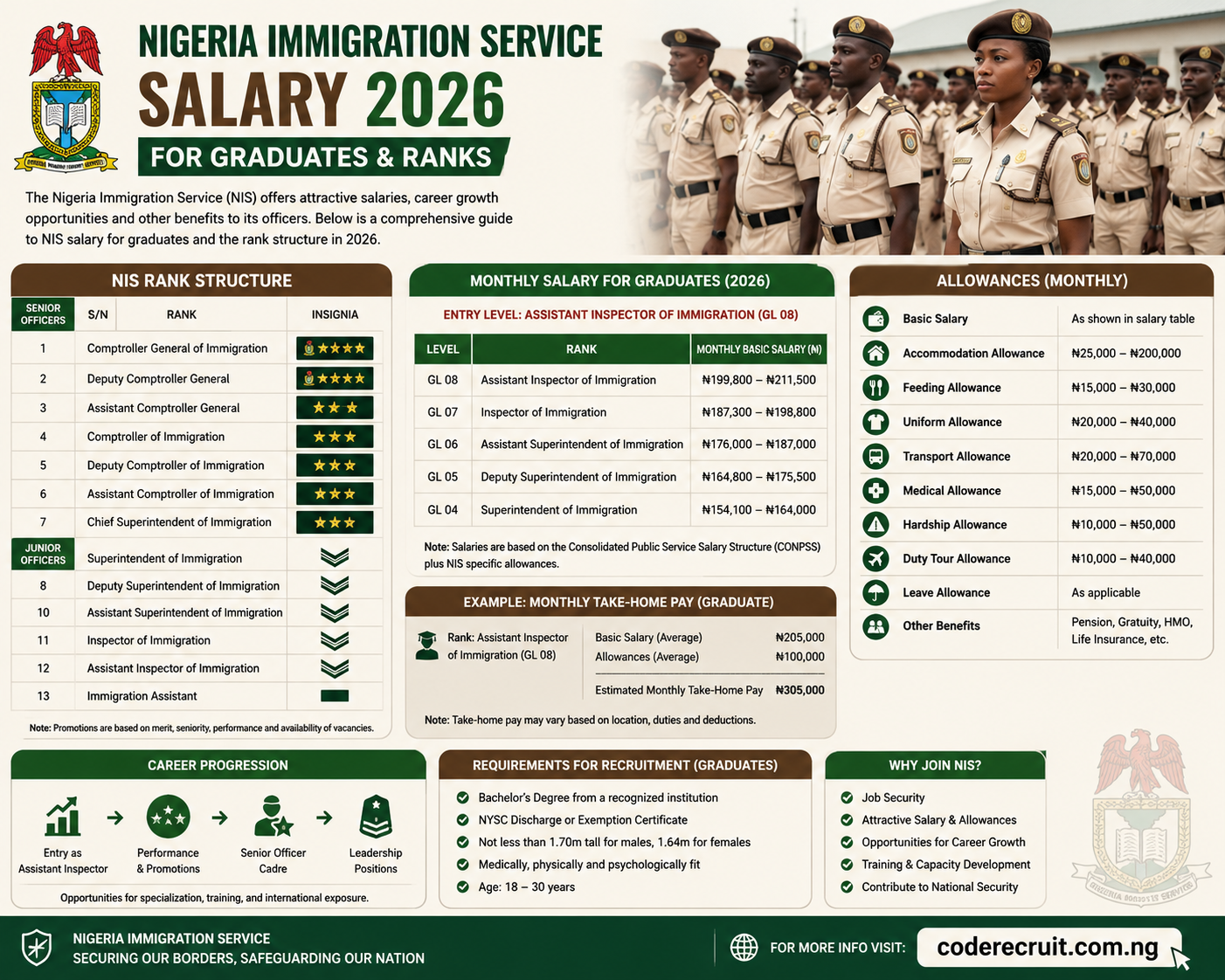
Nigeria Immigration Salary for Graduates (BSc/HND) in 2026
University degree holders (BSc or BA) and HND graduates are among the most sought-after entry-level recruits for the Nigeria Immigration Service. Upon successful recruitment and completion of training, they are placed at the rank of Assistant Superintendent of Immigration II (ASI II), which is a commissioned officer rank.
Monthly Salary for BSc/HND Graduates (ASI II) in 2026
| Rank | CONPASS Level | Estimated Monthly Basic Salary | Estimated Annual Basic Salary |
|---|---|---|---|
| Assistant Superintendent of Immigration II (ASI II), Fresh Graduate | CONPASS 08 | ₦180,000 – ₦260,000 | ₦2,160,000 – ₦3,120,000 |
| Assistant Superintendent of Immigration II (ASI II), 3+ Years Service | CONPASS 08 | ₦260,000 – ₦320,000 | ₦3,120,000 – ₦3,840,000 |
| Assistant Superintendent of Immigration I (ASI I) | CONPASS 09 | ₦280,000 – ₦360,000 | ₦3,360,000 – ₦4,320,000 |
Note on salary figures: The figures above represent estimated basic salaries only, exclusive of allowances. With allowances (housing, transport, uniform, hazard, and medical), total monthly take-home pay can be substantially higher. Some sources place total monthly compensation for a fresh graduate ASI II between ₦310,000 and ₦400,000 when allowances are factored in.
Training Allowance for Graduate Recruits
Graduates who have been recruited but are still undergoing their mandatory paramilitary training are entitled to a training allowance in addition to a reduced basic pay during the training period. Once training is completed and they are fully deployed, the training allowance ceases and they begin receiving their full basic salary plus all applicable service allowances.
Preferred Degree Disciplines
While the NIS recruits from all disciplines, certain degree backgrounds are prioritized during selection exercises:
- Law (LLB)
- International Relations
- Political Science
- Security and Strategic Studies
- Public Administration
- Criminology and Security Studies
- Computer Science and Information Technology
- Medicine and Nursing (for medical officers)
- Accounting and Finance
Nigeria Immigration Salary for OND/NCE Holders in 2026
Holders of an Ordinary National Diploma (OND) or Nigeria Certificate in Education (NCE) enter the Immigration Service at the rank of Assistant Inspector of Immigration (AII). This is a non-commissioned officer rank placed at CONPASS Level 6.
| Rank | CONPASS Level | Estimated Monthly Basic Salary |
|---|---|---|
| Assistant Inspector of Immigration (AII), Entry | CONPASS 06 | ₦150,000 – ₦190,000 |
| Inspector of Immigration (II), After Promotion | CONPASS 07 | ₦190,000 – ₦240,000 |
OND holders should be aware that their promotion potential within the service is limited unless they acquire a higher qualification (HND or BSc). The service strongly encourages officers to pursue further education while serving, and distance learning programmes are available for this purpose.
Nigeria Immigration Salary for SSCE Holders in 2026
Candidates with West African Senior School Certificate (WAEC), National Examination Council (NECO), or SSCE results are placed at the lowest entry point in the service, Immigration Assistant III (IA III) — which corresponds to CONPASS Level 3.
| Rank | CONPASS Level | Estimated Monthly Basic Salary |
|---|---|---|
| Immigration Assistant III (IA III), Entry | CONPASS 03 | ₦130,000 – ₦156,000 |
| Immigration Assistant II (IA II) | CONPASS 04 | ₦140,000 – ₦165,000 |
| Immigration Assistant I (IA I) | CONPASS 05 | ₦155,000 – ₦180,000 |
SSCE holders are advised to pursue further education to unlock higher entry ranks and break through the salary and promotion ceiling that comes with the IA cadre. Many officers have used distance learning to upgrade their qualifications after joining the service.
Full Rank-by-Rank Immigration Salary Structure 2026
Below is a comprehensive estimated salary table for every rank in the Nigeria Immigration Service as of 2026. These figures represent basic monthly salaries under the CONPASS structure, exclusive of allowances. Officers’ total monthly earnings are typically higher when all applicable allowances are included.
| Rank | Category | Estimated Monthly Basic Salary | Estimated Annual Basic Salary |
|---|---|---|---|
| Comptroller-General of Immigration (CGI) | Senior Officer | ₦1,500,000+ | ₦18,000,000+ |
| Deputy Comptroller-General (DCG) | Senior Officer | ₦700,000 – ₦900,000 | ₦8,400,000 – ₦10,800,000 |
| Assistant Comptroller-General (ACG) | Senior Officer | ₦500,000 – ₦700,000 | ₦6,000,000 – ₦8,400,000 |
| Comptroller of Immigration (CI) | Senior Officer | ₦220,000 – ₦250,000 | ₦2,640,000 – ₦3,000,000 |
| Deputy Comptroller of Immigration (DCI) | Senior Officer | ₦190,000 – ₦220,000 | ₦2,280,000 – ₦2,640,000 |
| Assistant Comptroller of Immigration (ACI) | Senior Officer | ₦170,000 – ₦200,000 | ₦2,040,000 – ₦2,400,000 |
| Chief Superintendent of Immigration (CSI) | Commissioned Officer | ₦145,000 – ₦180,000 | ₦1,740,000 – ₦2,160,000 |
| Superintendent of Immigration (SI) | Commissioned Officer | ₦130,000 – ₦160,000 | ₦1,560,000 – ₦1,920,000 |
| Deputy Superintendent of Immigration (DSI) | Commissioned Officer | ₦120,000 – ₦150,000 | ₦1,440,000 – ₦1,800,000 |
| Assistant Superintendent of Immigration I (ASI I) | Commissioned Officer | ₦110,000 – ₦140,000 | ₦1,320,000 – ₦1,680,000 |
| Assistant Superintendent of Immigration II (ASI II), Graduate Entry | Commissioned Officer | ₦180,000 – ₦260,000 | ₦2,160,000 – ₦3,120,000 |
| Chief Inspector of Immigration (CII) | Non-Commissioned Officer | ₦95,000 – ₦120,000 | ₦1,140,000 – ₦1,440,000 |
| Senior Inspector of Immigration (SII) | Non-Commissioned Officer | ₦85,000 – ₦110,000 | ₦1,020,000 – ₦1,320,000 |
| Inspector of Immigration (II) | Non-Commissioned Officer | ₦75,000 – ₦100,000 | ₦900,000 – ₦1,200,000 |
| Assistant Inspector of Immigration (AII), OND Entry | Non-Commissioned Officer | ₦150,000 – ₦190,000 | ₦1,800,000 – ₦2,280,000 |
| Immigration Assistant I (IA I) | Non-Commissioned Officer | ₦155,000 – ₦180,000 | ₦1,860,000 – ₦2,160,000 |
| Immigration Assistant II (IA II) | Non-Commissioned Officer | ₦140,000 – ₦165,000 | ₦1,680,000 – ₦1,980,000 |
| Immigration Assistant III (IA III), SSCE Entry | Non-Commissioned Officer | ₦130,000 – ₦156,000 | ₦1,560,000 – ₦1,872,000 |
| Passport Officer (Lowest Rank) | Non-Commissioned Officer | ₦30,000 – ₦60,000 | ₦360,000 – ₦720,000 |
Disclaimer: These salary figures are estimated from publicly available sources and reports by current and former NIS personnel. Official salary figures are classified under Federal Government policy. Actual salaries may vary depending on the officer’s step within their grade level, posting location, and annual government salary reviews.
Complete List of NIS Ranks (Highest to Lowest) in 2026
The Nigeria Immigration Service has a structured rank hierarchy divided into two broad categories: Commissioned Officers (senior and graduate-level ranks) and Non-Commissioned Officers (NCOs, junior ranks). Below are all NIS ranks from the highest to the lowest:
Senior / Commissioned Officers
- Comptroller-General of Immigration (CGI), Highest Rank
- Deputy Comptroller-General of Immigration (DCGI)
- Assistant Comptroller-General of Immigration (ACGI)
- Comptroller of Immigration (CI)
- Deputy Comptroller of Immigration (DCI)
- Assistant Comptroller of Immigration (ACI)
- Chief Superintendent of Immigration (CSI)
- Superintendent of Immigration (SI)
- Deputy Superintendent of Immigration (DSI)
- Assistant Superintendent of Immigration I (ASI I)
- Assistant Superintendent of Immigration II (ASI II), Graduate Entry Point
Non-Commissioned Officers (NCOs)
- Chief Inspector of Immigration (CII)
- Senior Inspector of Immigration (SII)
- Inspector of Immigration (II)
- Assistant Inspector of Immigration (AII), OND/NCE Entry Point
- Immigration Assistant I (IA I)
- Immigration Assistant II (IA II)
- Immigration Assistant III (IA III), SSCE Entry Point / Lowest Rank
The NIS rank structure closely mirrors those of its sister agencies, the Nigeria Security and Civil Defence Corps (NSCDC) and the Nigeria Correctional Service, as all three share the same CONPASS salary framework and rank hierarchy design.
Allowances & Benefits for Immigration Officers in 2026
Beyond the basic salary, Nigeria Immigration Service officers receive a range of allowances and benefits that can significantly boost their total monthly earnings. In many cases, allowances account for a substantial portion of total take-home pay, sometimes nearly doubling the basic salary for officers in operational or high-risk postings.
Standard Allowances
| Allowance Type | Who It Applies To | Purpose |
|---|---|---|
| Housing Allowance | Officers not residing in government quarters | Covers rent and accommodation costs |
| Transport Allowance | All officers | Covers daily commuting and official movement costs |
| Uniform / Clothing Allowance | All officers | Maintenance and periodic replacement of official uniforms and kits |
| Hazard / Operational Allowance | Officers in high-risk deployments or border operations | Compensation for dangerous or physically demanding duties |
| Medical Allowance | Officers and their direct dependants | Access to healthcare and medical treatment support |
| Leave Grant / Vacation Allowance | All confirmed officers | Paid annually to cover costs during annual leave |
| Training Allowance | Newly recruited officers during training period only | Covers living costs during mandatory paramilitary training |
| Duty Tour Allowance (DTA) | Officers on official travel or postings away from station | Covers accommodation and meal costs during official travel |
| Estacode Allowance | Senior officers on international missions or travel | Foreign currency per diem for overseas official assignments |
Other Benefits
- Pension and Gratuity: NIS officers are enrolled in the Contributory Pension Scheme (CPS). Upon retirement, they are entitled to pension payments and a lump-sum gratuity based on years of service and final salary.
- Government Quarters: Senior officers may be allocated government housing at their duty station, which removes housing costs entirely.
- Official Vehicles: Officers of Comptroller rank and above are entitled to official vehicles and drivers.
- Group Life Insurance: Officers are covered by the government’s group life insurance scheme, which benefits their next of kin in the event of death in service.
- Subsidized Education: Children of immigration officers may benefit from subsidized school fees in certain federal schools.
Promotion & Career Progression in the NIS
Promotion within the Nigeria Immigration Service is based on a combination of years of service, performance, educational qualifications, and available vacancies. Officers typically undergo promotion examinations conducted by the NIS at various career stages.
Typical Promotion Timelines
| Stage | Rank | Typical Years to Attain |
|---|---|---|
| Entry | Assistant Superintendent of Immigration II (ASI II) | Year 1 (upon deployment) |
| 1st Promotion | Assistant Superintendent of Immigration I (ASI I) | 3 – 4 years |
| 2nd Promotion | Deputy Superintendent of Immigration (DSI) | 6 – 8 years |
| 3rd Promotion | Superintendent of Immigration (SI) | 10 – 13 years |
| 4th Promotion | Chief Superintendent of Immigration (CSI) | 14 – 17 years |
| 5th Promotion | Assistant Comptroller of Immigration (ACI) | 18 – 22 years |
| Senior Level | Comptroller and above | 22+ years (competitive and merit-based) |
Officers who demonstrate exceptional performance, earn additional qualifications, or pass competitive promotion exams may advance faster than the timelines above. Conversely, vacancies and budget constraints can slow promotions across the entire service. With each promotion, salaries and allowances increase automatically in line with the new rank’s CONPASS level.
Requirements to Join the Nigeria Immigration Service in 2026
To be eligible for recruitment into the Nigeria Immigration Service, candidates must meet the following basic requirements:
General Requirements
- Must be a Nigerian citizen by birth
- Age limit: Between 18 and 30 years old at the time of application
- Must be medically fit and physically able to perform paramilitary duties
- Must be of good character with no criminal record
- Must be single (for entry-level recruits in most exercises, though this may vary)
- Must have a minimum height of 1.67 metres (5 ft 6 in) for males and 1.64 metres (5 ft 5 in) for females
- Must not have any visible tattoos or body modifications incompatible with paramilitary service
Educational Requirements by Entry Level
- BSc/HND Entry (ASI II): Minimum of a Second Class Lower (2:2) degree or Upper Credit HND from an accredited Nigerian university or polytechnic
- OND/NCE Entry (AII): OND or NCE with at least Lower Credit from an accredited institution
- SSCE Entry (IA III): Minimum of five credits including English Language and Mathematics in not more than two sittings
Recruitment into the NIS is conducted periodically through official announcements on the NIS website (www.immigration.gov.ng) and through the Federal Government’s recruitment portal. Always apply only through official channels to avoid scams.
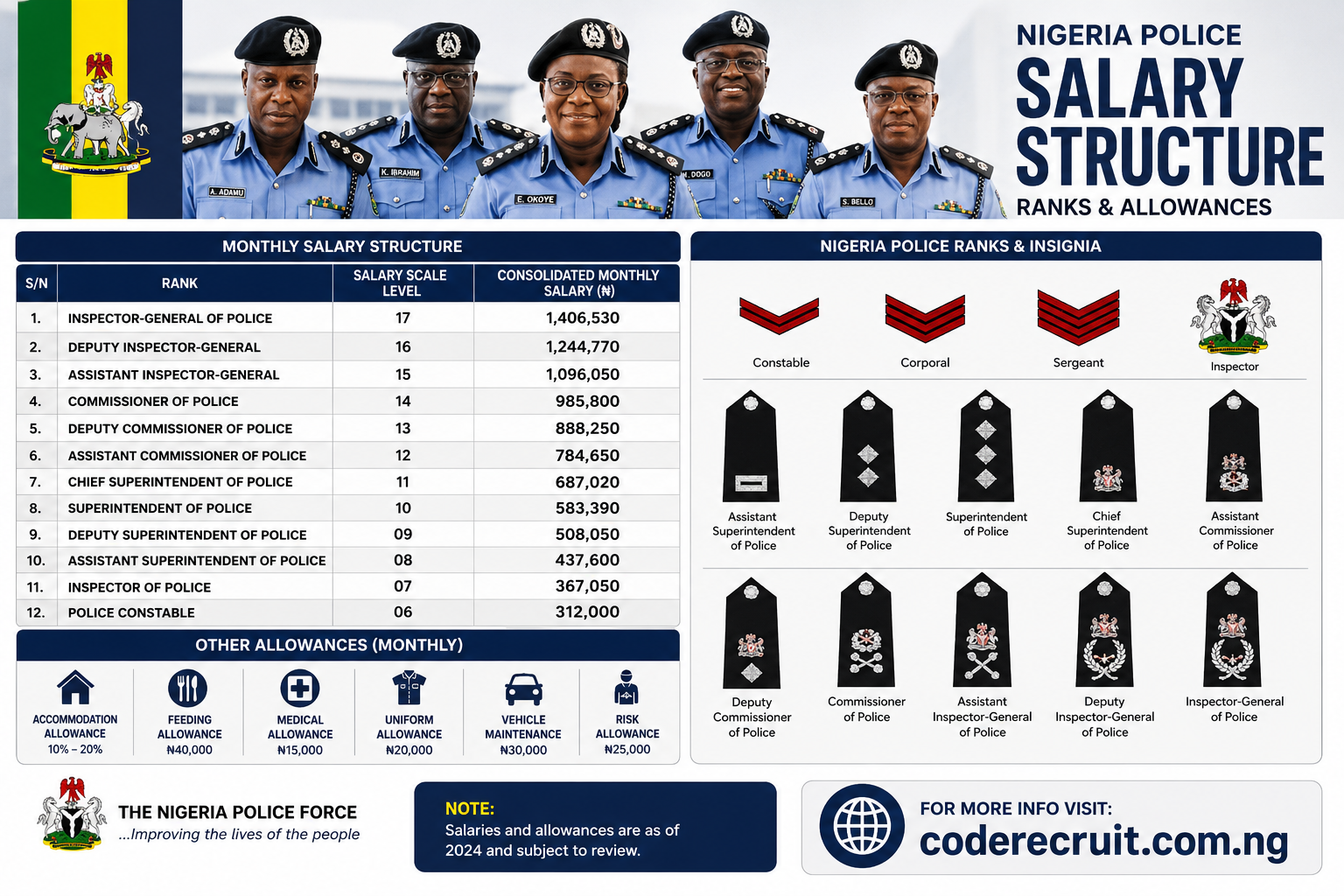
NIS Salary vs Other Paramilitary Agencies in Nigeria (2026)
Many candidates are deciding between several federal paramilitary services when applying. Here is how Nigeria Immigration Service graduate salaries compare to sister agencies for 2026:
| Agency | Graduate Entry Rank | Estimated Monthly Basic Salary | Monthly Salary with Allowances (est.) |
|---|---|---|---|
| Nigeria Immigration Service (NIS) | ASI II | ₦180,000 – ₦260,000 | ₦310,000 – ₦400,000 |
| Nigerian Customs Service (NCS) | ASC II / Inspector | ₦75,000 – ₦95,000 | ₦200,000 – ₦300,000+ |
| Nigeria Security & Civil Defence Corps (NSCDC) | Assistant Superintendent | ₦80,000 – ₦120,000 | ₦200,000 – ₦280,000 |
| Nigerian Police Force (NPF) | Inspector of Police (IP) | ₦80,000 – ₦130,000 | ₦180,000 – ₦250,000 |
| Nigeria Correctional Service (NCoS) | Assistant Superintendent | ₦70,000 – ₦110,000 | ₦180,000 – ₦240,000 |
Based on basic salary alone, the Nigeria Immigration Service remains one of the highest-paying paramilitary agencies in Nigeria for graduate-level recruits. However, it is worth noting that Nigerian Customs Service officers may earn very high income from duty-related allowances and border postings, which are not reflected in basic salary figures alone.
Immigration Training Allowance 2026
All newly recruited Immigration Service officers, regardless of qualification, must undergo compulsory paramilitary training at one of the four NIS training schools located across the country. Training covers physical fitness, immigration law, border management procedures, use of information systems, and paramilitary discipline.
Training Allowance Details
- Recruits receive a training allowance during the training period, which is lower than the full basic salary
- The allowance covers basic living expenses during the residential training period
- Once training is completed and officers are confirmed and deployed, the training allowance automatically ceases
- Officers then begin receiving their full basic salary plus all applicable service allowances
- Training duration typically ranges from 3 to 6 months, depending on the recruitment batch
Recruits should budget carefully for the training period, as the training allowance may not always be sufficient to cover personal expenses beyond the training institution. It is advisable to have personal savings to support yourself during this period.
Conclusion
The Nigeria Immigration Service remains one of the most respected and well-compensated paramilitary agencies in Nigeria in 2026. For graduates with a BSc or HND, the starting rank of Assistant Superintendent of Immigration II (ASI II) comes with a competitive monthly basic salary of ₦180,000–₦260,000, and total earnings that can exceed ₦400,000 per month when all allowances are included.
Whether you hold an SSCE certificate, OND, HND, or a university degree, there is an entry pathway for you in the NIS, but your qualification will determine your starting rank, your salary, and your ceiling for promotion. Graduates who upgrade their qualifications while serving unlock higher ranks and better pay packages over their career.
Always monitor our page for recruitment announcements, and never pay anyone for recruitment placement, it is free. Stay informed, stay prepared, and best of luck in your application.