- Commissioned Officers: Professionally trained leaders who receive their commission from the President. They typically enter through the Nigerian Defence Academy (NDA), Direct Short Service Commission (DSSC), or Short Service Commission (SSC). Graduates join through this cadre.
- Non-Commissioned Officers (NCOs): Soldiers who rise through the ranks based on performance, years of service, and discipline. They typically enter through the Regular Recruit Intake (RRI) using SSCE or ND certificates.
As a graduate, you will be joining as a Commissioned Officer, a position of leadership, higher pay, and greater career responsibility from day one.
Graduate Entry Routes into the Nigerian Army in 2026
There are two main ways a graduate can join the Nigerian Army in Nigeria:
- Direct Short Service Commission (DSSC), For graduates who want to use their professional or academic specialisation in a specific corps within the Army. This is the most popular graduate entry route.
- Short Service Combatant Commission (SSC), For graduates who want to become combatant officers in the Army, similar to regular officers in terms of duties and field operations.
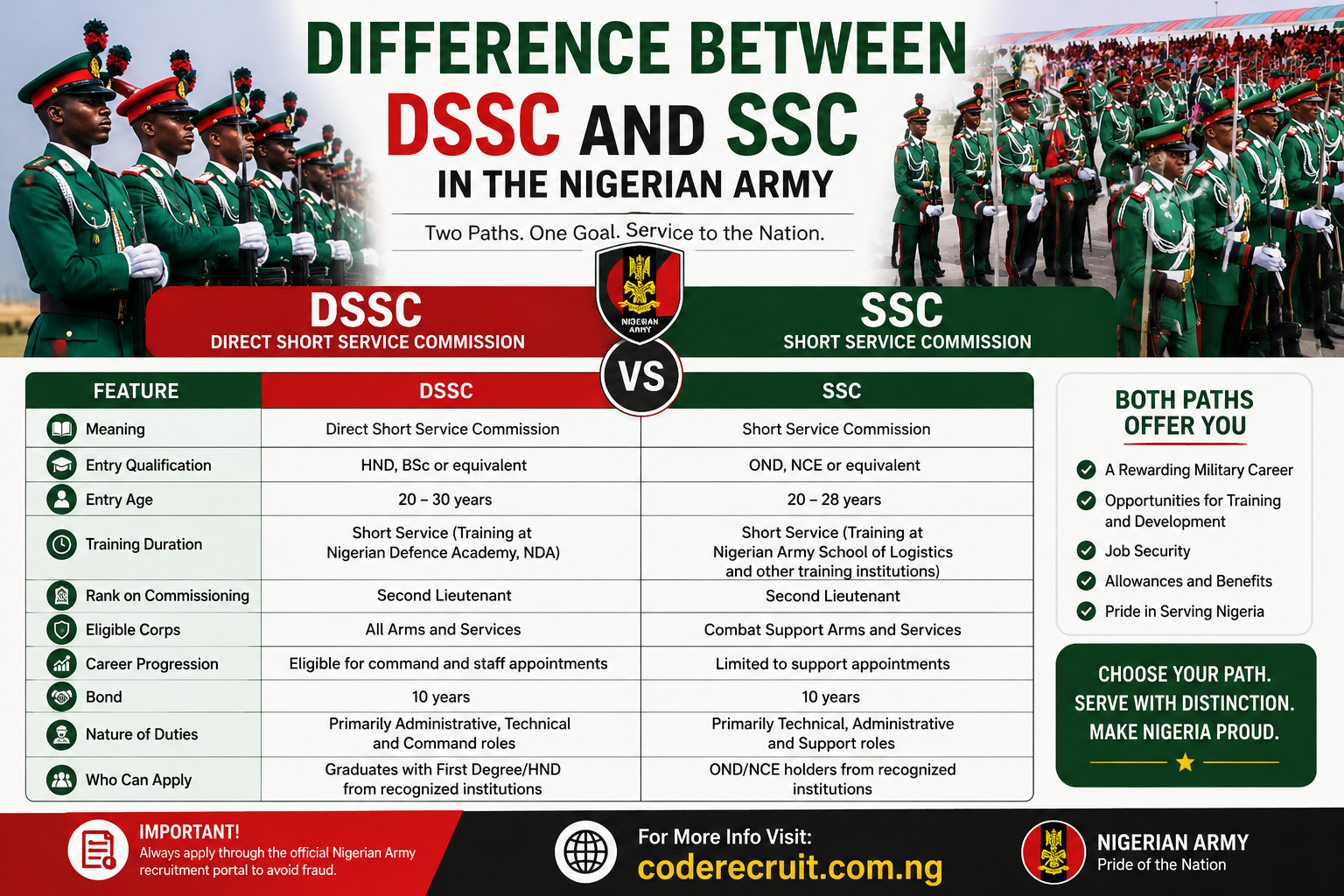
Both routes lead to a commission as an officer, but they differ significantly in purpose, age limit, training duration, and career path. Understanding the difference is the first and most important step before applying.
In addition to these two routes, graduates of the Nigerian Defence Academy (NDA), a 5-year degree programme open to candidates with 5 O’Level credits: receive Regular Commission as officers upon graduation. However, the NDA route is not exclusive to degree holders and is typically entered at a younger age.
DSSC vs SSC: Key Differences Explained
Many graduates are confused by the terms DSSC and SSC. Here is a clear breakdown of the differences between both graduate officer commission types:
| Feature | DSSC (Direct Short Service Commission) | SSC (Short Service Combatant Commission) |
|---|---|---|
| Full Meaning | Direct Short Service Commission | Short Service Combatant Commission |
| Target Candidate | Specialists: professionals who want to use their career expertise in the Army (doctors, engineers, lawyers, IT specialists, educators, etc.) | Graduates who want to be frontline combatant officers, similar to regular Army officers |
| Age Limit | 22 to 35 years (Medical Consultants up to 40 years) | 22 to 28 years |
| Minimum Qualification | B.Sc. (Second Class Lower) or HND (Lower Credit) and above | B.Sc. (Second Class Upper) or HND (Upper Credit) and above |
| NYSC Requirement | Required (discharge, exclusion, or exemption certificate) | Required |
| Training Duration | 6 months | 9 months |
| Training Location | Nigerian Defence Academy (NDA), Kaduna; Nigerian Army School of Infantry (NASI), Jaji | NDA, Kaduna; NASI, Jaji |
| Entry Rank | Second Lieutenant (or equivalent based on qualifications) | Second Lieutenant |
| Role After Commission | Deployed in their area of professional specialisation within the Army | Field combatant officers: deployed for operational duties |
| Conversion to Regular | Possible after a minimum of 3 years of service | Possible for outstanding officers |
| Official Portal | recruitment.army.mil.ng | recruitment.army.mil.ng |
Summary: If you are a doctor, engineer, lawyer, ICT professional, educator, or other specialist, apply for DSSC. If you want to serve on the frontlines as a military officer and are not above 28 years old, apply for SSC.
Nigerian Army DSSC Requirements 2026
The following are the officially stated requirements for the Nigerian Army Direct Short Service Commission (DSSC) in 2026:
General Requirements for All DSSC Applicants
- Citizenship: Must be a Nigerian citizen as defined in the Constitution of the Federal Republic of Nigeria.
- Age Limit: Must be between 22 and 32 years old by the closing date. Medical Consultants in recognised specialties may apply up to 40 years of age.
- Height: Not less than 1.68 metres for male candidates and 1.65 metres for female candidates.
- Medical Fitness: Must be medically, physically, and psychologically fit in accordance with Nigerian Army standards.
- Criminal Record: Must be free from any criminal conviction, cultism, or association with secret societies.
- No Tattoos: Applicants must not have tattoos on any part of the body.
- Academic Qualification: Minimum of a Bachelor’s Degree (not less than Second Class Lower Division) from a recognised university, OR an HND (not less than Lower Credit) from a recognised polytechnic.
- O’Level Requirement: Minimum of five (5) credit passes in WASSCE, SSCE, NECO, or GCE O’Level, including English Language and Mathematics.
- NYSC: Must hold a valid NYSC Discharge, Exclusion, or Exemption Certificate.
- Professional Registration: For corps-specific roles (medical, legal, engineering, education, etc.), applicants must be fully registered with the appropriate professional regulatory body and hold a valid practising licence.
- Marital Status: Both married and single candidates may apply.
Note: For the DSSC 29/2026 recruitment, the Nigerian Army required a minimum of Second Class Upper degree or HND Upper Credit. Always check the current recruitment advertisement for any updates to minimum grade requirements, as they can vary per intake.
Nigerian Army SSC Requirements 2026
The following are the requirements for the Nigerian Army Short Service Combatant Commission (SSC):
- Citizenship: Must be a Nigerian citizen as defined in the Constitution of the Federal Republic of Nigeria.
- Age Limit: Must be between 22 and 28 years old by the closing date of the advertisement.
- Height: Not less than 1.68 metres for males and 1.65 metres for females.
- Medical Fitness: Must be medically, physically, and psychologically fit.
- Criminal Record: No criminal convictions. No involvement in cultism or secret societies.
- No Tattoos: Absolutely no tattoos on any part of the body.
- Academic Qualification: Minimum of a Bachelor’s Degree (Second Class Upper) or HND (Upper Credit) from a recognised institution.
- O’Level Requirement: Minimum of five (5) credit passes including English Language and Mathematics in WASSCE, SSCE, or GCE O’Level.
- NYSC: Must possess a valid NYSC Discharge, Exclusion, or Exemption Certificate.
The SSC requires a higher minimum academic grade (Second Class Upper / HND Upper Credit) compared to the DSSC, and has a lower age limit (28 years vs 32–35 years for DSSC).
Available Corps for DSSC Graduate Officers in the Nigerian Army
One of the most important decisions when applying through the DSSC route is choosing the correct corps. Your degree or professional background determines the corps you can apply for. Applying for the wrong corps will lead to disqualification. Below is a breakdown of the main corps open to graduate applicants:
1. Nigerian Army Engineers
Graduates with the following qualifications should apply under this corps:
- Quantity Surveying
- Architecture
- Building Technology
- Estate Management
- Surveying and Geoinformatics
- Geographic Information Systems (GIS)
- Geology
- Urban and Regional Planning
2. Nigerian Army Signals Corps
Candidates with technology and communications backgrounds should apply here:
- Electrical and Electronic Engineering
- Computer Science
- Computer Engineering
- Cyber Security
- Software Engineering
- Telecommunications
- Networking
- Database Management
- Drone-related technology fields
3. Nigerian Army Medical Corps
This corps is strictly for qualified and registered health professionals:
- Medical Consultants, in recognised specialties such as Surgery, Medicine, Obstetrics and Gynaecology, Paediatrics, Dentistry, and other fields (age limit up to 40 years)
- Non-Consultant Medical Doctors, with MBBS or BDS, fully registered with the Medical and Dental Council of Nigeria (MDCN)
- Dental Surgeons
- Nurses, registered with the Nursing and Midwifery Council of Nigeria
- Pharmacists
- Allied Health Professionals, Medical Laboratory Scientists, Radiographers, Physiotherapists, Optometrists, Psychologists, and other health workers fully registered with their respective professional bodies
4. Nigerian Army Electrical and Mechanical Engineers (NAEME)
Graduates in the following engineering disciplines apply under this corps:
- Mechanical Engineering
- Electrical or Electronic Engineering
- Mechatronics Engineering
- Robotics Engineering
- Automotive Engineering
- Industrial or Production Engineering
- Metallurgical Engineering
- Weapon Engineering
- Biomedical Engineering
- Aircraft Maintenance Engineering
- Avionics Engineering
Relevant professional registration is required for this corps.
5. Nigerian Army Education Corps
Graduates with education-related qualifications apply under this corps:
- Mathematics Education
- Computer Science Education or ICT Education
- Library and Information Science
- Other education-related degrees and HNDs
Applicants must be registered with the appropriate professional bodies such as the Teachers Registration Council of Nigeria (TRCN).
6. Nigerian Army Band Corps
The Nigerian Army also accepts graduates of Music or individuals with strong musical backgrounds and training into the Nigerian Army Band Corps.
7. Other Corps
Depending on the current recruitment intake, the Nigerian Army may also open applications for the following corps:
- Nigerian Army Finance Corps: for Accounting, Banking and Finance graduates
- Nigerian Army Intelligence Corps
- Nigerian Army Legal Services: for graduates of Law (LLB) who have been called to the Nigerian Bar
- Nigerian Army Supply and Transport Corps: for Logistics, Supply Chain, and related disciplines
- Nigerian Army Military Police
Important: Always read the specific recruitment advertisement carefully to confirm which corps are open for the particular recruitment cycle you are applying for. Only apply for a corps that precisely matches your qualification.
Nigerian Army Graduate Officer Training: Duration and Location
All successful graduate officer candidates who pass the selection process and are offered a commission must undergo mandatory military training before being officially commissioned:
| Entry Route | Training Duration | Training Location |
|---|---|---|
| DSSC (Direct Short Service Commission) | 6 months | Nigerian Defence Academy (NDA), Kaduna; Nigerian Army School of Infantry (NASI), Jaji |
| SSC (Short Service Combatant Commission) | 9 months | Nigerian Defence Academy (NDA), Kaduna; Nigerian Army School of Infantry (NASI), Jaji |
During training, all cadets receive a monthly training allowance from the Nigerian government to cover basic needs. For HND/B.Sc. holders (which applies to all graduate officer cadets), the training stipend is approximately ₦40,000 per month. A portion of this allowance is saved by the authorities and disbursed as a lump sum upon completion of training.
The training is rigorous and covers:
- Basic military drills and physical conditioning
- Weapons handling and field operations
- Military law and ethics
- Leadership and command training
- Corps-specific professional skills (for DSSC officers)
- Survival and combat tactics (especially for SSC officers)
Weekends during basic training are not free. The programme is intensive and designed to build discipline, resilience, and leadership capacity in all cadets.
Nigerian Army Graduate Officer Salary and Allowances 2026
The Nigerian Army has an updated salary structure for 2026, reflecting adjustments following recent changes to the national minimum wage and ongoing reforms in federal security service compensation. Here is what graduate officers can expect:
Starting Salary for Graduate Officers
Graduate officers who join through DSSC or SSC are commissioned as officers and therefore earn significantly higher salaries than soldiers who enter with SSCE or ND certificates:
| Entry Qualification | Approximate Starting Monthly Salary |
|---|---|
| SSCE / NCE / ND holders (Non-Commissioned) | ₦104,000 |
| HND / B.Sc. holders (Commissioned Officers: DSSC/SSC) | ₦240,000 and above |
Salaries increase progressively as officers are promoted through the ranks. Officers with higher qualifications (such as medical specialists or postgraduate degree holders) typically receive higher starting pay.
Additional Allowances for Nigerian Army Officers
In addition to the basic monthly salary, commissioned officers receive various allowances depending on their posting, duties, and qualifications:
- Transport Allowance
- Operational Allowance, additional pay during active operations or deployments
- Special Forces Allowance, for officers serving in elite units
- Uniform Allowance, periodically provided
- Special Trade Allowance, for specific professional designations
- Housing Allowance, or access to military barracks accommodation
- Medical Benefits, access to military healthcare facilities for the officer and immediate family
- Peacekeeping Mission Allowances, significantly higher allowances for officers deployed on UN or AU peacekeeping missions
Career Progression and Promotions
Promotions in the Nigerian Army depend on merit, years of service, conduct, and discipline. The standard commissioned officer ranks from entry level upward are:
- Second Lieutenant (2nd Lt): Entry rank for most graduate officers
- Lieutenant (Lt)
- Captain (Capt)
- Major (Maj)
- Lieutenant Colonel (Lt Col)
- Colonel (Col)
- Brigadier General (Brig Gen)
- Major General (Maj Gen)
- Lieutenant General (Lt Gen)
- General
Officers who perform outstandingly can rise through the ranks faster than their peers. DSSC officers who complete a minimum of three years of service may apply for conversion to a regular commission.
Benefits of Joining the Nigerian Army as a Graduate
Beyond the salary and allowances, joining the Nigerian Army as a graduate officer comes with a range of personal, professional, and institutional benefits:
- Stable Government Employment: The Nigerian Army is a federal government institution offering one of the most secure forms of public employment in Nigeria.
- Defined Career Progression: A structured promotion ladder with clear criteria for advancement gives officers long-term career visibility.
- Military Healthcare: Officers and their families have access to military hospitals and healthcare facilities across Nigeria.
- Housing and Accommodation: Access to military barracks housing significantly reduces living expenses.
- Professional Development: The Army invests heavily in training: local and international: for its officers, particularly specialists in DSSC corps.
- National and International Prestige: Serving as a commissioned officer in the Nigerian Army is a position of honour, national service, and continental respect.
- Pension and Retirement Benefits: Officers who serve for qualifying periods are entitled to pension and post-service gratuity.
- Peacekeeping Opportunities: Deployment on UN and AU peacekeeping missions: which come with significantly elevated allowances and international exposure.
- Higher Status as a Graduate: Graduates who join the Army as commissioned officers are placed above non-commissioned officers and soldiers who enter with SSCE certificates, giving them immediate leadership responsibilities and higher remuneration from day one.
How to Apply for Nigerian Army Graduate Recruitment 2026: Step-by-Step Guide
All applications to join the Nigerian Army as a graduate must be submitted online only through the official Nigerian Army recruitment portal. There is no offline or paper-based application process. The application is completely free of charge, no payment is required at any stage.
Step-by-Step Application Process:
- Visit the Official Recruitment Portal: Go to https://recruitment.army.mil.ng
- Select Your Entry Route: On the homepage, choose either DSSC (Direct Short Service Commission) or SSC (Short Service Combatant Commission), depending on which is currently open and which matches your profile.
- Read All Requirements Carefully: Before proceeding, read all the requirements for the specific corps or role you wish to apply for. Only apply for a corps that exactly matches your academic or professional qualification.
- Click “Apply Now”: Proceed to the application section.
- Answer Service Status Question: You will be asked whether you are currently serving or have previously served in the Nigerian Armed Forces. Choose the correct option and continue.
- Create an Account (New Users): If you do not have an existing account, click “Sign Up” and verify your email address before proceeding.
- Log In (Returning Users): If you already have an account, log in with your credentials.
- Complete the Application Form: Fill in all required personal, academic, and professional details accurately. Double-check every entry before moving to the next section.
- Upload All Required Documents: Attach scanned copies of all required documents (see document list below).
- Submit Your Application: After reviewing your form, submit it before the stated deadline. Do NOT submit more than one application: multiple applications lead to automatic disqualification.
- Print Your Application Slip: After submission, print your application slip. This document has two pages:
- Page One must be signed by a Court Registrar
- Page Two must be signed by a Local Government Chairman/Secretary, or a senior military or police officer from your state of origin
These signed pages must be presented during screening.
Documents Required to Join the Nigerian Army as a Graduate
The following documents must be prepared, scanned, and uploaded during your online application, and originals presented at the time of screening:
- Valid Nigerian Passport Photograph (recent, clear, white background)
- O’Level Result(s), WASSCE, SSCE, NECO, or GCE O’Level certificate showing a minimum of five credits including English Language and Mathematics
- University Degree Certificate, B.Sc., MBBS, LLB, or equivalent, showing minimum Second Class Lower (or Upper, depending on route)
- OR HND Certificate, showing Lower Credit or Upper Credit from a recognised polytechnic
- Academic Transcript, for verification of degree class
- NYSC Discharge Certificate, Exclusion Certificate, or Exemption Certificate
- Professional Body Registration Certificate and valid Practising Licence (for medical, legal, engineering, and other regulated professions)
- State of Origin Certificate, signed by the Local Government Chairman/Secretary
- Birth Certificate or Sworn Declaration of Age
- National Identification Number (NIN) Slip
- Bank Verification Number (BVN)
- Local Government Identification Letter (required for signing the application slip at screening)
Warning: Candidates found with forged or fake documents will be immediately disqualified and handed over to the police for prosecution. Ensure all documents are authentic and officially issued.
Official Nigerian Army Recruitment Portal
The only official recruitment portal for joining the Nigerian Army: including both DSSC and SSC routes: is:
https://recruitment.army.mil.ng
All applications must be submitted exclusively through this portal. The Nigerian Army has repeatedly warned the public to ignore any application portal that opens before the official announcement on this platform or the official Nigerian Army website at www.army.mil.ng.
Scam Warning: Nigerian Army Recruitment Fraud Alert
Fraudsters frequently attempt to exploit job seekers during Nigerian Army recruitment exercises. The following warnings are critical for every applicant:
- The Nigerian Army recruitment is 100% FREE. No payment is required at any stage: not for registration, form purchase, screening, or shortlisting. Any person or agent demanding payment is a fraudster.
- There are no agents or middlemen. The Nigerian Army does not use recruitment agents, and no one has the authority to guarantee placement or shortlisting.
- Apply only through the official portal: recruitment.army.mil.ng. Any other website or social media link claiming to be a Nigerian Army recruitment portal is fake.
- Do not submit your application more than once. Multiple applications from the same candidate lead to automatic disqualification.
- Verify announcements on the official Nigerian Army website: www.army.mil.ng before acting on any recruitment information you receive from third-party sources or social media.
Final Words
Joining the Nigerian Army as a graduate is one of the most honourable, rewarding, and structured career decisions a young Nigerian professional can make. With clearly defined entry routes through the DSSC and SSC, a structured salary and allowance framework, defined promotion pathways, and the prestige of serving Nigeria at the highest level, a career as a commissioned officer in the Nigerian Army is a calling that goes far beyond just a job.
Whether you are a medical doctor, engineer, ICT specialist, lawyer, educator, or simply a graduate who wants to serve on the frontlines of Nigeria’s security: the Nigerian Army has a place for you.
When the next recruitment window opens, visit the official portal at recruitment.army.mil.ng, select the right entry route for your qualification, and apply early. Remember: the application is free, it is online only, and no agent or middleman is required or authorised.
Share this guide with every Nigerian graduate considering a career in the military. Bookmark this page for updates on the next Nigerian Army DSSC and SSC recruitment cycles.
God bless the Federal Republic of Nigeria.