The role of Part-Time Non-Executive Chairman at HDFC Bank became vacant after Atanu Chakraborty, a retired Indian Administrative Service (IAS) officer and former Economic Affairs Secretary of India, abruptly resigned on 18 March 2026. His departure came roughly a year into his second three-year term, which had been approved to run from May 2024 to May 2027.
To maintain continuity, the Reserve Bank of India (RBI) approved Keki Mistry as interim Part-Time Chairman for a three-month period beginning 19 March 2026. With that interim term concluding around 19 June 2026, the bank’s board has been working through a formal succession process, and that process has now reportedly produced a shortlist of five names.
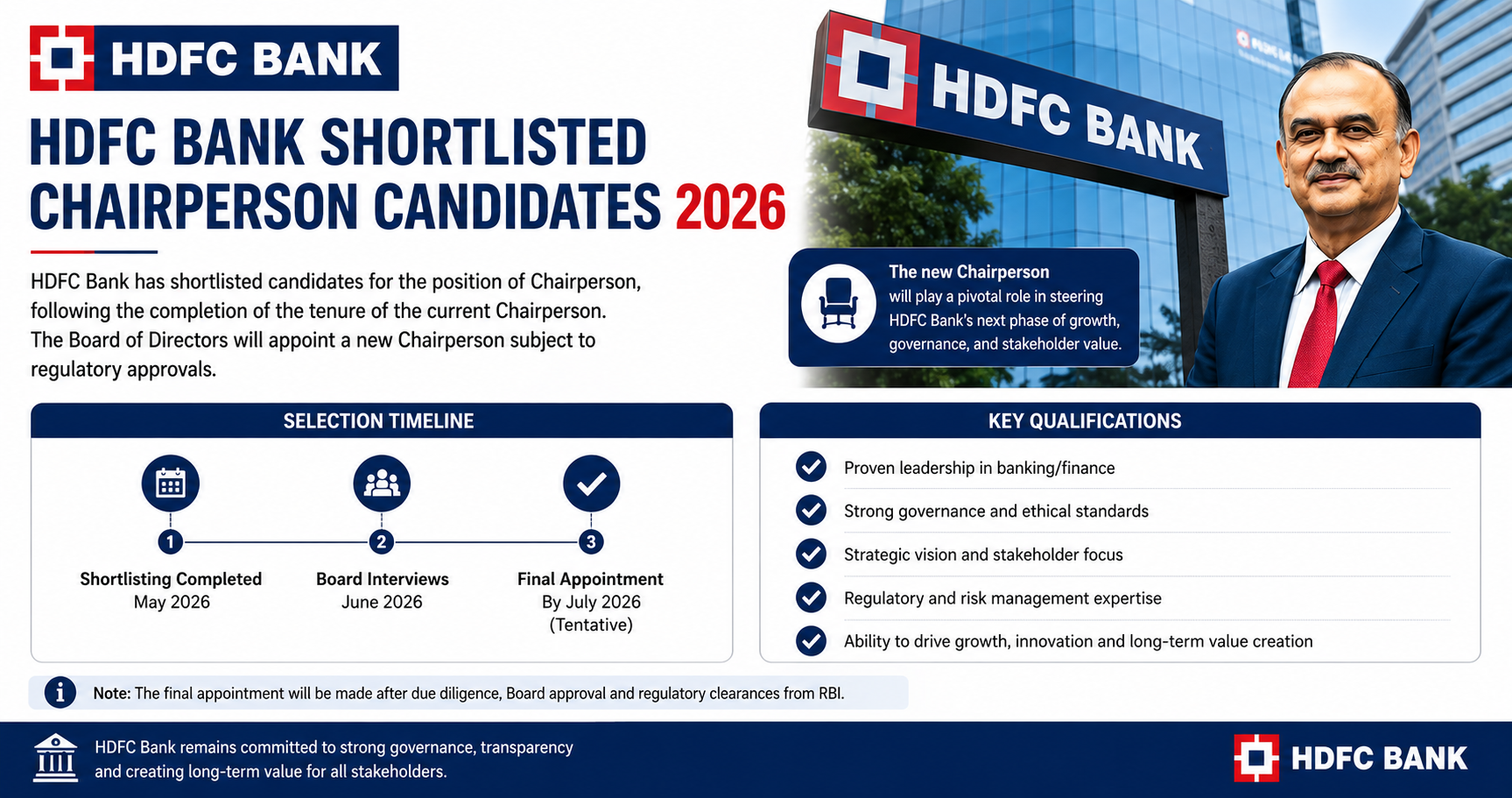
According to a CNBC-TV18 report, the board is likely to appoint a new Chairperson in the first half of July 2026, subject to the customary approval of the Reserve Bank of India under Section 35B of the Banking Regulation Act.
The Sudden Exit of Atanu Chakraborty
Atanu Chakraborty’s resignation sent shockwaves through India’s banking sector because of the language he used. In his resignation, the Board of Directors placed on record its appreciation for his tenure and wished him success in future endeavours, but reports indicate Chakraborty cited “certain happenings and practices” not in congruence with his personal values and ethics as the reason for stepping down with immediate effect.
Background on Atanu Chakraborty
- A retired 1985-batch IAS officer from the Gujarat cadre
- Served as Economic Affairs Secretary of India from July 2019 to April 2020
- Prior to that, he headed the Department of Investment and Public Asset Management (DIPAM)
- He was appointed Chairman of HDFC Bank by the Reserve Bank of India in April 2021 and served in office from 3 July 2021 to 18 March 2026
- His second three-year term had been approved by the RBI to run from May 2024 to May 2027, meaning his resignation came roughly halfway through that term
The Aftermath: An Independent Review
Following Chakraborty’s resignation, HDFC Bank moved to commission an extensive review. According to reporting, the bank appointed both domestic and international law firms to scrutinize board records and communications over the preceding two years, with the aim of establishing whether any governance concerns or unethical practices had in fact been raised during his tenure. The review also reportedly examined matters connected to historical AT-1 bond mis-selling allegations.
Importantly, the Reserve Bank of India has stated that no major governance issues were found in its own assessment, even as the bank’s internal review continued. Despite these reassurances, the unusual circumstances of the exit added a layer of governance scrutiny to an already consequential leadership transition.
Keki Mistry’s Interim Chairmanship
Stepping into the breach was Keki Mistry, one of Indian banking’s most recognizable veteran figures. Mistry was appointed interim part-time chairman for a three-month period on 19 March 2026, a day after Atanu Chakraborty resigned.
Who Is Keki Mistry?
- He is 71 years old and a chartered accountant by training
- He currently chairs the Primary Market Advisory Committee at the Securities and Exchange Board of India (SEBI)
- He joined HDFC Bank’s board as a non-executive director after HDFC Limited merged into HDFC Bank, effective 1 July 2023
- He previously served as Vice Chairman and CEO of the erstwhile Housing Development Finance Corporation (HDFC Limited) before its landmark merger with HDFC Bank
Mistry’s Public Reassurance
On a 19 March 2026 analyst call, Mistry sought to draw a line under the controversy surrounding his predecessor’s exit. He stated that there were no material issues on hand which needed addressing, and that there were no operational matters or issues which had been highlighted. He also confirmed that the bank’s Nomination and Remuneration Committee would meet within a month to consider leadership recommendations, including the CEO succession question.
Why Mistry Is Unlikely to Continue
Despite his stature, Mistry has been clear that he does not see himself in the role beyond the interim period. Sources indicated that the chairman’s role, by design, needs to be independent, and that Mistry’s long association with the HDFC group could raise conflict-of-interest questions if he stayed on in a full-time capacity. Mistry himself has indicated he is unlikely to extend his interim tenure, with his role focused on providing stability during the transition period.
The Five Shortlisted Chairperson Candidate Profiles
According to a detailed CNBC-TV18 report, HDFC Bank’s board has narrowed its search to five candidates, and while individual names have not been officially confirmed or published, the profiles of each shortlisted candidate have been described in detail. The shortlist is said to be built deliberately to signal independence from the HDFC group, cutting across India’s regulatory establishment, public-sector banking, and corporate India.
Here is a breakdown of the five candidate profiles as reported:
| # | Candidate Profile | What This Profile Brings |
|---|---|---|
| 1 | A recently retired Deputy Governor of the Reserve Bank of India | Brings direct regulatory familiarity with the bank’s operations and an insider’s understanding of RBI’s expectations for systemically important banks |
| 2 | A retired bureaucrat from the Indian Administrative Service (IAS) | Provides the kind of administrative weight the chairman’s office typically carries at large lenders, notably, this mirrors the profile of outgoing chairman Atanu Chakraborty |
| 3 | A former head of a public sector bank (PSB) | Brings the operating experience that comes from running a state-owned competitor, offering a grounded, on-the-ground banking perspective |
| 4 | A former India CEO of a multinational company | Signals an outside, non-banking commercial perspective, bringing global corporate governance and strategy experience from outside the financial sector |
| 5 | A technology veteran | Described as the most unconventional pick, especially relevant in a year when banking regulators have stepped up scrutiny of IT and cyber risk at large lenders |
Important note on transparency: As of this writing, HDFC Bank has not officially confirmed any of the five names publicly. A bank spokesperson told Fortune India that the lender “does not comment on media speculation”, and Mistry did not respond to requests for comment on the shortlist. This article will be updated as official confirmation emerges.
Why These Five Profiles? Reading Between the Lines
The composition of this shortlist tells its own story about what HDFC Bank’s board, and likely the Reserve Bank of India, believe the institution needs at this moment. Each profile addresses a distinct dimension of the challenges facing India’s largest private lender in 2026.
1. The Regulatory Insider (Ex-RBI Deputy Governor)
A retired RBI Deputy Governor brings credibility precisely at a moment when the bank is under heightened governance scrutiny following Chakraborty’s exit. This profile would reassure regulators and markets that the chairperson understands central bank expectations from the inside.
2. The Administrative Heavyweight (Retired IAS Officer)
This profile continues a pattern seen at HDFC Bank, both Chakraborty and, before him, Shyamala Gopinath (a former RBI Deputy Governor) brought significant public-institution gravitas to the role. A senior bureaucrat profile signals continuity in the kind of stature the chairmanship has historically carried.
3. The Public Sector Bank (PSB) Veteran
Someone who has run a large public sector bank brings hands-on operational banking experience, something that can complement a board increasingly focused on execution, asset quality, and competitive positioning against PSU rivals like State Bank of India, Punjab National Bank, and Bank of Baroda.
4. The Multinational Corporate Leader
A former India CEO of a global multinational brings an outsider’s lens, corporate governance practices, customer-centricity models, and strategic discipline drawn from outside the traditionally insular world of Indian banking.
5. The Technology Veteran
Perhaps the most telling inclusion. Banking regulators have stepped up scrutiny of IT and cyber risk at large lenders, and HDFC Bank, with its scale and the complexity introduced by the HDFC Limited merger’s technology integration, faces ongoing pressure around digital resilience, core banking system stability, and cybersecurity governance. A technology-savvy chairperson at board level would be unusual for an Indian bank but reflects the growing centrality of tech risk to financial stability.
The Parallel CEO Succession Question
While the chairperson search has dominated headlines, industry watchers argue the more consequential decision facing HDFC Bank in 2026 concerns its Managing Director and CEO, Sashidhar Jagdishan.
Jagdishan’s Term and the Stakes Involved
- CEO Sashidhar Jagdishan’s current term expires on 26 October 2026
- Brokerages have suggested that the CEO succession decision will do more to set HDFC Bank’s stock trajectory than whoever takes the chairperson’s seat
- On 18 April 2026, Jagdishan announced that the process for re-appointing a CEO was actively progressing, with a decision expected “in due course”
- Jagdishan has led HDFC Bank since October 2020, succeeding the bank’s iconic founding CEO Aditya Puri
The new chairperson, once appointed, will likely play a central role in finalizing, or potentially revisiting, the CEO succession question, making the chairperson appointment and the CEO decision deeply interlinked in terms of timing and governance optics.
How the Chairperson Selection Process Works
The appointment of a chairperson at a major Indian private bank like HDFC Bank is not a simple corporate decision, it follows a structured, regulator-supervised process governed by the Banking Regulation Act, 1949, and RBI guidelines on bank governance.
Step-by-Step Process
- Vacancy arises — typically through resignation, retirement, or end of term of the incumbent chairperson
- Board constitutes/activates a search process — typically driven by the Governance, Nomination and Remuneration Committee (GNRC), which evaluates internal and external candidates
- Interim appointment (if needed) — a sitting independent director may be appointed as interim chairperson to maintain continuity, as happened with Keki Mistry
- Shortlisting — the GNRC develops a shortlist of candidates based on regulatory fit-and-proper criteria, independence requirements, and the strategic needs of the bank
- Board recommendation — the board formally recommends its preferred candidate
- RBI approval — under Section 35B of the Banking Regulation Act, the appointment of the chairman of a banking company requires prior approval from the Reserve Bank of India
- Shareholder approval — the appointment is also placed before shareholders for ratification at the earliest possible general meeting
- Public disclosure — the appointment is formally disclosed to stock exchanges (BSE, NSE, and the New York Stock Exchange, given HDFC Bank’s ADR listing)
Fit and Proper Criteria
The RBI’s “fit and proper” criteria for bank directors and chairpersons assess factors including integrity, track record, financial soundness, conflicts of interest, and absence of any disqualifying convictions or regulatory actions. Given the heightened scrutiny following Chakraborty’s exit, this stage of due diligence is expected to be especially rigorous for HDFC Bank’s next chairperson.
What Does the HDFC Bank Chairperson Actually Do?
The Chairperson of HDFC Bank holds a Part-Time Non-Executive position, distinct from the Managing Director/CEO role, which is the bank’s top executive position responsible for day-to-day operations.
Key Responsibilities of the Chairperson
- Presiding over meetings of the Board of Directors
- Ensuring effective corporate governance and board oversight of management
- Acting as a bridge between the board, management, and regulators (especially the RBI)
- Chairing or overseeing the work of key board committees, including audit, risk, and nomination/remuneration committees, depending on board structure
- Providing strategic guidance without involvement in day-to-day operational decisions, which remain the responsibility of the MD & CEO
- Representing the bank’s governance posture to institutional investors, rating agencies, and regulators
As an Independent Director, the chairperson is also subject to RBI rules limiting tenure, typically capped at eight years across two terms for part-time chairpersons at private banks, with each term not exceeding three years subject to RBI approval, after which the individual would need to step down or seek a fresh approval process.
A Look Back: Previous HDFC Bank Chairpersons
To understand the pattern behind the current shortlist, it helps to look at who has held this seat historically. The chairperson’s office at HDFC Bank has consistently been occupied by figures with deep regulatory or public-sector pedigree.
| Chairperson | Tenure | Background |
|---|---|---|
| C.M. Vasudev | Until January 2015 | Former bureaucrat / civil servant |
| Shyamala Gopinath | 2 January 2015 – 2 July 2021 | Former Deputy Governor of the Reserve Bank of India, serving seven years in that role |
| Atanu Chakraborty | 3 July 2021 – 18 March 2026 | Retired IAS officer; former Economic Affairs Secretary of India |
| Keki Mistry (Interim) | 19 March 2026 – approx. 19 June 2026 | Chartered accountant; former Vice Chairman and CEO of HDFC Limited |
| To Be Announced | Expected: First half of July 2026 | One of five shortlisted profiles (see Section 4) |
Notably, two of the last three chairpersons, Shyamala Gopinath and Atanu Chakraborty, fit squarely within “former RBI official” and “retired bureaucrat” categories, which are also two of the five profiles in the current shortlist. This suggests the board may be inclined to continue a familiar pattern, even as it considers more unconventional options like the technology veteran.
Market and Investor Reaction
HDFC Bank’s leadership uncertainty has coincided with a period of relative underperformance for the stock. As of early May 2026, the bank’s market capitalization stood around ₹11.91 trillion, with a price-to-earnings ratio of approximately 15.70, and the stock trading in the ₹760-775 range, having underperformed sector peers over the past year.
Analysts have linked part of this underperformance to the recent leadership turbulence and the ongoing review into the circumstances of Atanu Chakraborty’s departure. The vague language used around “happenings and practices” not aligning with personal ethics has cast a shadow over an otherwise fundamentally strong institution, creating investor anxiety despite the RBI’s reassurances that no material issues were found.
For markets, the resolution of both the chairperson search and the CEO succession question is widely seen as a potential catalyst event — clarity on either front could help remove the governance overhang that has weighed on sentiment through much of 2026.
Full Timeline of the 2026 Leadership Shake-Up
| Date | Event |
|---|---|
| 28 November 2025 | Board approves appointment of Vibhash Naik as Chief Human Resource Officer, effective 1 February 2026, based on Governance, Nomination and Remuneration Committee recommendations |
| 18 March 2026 | Atanu Chakraborty resigns as Part-Time Chairman and Independent Director with immediate effect, citing personal values and ethics reasons |
| 18 March 2026 | RBI grants approval for Keki Mistry’s appointment as interim Part-Time Chairman |
| 19 March 2026 | Keki Mistry takes charge as interim Part-Time Chairman for a three-month period; holds analyst call to reassure stakeholders |
| 18 April 2026 | CEO Sashidhar Jagdishan confirms the CEO re-appointment process is actively progressing |
| 19 April 2026 | Kaizad Bharucha re-appointed as Deputy Managing Director for a further three-year term (April 2026 – April 2029) |
| Early May 2026 | Bank’s market cap around ₹11.91 trillion amid ongoing leadership uncertainty |
| Reported mid-2026 | CNBC-TV18 reports the chairperson search has narrowed to five candidates |
| ~19 June 2026 | Keki Mistry’s interim term as Chairman is expected to conclude |
| First half of July 2026 (expected) | Board likely to appoint new permanent Chairperson, subject to RBI approval |
| 26 October 2026 | CEO Sashidhar Jagdishan’s current term is set to expire |
What Happens Next?
With the interim chairmanship clock running down, several things are likely to unfold over the coming weeks:
- Board finalization: The Governance, Nomination and Remuneration Committee is expected to present its final recommendation to the full board, likely converging on one of the five shortlisted profiles described above.
- RBI fit-and-proper review: Before any formal announcement, the preferred candidate must clear the Reserve Bank of India’s fit-and-proper assessment and receive prior approval under Section 35B of the Banking Regulation Act.
- Stock exchange disclosure: Once approved, HDFC Bank will be required to disclose the appointment to the BSE, NSE, and the New York Stock Exchange (given its ADR listing), as it has done for previous board changes.
- CEO succession clarity: Given that Jagdishan’s term concludes in October 2026, expect the new chairperson, once seated, to play a central role in either confirming his re-appointment or beginning a search for his successor.
- Continued governance review: The independent legal review into the circumstances of Chakraborty’s resignation may also conclude around this period, potentially shaping public perception of the incoming chairperson’s mandate.
Given HDFC Bank’s systemic importance to the Indian financial system, and its dual listing on Indian exchanges and the NYSE, any announcement regarding the new chairperson is likely to be closely watched by domestic and international investors alike.
Conclusion
HDFC Bank’s search for a new Chairperson in 2026 is unfolding against the backdrop of one of the most consequential leadership transitions in its recent history, triggered by the unexpected resignation of Atanu Chakraborty and steadied, for now, by the interim stewardship of veteran banker Keki Mistry.
With five distinct candidate profiles reportedly under consideration, spanning regulatory, bureaucratic, public-sector banking, multinational corporate, and technology backgrounds, the board’s eventual choice will say a great deal about where India’s largest private lender sees its priorities heading.
With an appointment expected in the first half of July 2026, and the equally significant CEO succession question looming in October, the coming months represent a pivotal period for HDFC Bank’s governance, strategy, and market positioning. We will update this post as official names and confirmations emerge.