Before discussing their differences, it is important to understand what these terms stand for.
What is DSSC?
DSSC stands for Direct Short Service Commission. It is a recruitment and commissioning program through which qualified Nigerian graduates, particularly those with professional expertise in fields like medicine, engineering, law, education, and information technology, are enlisted directly into the Nigerian Army to serve in specialist, non-combatant roles. The word “Direct” in the acronym indicates that candidates are commissioned directly based on their professional qualifications, bypassing certain aspects of combat officer training.
What is SSC?
SSC stands for Short Service Combatant Commission. Unlike the DSSC, the SSC is a commissioning program designed specifically for graduates who wish to become combatant officers: those who lead troops, engage in military operations, and serve on the frontlines. SSC officers are trained as fighting soldiers and military leaders.
Purpose and Target Candidates
The core distinction between DSSC and SSC lies in their purpose and the type of person each program targets.
DSSC, For Professionals and Specialists
The Nigerian Army DSSC is specifically designed for graduates who already have a professional career and wish to continue practicing that career within the military structure. If you are a doctor, dentist, pharmacist, lawyer, engineer, accountant, ICT specialist, chaplain, or educator, the DSSC is the pathway meant for you. When you join the Army via DSSC, you are essentially bringing your civilian expertise into the military and using it to serve the institution in a specialized capacity.
DSSC officers are non-combatant in nature. Their primary job is to provide professional services within the Army’s administrative and technical departments. They are not trained or deployed primarily as frontline fighters.
SSC, For Combat-Oriented Graduates
The SSC is for graduates who want to serve as fully-trained combat officers. These are individuals who are passionate about military life, field operations, troop command, and frontline leadership. SSC officers are assigned to combat corps such as the Infantry, Armour, Artillery, and similar departments. They are trained to lead soldiers in tactical operations and military campaigns.
Training Duration and Location
One of the most notable differences between DSSC and SSC is the duration and intensity of training.
DSSC Training
DSSC training typically lasts between 6 to 9 months. The training is less intense compared to the SSC because DSSC candidates are not being groomed for combat roles. Instead, the training focuses on military orientation, discipline, basic leadership skills, and physical fitness to prepare the professionals for life in the Army. DSSC training is conducted at the Nigerian Army School of Infantry, Jaji, Kaduna State.
SSC Training
SSC training is significantly more rigorous and typically lasts between 9 to 12 months. The training covers combat tactics, weapons handling, field operations, military strategy, physical endurance, troop leadership, and all the skills required of a frontline military officer. SSC training is conducted at the Nigerian Defence Academy (NDA) in Kaduna or other designated military training institutions.
Roles and Deployment
Where Are DSSC Officers Deployed?
After training, DSSC officers are deployed to career corps and technical departments of the Nigerian Army. These include:
- Nigerian Army Medical Corps (for doctors, nurses, pharmacists)
- Nigerian Army Engineers (for engineering graduates)
- Nigerian Army Signals Corps (for ICT and communication specialists)
- Nigerian Army Electrical and Mechanical Engineers (NAEME)
- Nigerian Army Education Corps (for educators and academics)
- Nigerian Army Finance Corps (for accountants and finance professionals)
- Army Legal Services and Military Police (for lawyers)
- Army Chaplaincy and Religious Affairs
Where Are SSC Officers Deployed?
SSC officers are deployed to combat corps within the Nigerian Army. These include:
- Infantry Corps (frontline ground forces)
- Armoured Corps (tank and armoured vehicle operations)
- Artillery Corps (heavy weapons and fire support)
- Military Intelligence (field intelligence operations)
- Nigerian Army Supply and Transport Corps
Entry Ranks After Commissioning
The starting rank after commissioning is another significant difference between DSSC and SSC officers.
DSSC Entry Rank
DSSC officers enjoy a significant advantage when it comes to entry ranks. Depending on their professional qualifications and field of expertise, a DSSC officer may be commissioned at the rank of:
- Lieutenant: for most graduates with a first degree or HND
- Captain: for those with advanced degrees or several years of professional experience
- Major: for highly specialized professionals such as medical consultants and professors
This means DSSC officers earn higher pay from the moment they are commissioned, compared to their SSC counterparts.
SSC Entry Rank
SSC officers are commissioned at the rank of Second Lieutenant (2Lt), which is the lowest commissioned officer rank in the Nigerian Army. They must serve a minimum of two years before being considered for promotion to full Lieutenant. This means they start with a lower salary and must work their way up through the rank structure.
Length of Service / Commission Period
DSSC Service Duration
The Direct Short Service Commission is typically granted for an initial period of 8 years, renewable annually for an additional 7 years, bringing the total to a possible 15 years of service. Officers who perform exceptionally well may also be converted to a Regular Commission, allowing them to serve for longer periods and reach higher ranks.
SSC Service Duration
The Short Service Combatant Commission is usually granted for a period of 10 years on the active list, with an option to extend for an additional 5 years based on performance and the Army’s needs, bringing the maximum total to 15 years. No extension is typically granted after the fifteenth year unless the officer converts to a Regular Combatant Commission.
Eligibility Requirements
Both programs share some basic requirements, but there are key differences especially in the age limit and academic qualifications.
General Requirements (Both DSSC and SSC)
- Must be a Nigerian citizen by birth
- Must possess at least a Bachelor’s degree (B.Sc., B.A., B.Ed.) or Higher National Diploma (HND) from a recognized institution
- Must have completed the National Youth Service Corps (NYSC) programme
- Must be physically, mentally, and medically fit
- Minimum height of 1.68 metres for males and 1.65 metres for females
- Must not have been convicted of any criminal offence
- Must not be a member of any cult, secret society, or fraternity
- Must not have tattoos or body inscriptions
- Must be of good character, attested by two recognized referees
- Must not have bow legs, flat feet, knock knees, defective eyesight, or speech impediments
DSSC-Specific Requirements
- Age: Generally between 20 and 32 years; medical consultants may be up to 40 years old
- Must possess relevant professional qualifications in a specialist field (e.g., MBBS for doctors, LLB for lawyers, BEng for engineers)
- Professional body registration may be required (e.g., MDCN for medical doctors, COREN for engineers)
- Minimum academic grade: Second Class Lower (2.2) for university graduates or Upper Credit for HND holders, in some corps
- Open to both civilians and serving military personnel
SSC-Specific Requirements
- Age: Generally between 22 and 28 years (younger than DSSC)
- Must possess at least a second class degree or HND equivalent
- Must be a civilian applicant (serving personnel typically apply through different channels)
- Must be willing to undergo full combat military training
- Must be physically fit to withstand rigorous military training
How Often Is Recruitment Conducted?
The frequency of recruitment exercises also differs between the two programs:
- DSSC: Recruitment is usually conducted annually (once every year). In times of increased manpower needs, the Army may conduct it twice in a year.
- SSC: Recruitment is usually conducted bi-annually (once every two years), though this can vary depending on the Army’s operational requirements.
There are no fixed dates for either recruitment, so prospective applicants are advised to regularly monitor the official Nigerian Army website (army.mil.ng) for announcements.
Salary and Allowances
Because DSSC officers enter at higher ranks than SSC officers, they tend to receive higher starting salaries. In the Nigerian military, salary is determined by rank, and since DSSC officers can enter as Lieutenants, Captains, or even Majors, they earn more from day one compared to SSC officers who begin as Second Lieutenants.
Both DSSC and SSC officers receive the same categories of allowances, which include:
- Basic military salary (rank-based)
- Housing or accommodation allowance
- Medical allowance
- Operational allowance (for active deployments)
- UN/Peacekeeping allowances (for officers deployed on international missions)
- Feeding allowance
- Annual leave allowance
The exact figures are subject to the Nigerian military pay structure and may change with government reviews.
Career Conversion to Regular Commission
Both DSSC and SSC officers can potentially convert to a Regular Commission, which allows them to serve indefinitely in the Army (beyond the 15-year short service period) and compete for higher command positions.
However, conversion is more straightforward for SSC officers who demonstrate exemplary performance in combat roles and meet the criteria set by the Army Board. DSSC officers may also convert, especially those in high-demand professional fields, but the process depends on the Army’s specific needs at the time of evaluation.
Similarities Between DSSC and SSC
Despite their differences, DSSC and SSC share several important features:
- Both are graduate recruitment programs: non-graduates cannot apply for either
- Both result in commissioning as an officer (not a regular soldier/rank and file)
- Both require applicants to be Nigerian citizens
- Both require applicants to be physically and medically fit
- Both are short service programs with a maximum of 15 years
- Both applications are free of charge and must be submitted online
- Both allow for possible conversion to Regular Commission
- Both are open to male and female applicants
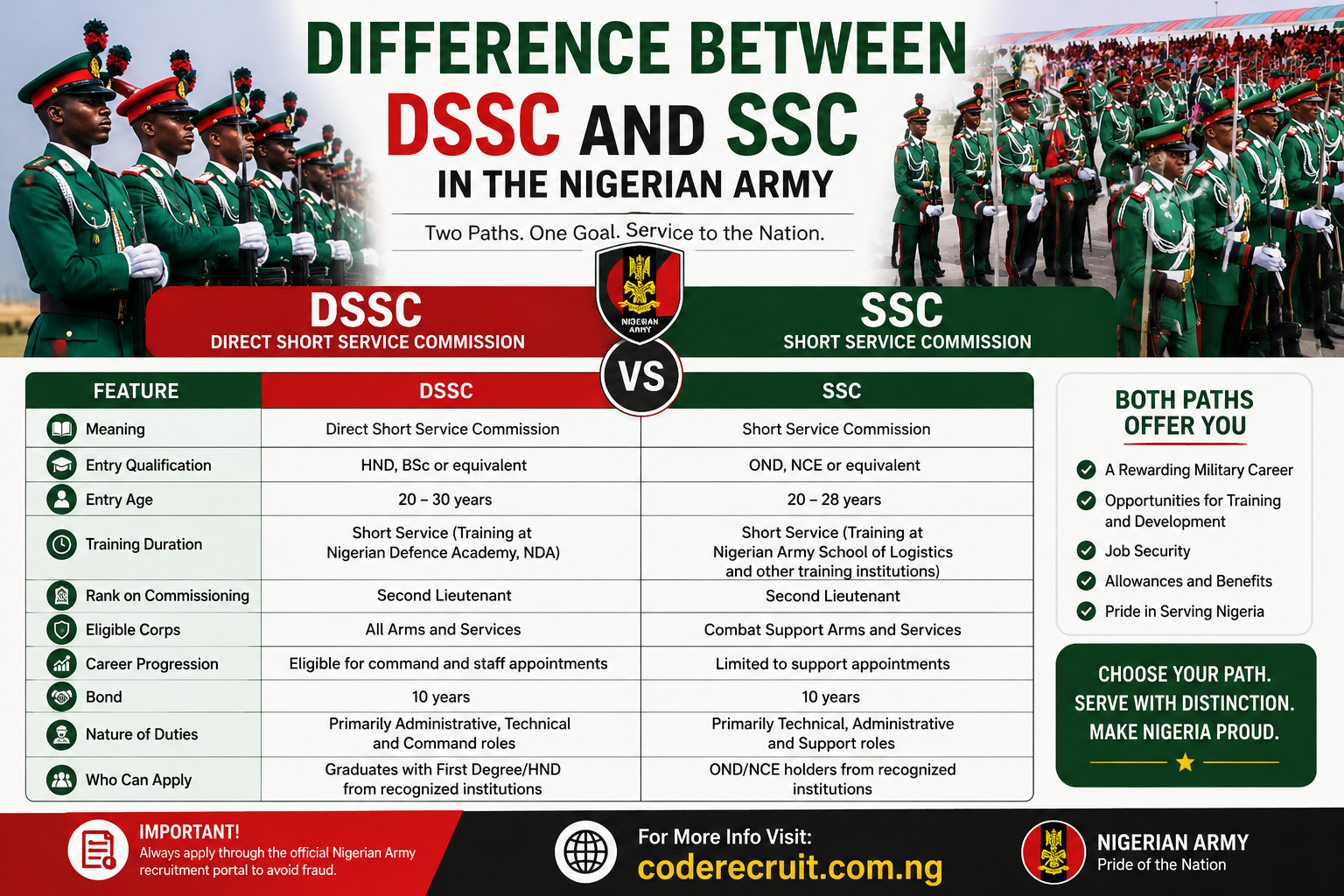
Side-by-Side Comparison Table
| Feature | DSSC (Direct Short Service Commission) | SSC (Short Service Combatant Commission) |
|---|---|---|
| Full Meaning | Direct Short Service Commission | Short Service Combatant Commission |
| Target Candidates | Professionals and specialist graduates | Graduates seeking combat roles |
| Nature of Role | Non-combatant / specialist | Combatant / frontline officer |
| Training Duration | 6 – 9 months | 9 – 12 months |
| Training Intensity | Moderate (military orientation) | High (full combat training) |
| Entry Rank | Lieutenant, Captain, or Major | Second Lieutenant |
| Age Limit | 20 – 32 years (up to 40 for consultants) | 22 – 28 years |
| Corps / Deployment | Medical, Engineers, Education, Signals, Finance, Legal | Infantry, Armour, Artillery, Intelligence |
| Service Duration | 8 years (renewable up to 15 years total) | 10 years (renewable up to 15 years total) |
| Recruitment Frequency | Annually | Bi-annually |
| Open to Serving Personnel? | Yes | Generally No |
| Starting Salary | Higher (due to higher entry rank) | Lower (starts at 2Lt pay) |
| Professional Qualification Required? | Yes (field-specific) | Not specifically required |
| Regular Commission Conversion | Possible | Possible (more common) |
Which Is Better: DSSC or SSC?
The question of which program is “better” depends entirely on your individual profile, career goals, and personal interests. Here is a simple guide to help you decide:
Choose DSSC If:
- You have a professional degree in medicine, engineering, law, education, ICT, or a related field
- You want to continue practicing your profession within a military structure
- You are older than 28 but still within the age limit for DSSC
- You prefer administrative and technical roles over frontline combat
- You want a higher starting rank and salary
- You are a serving military personnel looking to earn a commission
Choose SSC If:
- You are passionate about combat, troop leadership, and field operations
- You are a younger graduate (between 22 and 28 years)
- You do not have a highly specialized professional degree
- You want to experience the full military lifestyle, deployments, operations, and field commands
- You aspire to rise through the combat officer chain of command
- You want a longer pathway to a Regular Combatant Commission
In summary, neither program is objectively superior to the other. DSSC suits professionals, while SSC suits combat enthusiasts. The right choice is the one that aligns with your qualifications and career ambitions.
Lastly
The Nigerian Army offers two distinct pathways for graduates who wish to serve as commissioned officers, the DSSC (Direct Short Service Commission) and the SSC (Short Service Combatant Commission). While both programs share the goal of recruiting talented graduates into the Army, they differ significantly in purpose, training, deployment, entry rank, age requirements, and career path.
The DSSC is best suited for professionals who want to deploy their specialist skills in service of the nation within a military framework. The SSC, on the other hand, is designed for passionate, physically fit graduates who aspire to lead troops and participate in combat operations.
Whichever pathway you choose, serving in the Nigerian Army is a noble and rewarding career that offers personal development, national purpose, and long-term benefits. Always monitor the official Nigerian Army website (army.mil.ng) for the latest recruitment announcements, deadlines, and requirements.
We hope this guide has given you a clear and thorough understanding of the difference between DSSC and SSC in the Nigerian Army. If you found this article helpful, share it with someone who is also considering a military career.