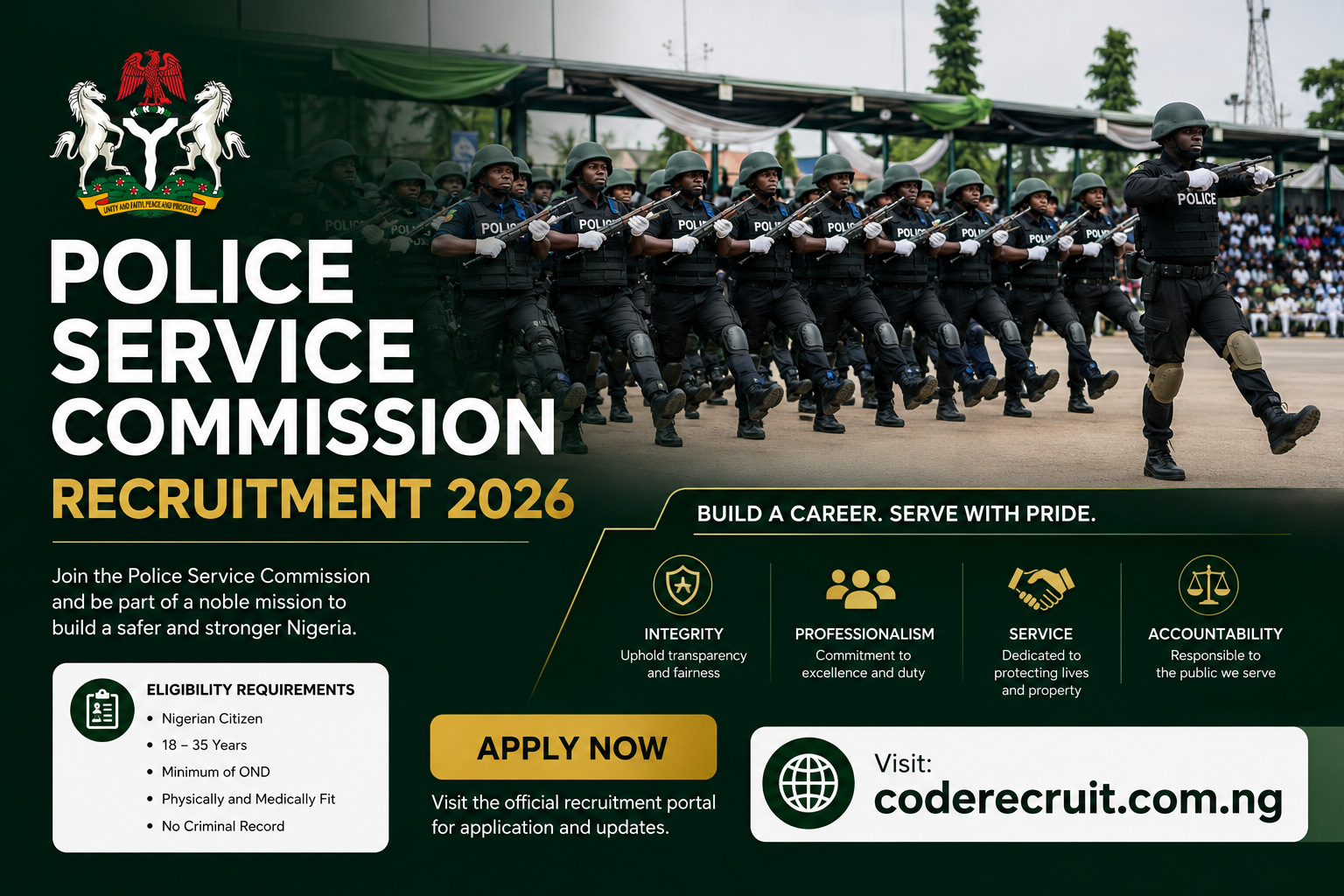
PSC Vision and Mission
The PSC’s vision is to “change the Nigeria Police Force to the Nigeria Police Service through modern democratic policing ethics, performing with courage, diligence, honesty and impartiality as a highly motivated, professionally disciplined, efficient, accountable and corruption-free Police Service.”
Its mission is “to improve service delivery in the Nigeria Police Force by promoting transparency and accountability in the police.”
Current PSC Leadership
- Chairman: DIG Hashimu Salihu Argungu (rtd)
- Head, Protocol and Public Affairs: Torty Njoku Kalu
- Official Email: [email protected]
- Official Website: www.psc.gov.ng
- Phone: 07034072677, 07034072676
- Working Hours: Monday–Friday, 8:00AM – 4:00PM (except public holidays)
About the Nigeria Police Force (NPF)
The Nigeria Police Force (NPF) is the primary law enforcement agency of the Federal Government of Nigeria. Headquartered in Abuja, the NPF is responsible for maintaining internal security, preventing and detecting crime, enforcing laws, and protecting the lives and property of Nigerian citizens across all 36 states and the FCT.
With over 350,000 personnel, the NPF operates through a network of state commands, area commands, and divisional police stations that reach communities across the entire country. The Force is headed by the Inspector General of Police (IGP), who is appointed by the President on the advice of the Nigeria Police Council.
The NPF’s community policing strategy has been significantly expanded under the current administration, with President Bola Tinubu directing the recruitment of 50,000 new constables as a key component of efforts to address rising crime and insecurity at the grassroots level.
2026 Recruitment Overview – Key Facts at a Glance
Here is a quick summary of the most important facts about the PSC/NPF 2026 recruitment exercise:
- Recruiting Body: Police Service Commission (PSC) in collaboration with the Nigeria Police Force (NPF)
- Target Intake: 50,000 Police Constables (General Duty and Specialist)
- Application Portal: npfapplication.psc.gov.ng
- Application Opening Date: Monday, 15 December 2025
- Original Closing Date: Sunday, 25 January 2026
- Extended Closing Date: Sunday, 8 February 2026 (after over 400,000 applications were received)
- Physical and Credentials Screening: March 9 – April 18, 2026
- Written Examination (Pen Paper Test / PPT): 28 – 30 April 2026, at designated centres across all 36 states and FCT
- Medical Screening Commencement: From 17 May 2026 / June 8, 2026 (for PPT-cleared candidates)
- Application Fee: Completely FREE
- Positions: General Duty Constables and Specialist Constables
- Report Any Scam To: [email protected]
This is not just one of the largest police recruitments in Nigeria — it is one of the largest single government recruitment exercises in West Africa. The sheer scale (50,000 positions with over 400,000 applicants) makes rigorous preparation at every stage absolutely essential.
Official PSC Recruitment Portal
All applications for the PSC/NPF recruitment must be submitted exclusively online through the official portal. There is absolutely no physical application process. The official portal details are:
- Primary Recruitment Portal: https://npfapplication.psc.gov.ng — This is the dedicated PSC/NPF application portal where all forms are submitted, accounts are managed, acknowledgement slips are printed, and examination invitation cards are downloaded.
- PSC Official Website: https://psc.gov.ng — For official PSC news, press releases, and recruitment announcements.
- Alternative Portal: www.policerecruitment.gov.ng — Also used for NPF recruitment-related information.
Critical Warning: Verify the exact URL before entering any personal information. The official portal URL is npfapplication.psc.gov.ng. Any website with a slightly different URL is fake. The presence of “https” and a padlock icon in your browser’s address bar confirms you are on a secure, official site.
How to Login to the PSC Recruitment Portal
If you have already registered an account on the PSC recruitment portal and need to log back in to check your application status, print your examination invitation card, or access screening details, follow these steps:
- Open Google Chrome or Mozilla Firefox (recommended browsers for government portals).
- Navigate to https://npfapplication.psc.gov.ng.
- Click on “Login” or “Sign In” on the homepage.
- Enter your registered email address and password as created during registration.
- Click the “Login” button to access your personal recruitment dashboard.
- From your dashboard, you can: view your application status, print your acknowledgement slip, download your examination invitation card, and check for notifications about the next stage of the recruitment.
Printing Your Examination Invitation Card
For candidates who passed the physical and credentials screening, the PSC directed all qualified applicants to log on to www.npfapplication.psc.gov.ng from Friday 24th April 2026 to print their Examination Invitation Card, which indicates the specific date, time, and venue of the written test. You must bring this printed card on exam day without fail.
Portal Login Troubleshooting
- Use the exact email address you registered with — even one wrong character will prevent login.
- Passwords are case-sensitive. Ensure your CAPS LOCK is off.
- Clear your browser’s cache and cookies if the page is loading incorrectly, then refresh.
- Try a different browser if one is not working — Chrome and Firefox are recommended.
- Disable any VPN services before accessing the portal.
- If the portal is temporarily unavailable, it may be under maintenance or experiencing high traffic. Try again after a few hours.
- For password reset, use the “Forgot Password” function on the login page. A reset link will be sent to your registered email.
Step-by-Step Application Guide
For new applicants who have not yet registered, here is the complete step-by-step process for applying on the PSC recruitment portal:
Step 1: Check Your Eligibility
Before visiting the portal, confirm you meet all the eligibility requirements listed in Section 7 of this guide. Applying when you do not meet the requirements wastes your time and the system’s resources.
Step 2: Gather Your Documents
Prepare all required documents (listed in Section 8) before opening the portal. Have scanned copies ready for upload. Ensure scans are clear and within required file sizes.
Step 3: Visit the Official Portal
Open your browser and navigate to https://npfapplication.psc.gov.ng. Confirm the URL is exactly correct and that the site is secured with HTTPS. On the homepage, click the link for “Police Constable Recruitment 2026” or the active recruitment option.
Step 4: Create a New Account
Click “Register” or “Create Account”. Enter your National Identification Number (NIN), a valid email address, and your phone number. Create a secure password. A verification code will be sent to your email or phone — enter it to activate your account. Keep your login details safe as you will need them throughout the recruitment process.
Step 5: Complete Your Bio-Data
Fill in your full name, date of birth, gender, marital status, contact address, state of origin, and Local Government Area. Ensure all names match exactly as they appear on your NIN and certificates. Errors in your date of birth, name spelling, or exam details can cause serious problems at the screening stage.
Step 6: Enter Your Educational Qualifications
Input your FSLC and O’Level results exactly as they appear on your certificate(s). For Specialist applicants, include additional qualifications and trade training certificates. For those with a history of online loan harassment by any financial institution, be aware this can affect eligibility.
Step 7: Select Your Preferred Category
Choose either General Duty (Police Constable) or a specific Specialist Role (e.g., Driver, Mechanic, Medical Assistant, K9, Band, Marine, etc.). Make sure the role you choose matches your actual qualifications and verifiable experience. For Specialist roles, provide details of relevant work experience including years of practice.
Step 8: Upload Your Documents
Upload your passport photograph in the specified size and format. Upload scanned copies of all required certificates and documents. Ensure all scans are clear and readable — blurred or cropped documents may lead to disqualification.
Step 9: Provide Referees
Provide the contact details of two referees who will attest to your good character. Referees must be reputable members of society who can vouch for your integrity and background.
Step 10: Review and Submit
Carefully review all information you have entered before submitting. Confirm that your names match your NIN and certificate names exactly. Once you are fully satisfied with the accuracy of all information, click “Submit”. After successful submission, a confirmation page will appear.
Step 11: Print Your Confirmation Slip
Immediately after successful submission, print or save your confirmation/acknowledgement slip. This slip is important for the physical screening stage. Do not lose it.
Eligibility Requirements
All applicants for the PSC/NPF Recruitment 2026 must meet the following eligibility criteria. Failure to meet any of these requirements will result in disqualification:
Nationality
Applicants must be Nigerian citizens by birth. Citizenship obtained through other means is not accepted for this recruitment exercise.
Age Requirement
- General Duty (Constables): Between 18 and 25 years old
- Specialist Cadre: Between 18 and 28 years old
Applicants who exceed the applicable upper age limit on the application deadline will not be eligible.
Height Requirement (General Duty Only)
- Male: Not less than 1.67 metres
- Female: Not less than 1.64 metres
Male applicants must also have a minimum chest measurement of 34 inches (86 cm).
Educational Qualification
- General Duty Constables: GCE Ordinary Level, SSCE/NECO or equivalent with a minimum of five (5) credits including English Language and Mathematics, in not more than two sittings.
- Specialist Cadre: GCE Ordinary Level, SSCE/NECO or equivalent with a minimum of four (4) credits including English Language and Mathematics, in not more than two sittings, plus a minimum of three (3) years of experience and Trade Test certificates in the relevant specialist field.
Physical and Medical Fitness
All applicants must be medically, physically, and psychologically fit. This will be verified during the physical screening and medical examination stages of the recruitment process.
Criminal Record
Applicants must be of good character with no criminal record. Any candidate with a prior conviction or criminal history will not be considered.
Financial Status
Applicants must be free from financial embarrassment. A history of online loan harassment by a financial institution can lead to disqualification.
Pregnancy
Female applicants must not be pregnant during training. Women are welcome to apply and are eligible for both General Duty and Specialist roles as long as they meet the same educational and physical standards.
National Identification Number (NIN)
All applicants must possess a valid NIN from NIMC. The NIN is required to create an account and complete the application on the portal.
Character References
Applicants must present two referees who will attest to their good character and integrity.
Required Documents
Prepare the following documents for both the online portal upload and physical presentation at the screening stage:
- Recent passport-size photograph (against a white or light-coloured background)
- Valid NIN slip from NIMC (with clear photograph)
- SSCE/WAEC/NECO/GCE result slip or certificate (original and photocopy)
- First School Leaving Certificate (FSLC)
- Birth certificate or sworn Age Declaration Affidavit
- Certificate of State of Origin (from your Local Government Area)
- Local Government Area identification letter
- Trade Test certificates (for Specialist applicants)
- Evidence of work experience (for Specialist applicants)
- Medical fitness certificate from a government-recognized hospital
- Printed acknowledgement/confirmation slip from the portal
- Printed Examination Invitation Card (for CBT stage onwards)
- Details and contacts of two character referees
Important: On the written examination day, candidates must come with: a pen, NIN Slip from NIMC (with clear photograph), and their printed Examination Invitation Card. The dress code for the exam day is: white shorts, white T-shirt, and white canvas.
Recruitment Cadres and Available Positions
The 2026 PSC recruitment covers two main cadres: the General Duty Cadre and the Specialist Cadre.
Cadre 1: General Duty (Police Constable)
This is the standard police constable category for candidates with SSCE/O’Level qualifications who will serve as frontline law enforcement officers. General Duty Constables are deployed to police stations, commands, and units across Nigeria. They perform the core functions of policing including patrol duties, criminal investigations, community policing, crowd control, traffic management, and crime prevention. This is the entry-level position into the Nigeria Police Force and the starting point of a structured long-term law enforcement career.
Cadre 2: Specialist Constables
The Specialist Cadre is designed for technically skilled Nigerians with trade training and work experience in specific fields. Specialist constables are embedded within dedicated police units where their technical skills directly support police operations. The full list of specialist positions is covered in the next section.
Full List of Specialist Positions
The following specialist units and roles are open for application. Each specialist applicant must have a minimum of four O’Level credits (including English and Mathematics) and at least three years of verifiable trade experience plus a Trade Test certificate in the relevant field:
Medical Unit
- Medical Assistant
Transport Unit
- Drivers
- Mechanics
- Auto-Electricians
- Dispatch Riders
EOD-CBRN (Explosive Ordnance Disposal / Chemical, Biological, Radiological and Nuclear)
- Forensic Assistants
- General Operatives
K9 Section (Canine Unit)
- Dog Handlers
Mounted Troop
- Horse Riders
Marine Unit
- Deckhands
- Divers
- Engineers
- Boat Mechanics
Artisans Unit
- Electricians
- Plumbers
- Welders
- Air Conditioning / Refrigeration Technicians
Tailoring Unit
- Tailors
Communication and IT Unit
- ICT Technicians
- Communication Operators
Band Section
- Musical Equipment Specialists
Applicants for Specialist positions should select the role that precisely matches their qualification and work experience. Providing false experience details is a criminal offence and will result in prosecution if discovered.
Nigeria Police Force Salary Structure 2026
NPF officers are paid on the Consolidated Police Salary Structure (CONPOSS), approved by the Federal Government and administered by the National Salaries, Incomes, and Wages Commission (NSIWC). Salaries are structured by rank, grade level, and years of service. Entry-level pay remains modest, but increases significantly with promotions and the addition of various allowances.
Monthly Base Salaries by Rank (Approximate 2026 Figures)
- Police Constable (Entry Level): Approximately ₦84,000 – ₦86,000 per month
- Lance Corporal: Approximately ₦90,000 – ₦100,000 per month
- Corporal: Approximately ₦100,000 – ₦115,000 per month
- Sergeant: Approximately ₦120,000 – ₦145,000 per month
- Sergeant Major: Approximately ₦150,000 – ₦180,000 per month
- Inspector of Police: Approximately ₦180,000 – ₦220,000 per month
- Assistant Superintendent of Police II (ASP II): Approximately ₦220,000 – ₦270,000 per month
- Superintendent of Police: Approximately ₦342,000+ per month
- Commissioner of Police: Approximately ₦1,500,000+ per month (with allowances)
- Inspector General of Police: Approximately ₦938,578+ (basic salary, excluding allowances)
Note: The Nigerian government’s recent minimum wage implementation may cause adjustments to lower-rank salaries through enhanced allowances. Total earnings depend on rank, step, location, and duty allowances.
Training Duration
Both the Cadet ASP and Cadet Inspector programmes run for 72 weeks (18 months), segmented into three stages: a Basic Stage (6 months), an Intermediate Stage (6 months), and an Advanced Stage (6 months). During training, recruits receive training allowances.
Allowances and Benefits
In addition to basic salary, NPF officers receive the following allowances, which vary by rank, location (including hardship area supplements), and role:
- Housing Allowance
- Transport Allowance
- Risk Allowance
- Uniform Allowance
- Medical Allowance and healthcare coverage
- Leave Bonus
- Pension Contributions and gratuity upon retirement
- Insurance and death benefits
- Hardship Area Allowance (for officers posted to conflict-prone zones)
Allowances can significantly boost total take-home pay, especially for field officers serving in challenging or high-risk duty posts.
Nigeria Police Force Ranks and Career Progression
The Nigeria Police Force has a structured rank hierarchy divided into Commissioned Officers and Non-Commissioned Officers / Other Ranks. All new constable recruits start at the bottom of the hierarchy and rise through promotion based on performance, years of service, and passing professional examinations.
Non-Commissioned Officers and Other Ranks
- Police Constable — entry rank for newly enlisted recruits
- Lance Corporal
- Corporal
- Sergeant
- Sergeant Major
- Inspector of Police
Commissioned Officers (Gazetted Officers)
- Assistant Superintendent of Police II (ASP II) — entry rank for direct graduate recruitment via POSS
- Assistant Superintendent of Police I (ASP I)
- Superintendent of Police (SP)
- Chief Superintendent of Police (CSP)
- Assistant Commissioner of Police (ACP)
- Deputy Commissioner of Police (DCP)
- Commissioner of Police (CP)
- Assistant Inspector General of Police (AIG)
- Deputy Inspector General of Police (DIG)
- Inspector General of Police (IGP) — highest rank
Constables who demonstrate exceptional performance and academic achievement can rise through the non-commissioned officer ranks and, with further academic qualifications and competitive examinations, can eventually cross to the commissioned officer cadre. The PSC recently elevated over 26,119 Inspectors to ASP II in its 3rd Plenary Meeting of January 2026 — a testament to the structured and active promotion culture within the Force.
Screening and Selection Process
The PSC/NPF recruitment is a rigorous, multi-staged process. Understanding each stage will help you prepare adequately and avoid being eliminated unnecessarily.
Stage 1: Online Application
The first stage — applying online through the official portal at npfapplication.psc.gov.ng — is covered fully in this guide. All applications are submitted online; no physical form collection is required.
Stage 2: Shortlisting
Applications are reviewed for compliance with all eligibility criteria. Candidates who meet the requirements are shortlisted. Those who submitted incomplete, inaccurate, or fraudulent information are disqualified at this stage.
Stage 3: Physical and Credentials Screening
Shortlisted candidates are invited to physical screening centres in their respective states. At this stage, original documents are verified against uploaded copies, and physical measurements (height, weight, chest) are taken. Candidates who fail to meet the physical requirements or whose documents are found to be fraudulent or inconsistent are disqualified immediately. Physical screening ran from March 9 to April 18, 2026 for the current exercise.
Stage 4: Written Examination (Pen Paper Test / PPT)
Only candidates who passed the physical and credentials screening are eligible for the written examination. Details of this stage are covered in the next section of this guide.
Stage 5: Medical Examination
Candidates who pass the written examination proceed to a comprehensive medical screening. This is the final major elimination stage before formal enlistment offers are made. Details are covered in Section 15.
Stage 6: Background Verification
The Nigeria Police conducts background checks on all candidates who have successfully passed the medical examination. This includes verification of criminal records, financial conduct, and character references.
Stage 7: Training
Finally selected candidates are posted to NPF training schools for an 18-month paramilitary training programme covering basic policing, law, physical fitness, firearms handling, community relations, and professional ethics. Training is divided into three 6-month phases: Basic, Intermediate, and Advanced.
Stage 8: Posting to Commands
Upon successful completion of training and passing out, officers are posted to commands, formations, and stations across Nigeria’s 36 states and the FCT.
Written Examination (Pen Paper Test / PPT) Details
The PSC, in collaboration with the NPF, fixed 28th–30th April 2026 for the written examination for applicants seeking enlistment as Police Constables. The examination applies to both General Duty and Specialist applicants who successfully passed the physical and credentials screening.
Key Examination Details
- Dates: April 28 – 30, 2026
- Venue: Designated centres across all 36 states and the Federal Capital Territory (FCT)
- Eligibility: Only candidates who successfully passed the physical and credentials screening
- Invitation Card: Qualified applicants were to log on to www.npfapplication.psc.gov.ng from Friday 24th April 2026 to print their Examination Invitation Card, which specifies the exact date, time, and venue.
What to Bring on Exam Day
- A pen
- NIN Slip from NIMC (with clear photograph)
- Printed Examination Invitation Card
- Dress Code: White shorts, white T-shirt, and white canvas shoes
What the Exam Covers
The written aptitude test typically covers the following subject areas:
- English Language (comprehension, grammar, vocabulary)
- Mathematics and basic numeracy
- General Knowledge and Current Affairs
- Civic Education and the Nigerian Constitution
- Logical reasoning and problem-solving
Begin revising these subjects as soon as you submit your application. Do not wait until after physical screening to start studying.
Medical Screening Stage
The medical screening is the final major gateway before formal enlistment offers are made. As of the current recruitment cycle, medical screening commenced on 17 May 2026, with an updated announcement indicating it would begin on June 8, 2026 for candidates who passed the Pen Paper Test (PPT). Only candidates who successfully passed the CBT/PPT and were shortlisted are eligible for this stage.
The Nigeria Police Force recruitment exercise is one of the largest single police recruitment exercises in Nigeria’s history, targeting 50,000 constables. Competition at every stage has been intense, making thorough preparation for the medical screening stage especially critical.
What the Medical Screening Covers
- Vision test (eyesight assessment)
- Hearing test
- Blood pressure and cardiovascular assessment
- Blood tests and full blood count
- Weight and body mass index (BMI) evaluation
- Overall physical health examination by qualified medical officers
- Assessment of any pre-existing medical conditions
How to Prepare for Medical Screening
- Maintain regular physical exercise, including running and cardiovascular workouts.
- Eat nutritious, balanced meals in the weeks leading up to the screening.
- Get adequate sleep and rest.
- Avoid alcohol and any substances that could affect blood test results.
- Have your eyesight checked by an optometrist in advance and address any correctable conditions.
- Present all original documents at the medical screening venue.
Candidates who fail to meet the required medical and physical standards at this stage will be disqualified regardless of how well they performed in earlier stages. There are no exceptions to the medical fitness requirement for police service.
How to Check PSC/NPF Shortlisted Candidates
After submitting your application, and at each subsequent stage of the recruitment, use the following methods to check your status:
Method 1: Check the Official Recruitment Portal
- Visit https://npfapplication.psc.gov.ng.
- Log in with your registered email address and password.
- Check your personal dashboard for any notifications regarding your shortlist status, invitation to screening, exam venue details, or next-stage instructions.
Method 2: Check Your Email
The PSC and NPF send notifications directly to applicants’ registered email addresses at each stage. Check your inbox and spam/junk folder regularly after the application deadline and after each stage of the exercise.
Method 3: Check the Official PSC Website
The PSC publishes official press releases and shortlist announcements on its website at www.psc.gov.ng. Check the “News” and “Press Release” sections for the latest updates.
Method 4: Follow Official Social Media
The PSC maintains official social media accounts. Follow them for real-time updates on shortlists, exam dates, and screening schedules. The PSC spokesperson’s handle is @PSCNigeria on X (formerly Twitter).
Important PSC Clarification: The PSC has warned that no police recruitment shortlist has been released through unofficial channels. Applicants are urged to disregard false claims from third parties and to remain patient during the evaluation process. Always verify information directly from npfapplication.psc.gov.ng or psc.gov.ng.
Tips for a Successful PSC/NPF Application
- Apply Early: Do not wait until the final days of the application window. The portal experiences extremely high traffic as the deadline approaches. Over 400,000 applications were received in the current cycle — early applicants avoid portal congestion and last-minute technical issues.
- Ensure NIN Consistency: Your name, date of birth, and state of origin as they appear on your NIN must match exactly across all your submitted documents. Any mismatch causes disqualification at the credentials screening stage.
- Submit Only Once: Multiple applications lead to automatic disqualification. Apply once and do it correctly.
- Upload Clear Scans: Use a high-quality scanner or smartphone camera under good lighting. Blurry, cropped, or unreadable document scans are rejected.
- Choose the Right Category: Apply only for a role you are genuinely qualified and experienced for. Misrepresenting your qualifications or experience is a criminal offence that can lead to prosecution.
- Print and Keep Your Slip: Immediately after submission, print your acknowledgement slip and store it safely. You will need it at physical screening and subsequent stages.
- Train Physically: The physical screening assesses height, weight, and general fitness. Begin regular exercise now — running, push-ups, pull-ups, and cardiovascular endurance training.
- Study for the PPT: Begin revising English Language, Mathematics, Current Affairs, General Knowledge, and Civic Education immediately after applying. Competition is intense at this scale.
- Know Your Exam Dress Code: The exam dress code is strictly white shorts, white T-shirt, and white canvas. Come properly dressed or risk being turned away.
- Monitor the Portal: Log in to your portal dashboard regularly for updates. Do not rely solely on third-party websites for recruitment news.
Warning – Beware of Scams and Fraudsters
The PSC has repeatedly and emphatically stated that the NPF recruitment exercise is entirely free of charge at every stage. There is no payment required for application forms, shortlisting, screening, training, or posting. Any individual or group requesting money in connection with this recruitment is a fraudster.
The PSC specifically warned against illegal charges by cybercafes and agents for NPF recruitment applications. You do not need to pay any operator, agent, or cybercafe to help you apply. The application is entirely self-service on the official portal.
Common Scam Tactics to Avoid
- Fake websites designed to look like the official PSC portal with slight URL variations.
- WhatsApp or Telegram messages claiming to offer guaranteed shortlisting or bypassing of screening stages for a fee.
- Phone calls from people impersonating PSC or NPF officials who demand payment for “processing” your application.
- Social media accounts using PSC or NPF logos to collect registration fees from applicants.
- Cybercafe operators who charge excessive fees to help applicants fill forms, beyond normal internet service charges.
- Individuals at motor parks, churches, mosques, or markets claiming to help secure police jobs for a fee.
Report any suspicious activity or scam attempts to the PSC directly at: [email protected]
The PSC and NPF have reaffirmed their commitment to a fair, transparent, and merit-driven process. Any form of job racketeering, scams, or financial inducement will be met with the full force of the law.
PSC Contact Information
For official inquiries about the Police Service Commission recruitment, use only the verified contact information below:
- Official Recruitment Portal: https://npfapplication.psc.gov.ng
- PSC Official Website: https://psc.gov.ng
- Email (Scam Reports and General Inquiries): [email protected]
- Phone: 07034072677, 07034072676
- Address: Police Service Commission Corporate Headquarters, Plot 64, Cadastral Zone B16, Sector Centre B, Jabi, Abuja
- Working Hours: Monday–Friday, 8:00AM – 4:00PM (except public holidays)
- Twitter/X: @PSCNigeria
Frequently Asked Questions (FAQ)
Q1: What is the official PSC recruitment portal?
The official Police Service Commission recruitment portal is https://npfapplication.psc.gov.ng. The PSC main website is www.psc.gov.ng. Always use only these links.
Q2: How many positions are available in the 2026 recruitment?
The Police Service Commission and Nigeria Police Force are recruiting 50,000 Police Constables — the largest single police recruitment in Nigeria’s history — covering both General Duty and Specialist cadres.
Q3: Is the application form free?
Yes. The PSC/NPF recruitment application is completely free of charge. You should not pay anyone at any stage for forms, shortlisting, screening, or any other service related to this recruitment.
Q4: What is the age limit for General Duty vs Specialist?
General Duty applicants must be between 18 and 25 years old. Specialist applicants must be between 18 and 28 years old.
Q5: Can women apply?
Yes. Women can apply for both General Duty and Specialist roles as long as they meet the same educational and physical standards — including the minimum height requirement — and are not pregnant during recruitment and training.
Q6: Can I apply with results from one sitting of WAEC?
Yes, you can apply with results from one sitting. The key requirement is that you have the minimum required number of credits, including English Language and Mathematics, in not more than two sittings total.
Q7: What is the height requirement for police recruitment?
For General Duty: males must be at least 1.67 metres and females at least 1.64 metres tall. There is also a minimum chest measurement of 34 inches (86 cm) for male applicants. Height requirements for Specialist cadre applicants may differ.
Q8: What does the written examination (PPT) cover?
The Pen Paper Test covers English Language, Mathematics, General Knowledge, Current Affairs, Civic Education, and logical reasoning. It is held at designated centres across all 36 states and the FCT.
Q9: What should I wear to the written exam?
The official dress code for the written examination is: white shorts, white T-shirt, and white canvas shoes. Also bring your pen, NIN slip, and printed Examination Invitation Card.
Q10: How do I know if I have been shortlisted?
Log in to your dashboard at npfapplication.psc.gov.ng to check your status. The PSC also sends notifications to registered emails. Official announcements are published on psc.gov.ng. Ignore unofficial claims from third parties.
Q11: What happens after the medical screening?
Candidates who pass the medical screening proceed to background verification, followed by formal enlistment and posting to NPF training schools for an 18-month training programme.
Q12: What is the salary of a new police constable?
A new Police Constable earns approximately ₦84,000 – ₦86,000 per month in basic salary, plus various allowances. Total take-home pay increases significantly with promotions, allowances, and years of service.
Final
The Police Service Commission (PSC) Recruitment 2026 is a historic exercise — 50,000 positions, over 400,000 applicants, and a nationwide multi-stage selection process that is setting new standards for transparency and scale in Nigerian public service recruitment. If you are a qualified Nigerian between the ages of 18 and 28, this is one of the most significant career opportunities available to you right now.
Whether you are applying as a General Duty Constable or bringing technical skills to one of the many Specialist roles available, the Nigeria Police Force offers a structured career with job security, regular salary, government benefits, pension, and a genuine opportunity to serve your country at the community level.
To recap the most critical points: the official portal is npfapplication.psc.gov.ng, the application is free, apply only once, ensure your NIN and all documents are consistent, train physically, study for the PPT, and wear white shorts, T-shirt, and canvas to the exam. Report any scam attempt to [email protected].
Bookmark this page for the latest updates on the PSC NPF recruitment — including medical screening dates, results, final shortlists, and training commencement dates. The Nigerian Police Force awaits your contribution. Apply, prepare, and serve with pride.
Best of luck to every applicant!